
The Power of Changing Beliefs: How It Makes You Wiser

I have a decision I’m considering. It’s a money decision. As I was thinking it through, it gave me an interesting perspective.

I have spoken to a few people close to me about this decision to get other perspectives. I made a spreadsheet to ensure I saw the decision clearly and realized I had strong feelings about how and why to make this decision.

I stopped for a second and asked myself, “Why do I feel this way?” It made me think about my relationship with money and my beliefs surrounding money decisions. I looked again at the spreadsheet and thought, “This is a math problem. So why do I have such strong feelings?”

It was a great exercise to learn about myself. I realized I had developed many of my beliefs, like most of us, long ago when my situation and priorities differed. So why am I holding on to them? It’s because it’s easy to stay the same and hard to change.

My takeaway is that many closely held beliefs that served us well at one point in our lives may hold us back at some future point. This doesn’t mean your values have changed, but how you view your careers, relationships, money, success, friendship and priorities can all change and, frankly, should change.

When deciding or reacting to someone or something, I look for opportunities to ask myself why I feel a certain way. If you journal, this can really help. I talked about this at Schnizzfest since it relates to self-awareness — journaling how you feel about situations versus a diary of what happened.

I hope this is what becoming wiser looks like, but only time will tell. 

Inside Sales: 3 Things to Know Before Getting Started

The more your MSP business grows and increases its qualified leads, the more important it is to have someone dedicated to inside sales.

Think about when would be the best time to hire an inside salesperson for your MSP, and then think about what type of person would be best suited for that role. Remember, combining inside and outside sales is not the answer to your sales problems.

Here are a few things to consider about inside sales before getting started.

Do you need inside sales?

It depends on where you are as a company. If you’re a small company with limited resources, you may want to start with maximizing your warm lead sources first to see how that goes. Another question you should ask yourself is, “Can I manage my database without inside sales?” If so, you may not be at the point where hiring an inside salesperson makes sense. However, you will want to add inside sales to your business over time. For instance, once you turn up the dial on your marketing efforts, an inside sales team will be necessary to follow up on the influx of leads you receive. 

Hire the right people   

Success becomes a lot easier with the right people. Who you hire for your inside sales team is as crucial as your inside sales process — experience in inside sales matters. Call reluctance is the number one obstacle. If you can find someone ready to pick up the phone and call, you will be successful. Something else to consider when hiring inside salespeople is whether the individual you are interviewing for inside sales is auditioning for outside sales instead. While they are both sales positions, they require different skill sets. Finally, put the inside sales candidate on the phone to review performance. Is the person comfortable? Are there any red flags? Can the candidate handle rejection? Does this individual have a positive attitude? Use your best judgment when monitoring the candidate’s calls.

Combining inside and outside sales is not a solution  

Your inside salesperson should be trying to set up meetings between you and prospects to discuss how to look at technology differently. Avoid hiring a salesperson to do both inside and outside sales. Usually, a business owner will hire an inside salesperson first. Once that person understands the process and has a functioning sales engine, the owner hires an outside salesperson. When you hire an outside salesperson without any leads, there’s time in the day for that person to make calls — but that doesn’t last very long. I have not seen someone succeed in both roles in the long term.

Getting started with inside sales can be intimidating. However, once you get going, you will reap the rewards. You may not necessarily see the results you are looking for right away since many of your leads are probably cold if you start from scratch, but with time, the number of quality leads will increase.

Unlock Your Leadership Potential With Self-Awareness

Are you self-aware? If you’re like most people, you’re nodding your head. Of course, you are! You know yourself inside and out. You probably wish the people around you were more like you — self-aware. However, I bet you didn’t know the following statistic: Studies suggest that only 10-15% of people are actually self-aware. Now, I’ll ask you again: Are you self-aware? 

First of all, what’s self-awareness? Well, there are several components to it. Simply put, self-awareness is recognizing and understanding your emotions, thoughts and behaviors. However, it also has a social aspect — understanding how others perceive you.  

Without a doubt, self-awareness is critical in our personal and professional lives. It can help us make better decisions, develop more fulfilling relationships and enhance our job performance. However, why do so many of us mistakenly believe we are self-aware when we’re not? 

One reason is our natural tendency to overestimate our abilities. Ever lose a prospect after thinking you would be sending over an agreement? (We’ve all been there, haven’t we?) This same bias leads us to believe we know ourselves better than we actually do. 

How can you become authentically self-aware?

It all starts with being genuinely curious. Be open to learning more about yourself, your character, your strengths and your weaknesses. It’s okay to be vulnerable. Pay close attention to what motivates you, what your triggers are and what you can do to control your emotions better. Then I want you to write down what you discover.  

Journaling is necessary to become more self-aware. But not just any journaling, mind you. Write about your feelings, not just what you did or what happened throughout your day. Journaling about your emotions will help you identify patterns in your behavior and give you an insight into how you tend to react in certain situations. 

Finally, schedule some time to read every day. Read books, articles and blogs that provide insights into human behavior, self-improvement and personal growth. Investing time in these areas will give you the knowledge and tools to become more self-aware. I’d even encourage you to read about topics you usually wouldn’t, to mix things up. 

If you want to improve your self-awareness, it’s time to get curious, journal everything and read more. And remember this: While only a tiny percentage of people are genuinely self-aware, that doesn’t mean you can’t be one of them. You must put in the work if you want to be more self-aware. It’s as simple as that. 

Getting Ahead of the Game: Follow Where the Enterprise Is Heading

Knowing where to shift your business isn’t easy. There are many external factors in play, and we’re usually too busy operating in our businesses to identify when and where we need to pivot to stay ahead of things. However, there is already a path to follow if you look closely enough.

The enterprise is usually further down the road than we are in the managed service provider (MSP) space. There are more resources, money and talent dedicated to enterprise businesses. It’s nearly impossible for MSPs to get ahead when the focus is directed elsewhere. However, when you are trying to figure out where to shift your business, turn to how things are being done in the enterprise, and you will be surprised at what you can learn.

Think to yourself: What is the enterprise doing I am not?

What type of technologies is the enterprise using? What about artificial intelligence (AI), machine learning (ML), robotic process automation (RPA) and ChatGPT? How are enterprise businesses using these technologies to streamline processes, automate workflows and deliver exceptional customer service?

We are already seeing the impact these technologies are starting to have on society. (Articles on ChatGPT are popping up everywhere, aren’t they?) While it may have taken a while, these technologies are here to stay, and they’re making their way down to our space and elsewhere.

For instance, consider how AI, ML, RPA and other types of technologies are changing support in the enterprise. This means our support role will be different in several years. These technologies have evolved far enough now that they are changing our space, too. These technologies are complete game changers for technicians. (Think about how much of our time we spend on closing tickets.)

Another core part of our business is projects. Even here, we see automation changing how we operate and do business. For example, Microsoft will continue to automate server and endpoint deployments.

Also, if you want to know where the MSP space is heading, it’s not a bad idea to follow the money in the enterprise. Where are investors investing in the enterprise? What types of tools and software are they writing checks for? While investing in automation, they are also throwing money at security. The enterprise is really far ahead of where we are in this space, which means our role in security will not be the same in the future as it is today.

We can learn much about where our industry is heading by paying attention to what’s happening in the enterprise. While the changes won’t happen immediately, they are inevitable. The more we keep an eye on what’s happening above, the better off we will be as an industry.

Seeing the Cathedral, Not the Bricks: The Power of Perspective in Business

How you approach life and business can mean the difference between failure and success. When things aren’t going well, sometimes you need a change in perspective. Making an effort to look at life differently will unlock opportunities for you when you least expect them.

I have a story that explains what a difference in perspective can make.

Two bricklayers are laying bricks on a hot afternoon. They’re working on the same project but spaced out from one another. A man approaches the first bricklayer and asks about what he’s doing. Wiping sweat from his forehead, the bricklayer tells the man that his job is to continue adding one brick on top of another until he completes his shift. The bricklayer then reaches into the pile beside him to grab another brick and returns to what he is doing.

Unsatisfied with the first bricklayer’s answer, the man walks down to the second bricklayer. Unlike the first bricklayer, the second bricklayer has a little pep in his step and is whistling. “Excuse me, sir,” the man says. “What are you doing?” Looking up at the man, the bricklayer smiles and says, “I’m building a cathedral.”

You’ve heard me say this before, but I will repeat it: Success in business and life is 90% attitude, self-image and self-discipline, and 10% is knowledge. How are you viewing your work? Are you giving it your all and turning negatives into positives? What about your self-limiting beliefs? What are you doing to overcome the obstacles you’re putting in front of yourself? You’re usually your worst enemy.

After you assess your life and adjust accordingly, turning to your team members is next. They’re the ones running your business and interacting with your customers every day. How are they viewing things? Do they have positive mindsets? Are they showing up to work for a larger purpose? If not, you have some work to do.

Your business lacks vision when your team members aren’t working toward a larger purpose. If that’s the case, it’s time for you to do some soul-searching. Take some time to look inward. Think about what you want from life. Where do you see yourself 10 years from now? What about 20 or 30 years from now? Once you know the answers to these questions, you can create values, goals and a vision for your business.

Remember: Positivity begets positivity. Changing your perception isn’t easy, but it’s necessary to succeed in business and life. Thinking positively begins with you.

Positivity is contagious, so don’t be afraid to spread it.

The Benefits of Business Metrics for Performance Management and Accountability

Metrics are critical to the success of a business, business functions and every role within those functions.

If you have been with TruMethods for a while, you’re aware of my passion for numbers and accountability. Throughout my career, I’ve learned that visibility and accountability on metrics alone could move the needle. From a high level, I call this “instrumenting the business.”

At the top, you have company goals, key drivers and high-level metrics (I call these “North Stars”). For a managed service provider (MSP), that could be the average seat price, average MRR, net MRR gain or support efficiency. All of this cascades down to every service delivery area, each functional area in the business and then to each role. All the metrics need to tie back to company goals, which takes some thought and ongoing maintenance.

Instrumentation should flow to everyone — that is critical. Too often, people work hard and think they are doing an excellent job when they are not meeting key metrics. We all want to do an excellent job, but it is not easy if we do not know exactly what success looks like.

Some people say that extreme focus on instrumentation and accountability can be bad for culture, like you are micromanaging people. I could not disagree more! This goes back to the concept of the essence. If each team contributes to the definition of the essence, then accountability to metrics is how each contributor can take responsibility for their results. To me, that is awesome.

No matter how good you are at this process, you can improve. Too many times, I ask business leaders questions about metrics they should know, and they cannot answer me. That’s like flying a plane without proper instrumentation.

That’s not the flight I want to be on. What about you?

Q1 2023 Check-In: How We’re Tracking Against Our Goals

Open your calendar to today’s date. What is so significant about it?

It may be hard to believe, but Q1 2023 is coming to an end. Did you spend your time productively? Are you hitting your goals so far this year? If you are unsure, this is a good time for you to check in with your team members and evaluate where you’re at as an organization.

First things first — did you complete your 2023 business plan? Now, I’m talking about a real plan, not your budget, and one that ties vision to targets, to your annual plan to your quarterly action plan. Has the plan been communicated to everyone in the organization? Does each functional area and service delivery area have a plan in place to support your business goals? 

Next, will your annual initiatives and quarterly actions move the needle, or are you focused on symptoms of the business that won’t make the kind of difference you think they will?

Finally, are you on track to complete your Q1 initiatives or, as I call them, your quarterly rocks? If not, now is the time to adjust. 

Everyone is at a different place in their business maturity, and everyone has different goals; however, there are two common things that every MSP needs to focus on more now than ever before — adding new monthly recurring revenue (MRR) at the right price and increasing the value and price to your current base. 

No one’s costs are going down right now. Tool and employee costs are higher for all of us. We also have more to do for our customers. While you can improve many areas of your business, adding new business as well as MRR and value to existing customers can help achieve your goals. 

Everything else cascades down from there. Make this your culture. You can offer your customers and team members the best experience with healthy margins.

Automated QBR Meeting Management

Conduct meetings your clients will love, with ease 

We are thrilled to introduce a new workflow in myITprocess that will take your Quarterly Business Review (QBR) meetings to the next level. You may already know that preparing for QBR meetings and tackling the post-meeting routines are extremely tedious and time-consuming. Now with this new workflow, you can conduct QBR meetings effortlessly with automated meeting invitations, agenda creation and post-meeting summary reports.

Save time by eliminating QBR administrative overhead, easily getting client buy-in and holding clients accountable with seamless meeting management from start to finish. Use this time to uncover missed revenue opportunities and cultivate profitable client relationships.

Let’s dive deeper into how this works.

Prepare for QBR meetings in seconds 

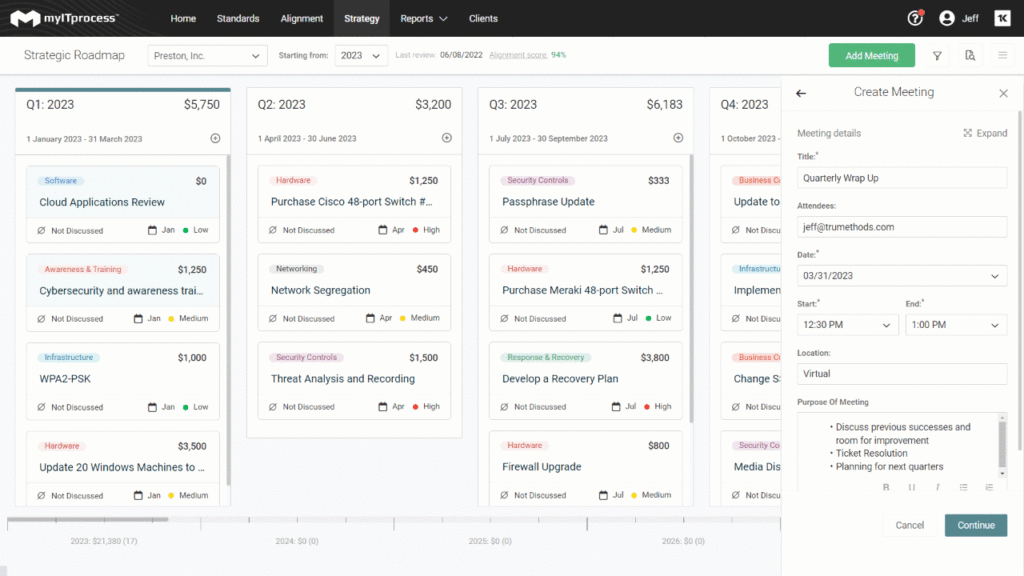
You can use this workflow to easily schedule QBRs by sending a detailed meeting invite straight to the participants’ preferred email platform, such as Google or Outlook, without leaving myITprocess. Add the participants, time, date, location and notes to discuss during your QBRs directly from within myITprocess.

Instantly create your QBR agendas by dragging myITprocess recommendations from your strategic IT roadmap onto the meeting invite, all in the same window. Agenda items will be automatically attached as a PDF to the meeting invite so participants can easily preview it beforehand.

Make QBRs a breeze with Presentation Mode 

Did you know that only 20% of MSPs have a structured QBR process despite it being critical for their success? myITprocess makes QBRs a breeze with a tried-and-tested framework, enabling you to arrange your IT roadmap and recommendations into an interactive presentation for streamlined discussion.

You can use the interactive, simple-to-follow and intuitive Presentation Mode feature in myITprocess to increase meeting engagement with clients. As you conduct the meeting, the agenda items added during the QBR meeting invite will automatically show in an interactive Presentation Mode. Easily modify, edit and update agenda items, and capture client’s feedback on the fly as you review each recommendation. This saves you time summarizing meeting outcomes and holds clients accountable for decisions made.

Put your post-meeting tasks on autopilot 

As only 10% of client-facing reports get read by your clients, you need to create bite-sized reports that your clients can easily read and act on.

Moreover, you can review agenda items during the QBR with Presentation Mode and effortlessly convert the decisions made for each item into a client-facing summary report to help keep clients accountable. All attendees will automatically receive the summary report after the meeting with the notes discussed for each agenda item.

Calendar_Notification_Preso_Mode.png

Learn more about this feature in this Knowledge Base article.

GET A DEMO

Right of Boom: Key Takeaways for MSPs

In February, I attended the Right of Boom conference, a cybersecurity event for managed service providers (MSPs). Many of the conference’s attendees were from the Weekly CyberCall community. I wrapped up the show with a few words and moderated a panel on packaging, pricing and security go-to-market. Based on my experience, I have some thoughts to share with you.

First off, the show’s format was unique. The conference organizers wrapped the entire show around a threat brief. They chose a threat actor and started left of boom with protection and moved right of boom to respond and recover. This gave everyone — owners, CIOs, vCISOs and engineers — unique perspectives on where they are regarding how they handle cyberattacks, which was awesome.

CISA Executive Director Brandon Wales also did a remote live interview. To me, this was a big deal, and it marks a turning point in our industry. Our government’s highest levels now recognize the MSP’s role in cybersecurity. There has also been some discussion on Capitol Hill around new cyber guidelines, some of which move more responsibility from SMBs to IT providers. While legislators may not pass these guidelines until 2024, we must follow developments closely.

Finally, I saw many of our TruPeer members there, which made me excited. Our members are the ones making progress and reassessing their security postures as a result. I’m proud of what we’ve accomplished as a community and will continue to ensure we’re leading the industry.

The CyberCall has built a great community, and I’m happy to see so many of you benefit from it. Change equals opportunity for well-run mature MSPs. This is an important year for all of us. Don’t lose sight of what’s ahead.

Too Many Anchors Are Holding You Back

Many of you may have heard the saying that you are the average of the five people you spend the most time with. While this may not be completely accurate, it has some truth to it.

You should spend time with positive people and avoid negative thinking. Because of this, I have fewer relationships, but they are much closer ones.

However, you must be careful. There are well-intended people close to us — family, friends, business partners — who can hold us back. These are people we have known for a long time, some of whom treat us like the people we used to be. Others love us, but they project onto us based on their anxieties or self-images.

These people can become anchors regarding your ability to fulfill your potential or improve your self-image — and they are not easy to deal with. It does not mean you necessarily have unhealthy relationships with these individuals. It just means you must be aware and find ways to communicate differently.

You are responsible for your attitude and self-image. You must protect them at all costs.

I am fortunate to have had people around me who have seen my potential. Despite that, I have had situations, opportunities or decisions over the years where others created unnecessary uncertainty for me on things that I was sure of.

Again, awareness is the key.

Take a minute to look at the people around you in business and life, and ask, “How do I like the way I see myself through their eyes?”

If you realize too many anchors are holding you down, it is time for you to take out the bolt cutters and set sail.