TruMethods Member Q&A: Get Comfortable Being Uncomfortable

Despite studies encouraging us to experience new things, we more often than not stick with what we know. But when we do that, we typically miss out on potential opportunities of becoming not only a greater person but also a better leader.

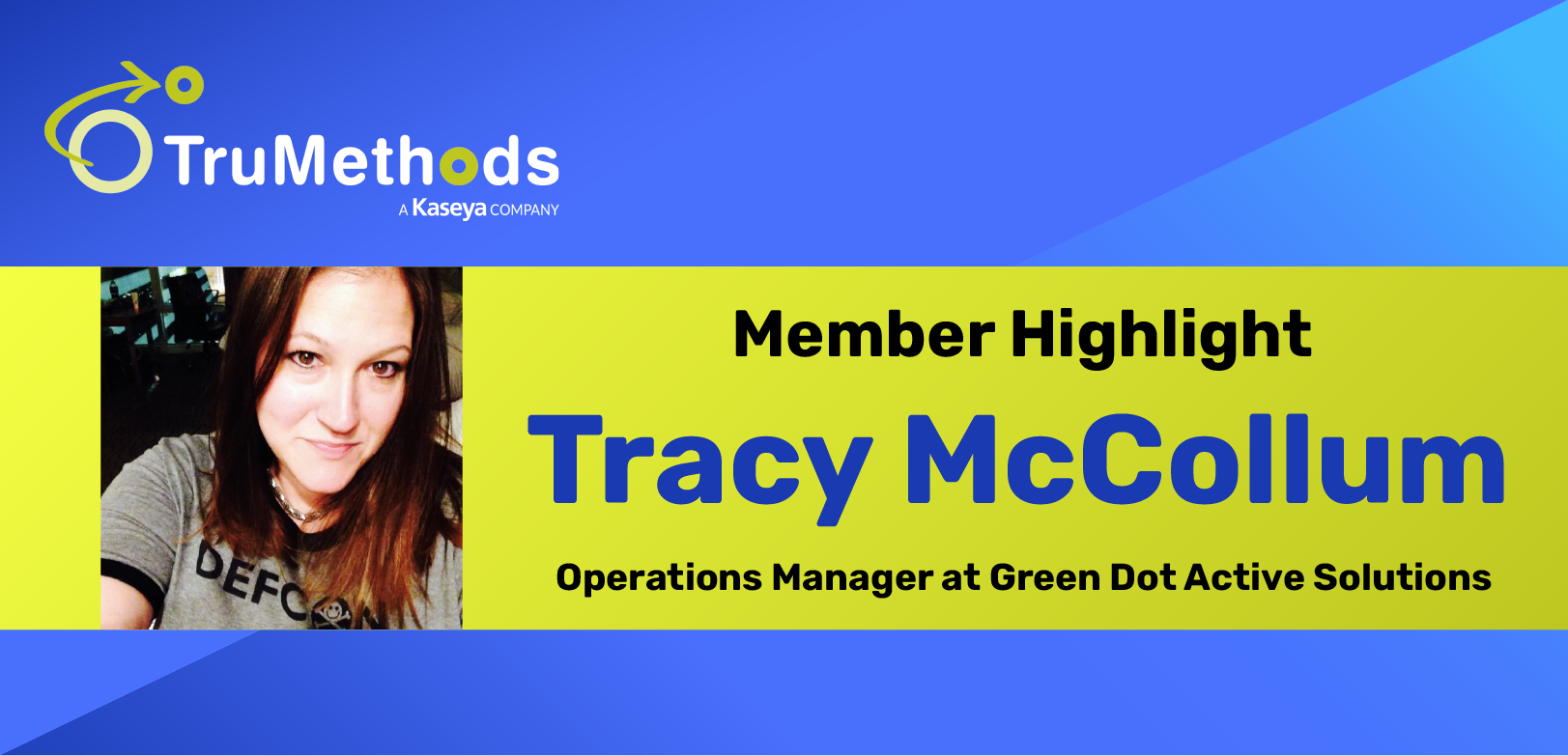
“I was nominated and graciously accepted to further develop and improve my leadership skills,” said Tracy McCollum, Operations Manager of Green Dot Active Solutions, a Pittsburgh-based MSP, in response to a question about her experience as a TruPeer pod captain. Every pod includes 8-10 companies, who elect a captain to facilitate meetings. “The technology industry needs more women in leadership roles, and I felt this was an opportunity for me to take a step in that direction. It helped that an interesting and supportive peer member from another country offered to co-captain with me — we could always use new friends in different places.”

During our one-on-one conversation, she shared her story about how becoming a pod captain has made her a better leader, why she decided to step outside of her comfort zone, and what participating in peer groups can do for MSPs.

A lightly edited transcript of our conversation follows.

When and why did you join TruMethods?

In 2014 — wow, it’s been a while!  After seeing Gary Pica present at several different IT conferences, we were impacted by his passion and genuine belief in the TruMethods framework. In 2014, we decided it was time to see how TruMethods could help us grow our business.

How has becoming a pod captain made you a better leader?

It provided an opportunity for me to step out of my comfort zone, which is always a benefit for personal and professional growth. Being able to handle and manage extra responsibility is a confidence booster. It’s also helped me to be more outgoing and connect with all pod members in ways I may not have done if I wasn’t in this role. I also ask for and receive feedback from the pod to see where I can improve as a leader and what changes are needed for the group to be successful. All of this is a great leadership learning experience!

What has your biggest takeaway been from TruPeer?

The positive connections with other members are invaluable. I don’t believe these relationships would exist and take off the way they do without the structure and support that comes from the TruPeer leadership and staff members. The kind candor shared between people in the same boat as we are has empowered us to talk about real problems and make many decisions we were lost on before.

How have the TruPeer experts helped you with succeeding?

They created this awesome culture that fosters invaluable connections with peers. They developed formulas and databases, so we can use hard metrics to measure where our business is at now and to determine exactly what we need to do to reach future goals. They research trends and create special projects for members to focus on to get ahead of the game. Most importantly — they show up and answer questions and personally interact with members of TruPeer.

How can TruMethods members get the most out of TruPeer?

Through engagement. Attend the meetings, interact with members, watch the videos, enter SMART numbers in the app, complete the business plans, attend office hours. There are so many resources in so many different platforms and you don’t have to do it all at once. Avoid burnout and pace yourself — you’ll get there. Once you’ve engaged and listened and have the support and accountability of your peers behind you, executing and achieving your bigger picture becomes much easier.

MSP peer group

Overcoming Initial Hurdles when Developing MSP Standards

Three and a half years ago I wrote a blog post on developing standards and their importance to your customers. A lot has changed since then and I thought it was time to update the post with recent content. Even today, developing standards takes time and energy, but an MSP can overcome initial challenges and gain a significant advantage over its competitors.

What’s A Standard?

Authoritative bodies define standards to help solve problems. Standards often meet the following criteria: introduce a recurring solution to an existing problem, receive mass adoption by the majority, and implemented by solutions providers. These qualities apply to standards across all industry types.

Standards prevent fragmentation among clients by streamlining operations, support, and the decision-making process. After all, standards and alignment is a key component of Technology Success. Aligning clients to your best practices reduces reactive noise and allows the vCIO to concentrate on budgeting and strategy.

In a world changed by COVID-19, standards and alignment are more important now than ever. The increase in personnel working from home exposed serious security flaws giving threat actors a new approach to confiscating sensitive data. Cybersecurity and the practice of implementing security measures—internally and externally—is at an all-time high.

How Should MSPs Develop Standards?

Developing standards from scratch is a daunting task. You need to research the appropriate frameworks or compliance requirements, format them to be usable, then choose what to keep. Luckily, there are many sources available for inspiration. Standards often fall into three categories: statutory or regulatory law, frameworks, and industry best practices.

Doing something “because that’s how it was always done” is the worst method of creating standards. Information passed through various employees, known as tribal knowledge, becomes lost in translation as it moves through the ranks. Tribal knowledge is verbal and changes over time with no formal documentation. Standards and best practices have written requirements and documenting them are mandatory.

As part of standards and alignment, we include the myITemplates repository in our myITprocess software. It contains a collection of statutory and regulatory compliance templates, frameworks like NIST and CIS, and industry best practices. Whenever you need some or most of these templates, you can drag and drop them into your standards library. Also, myITprocess comes with a 150-question starter template out of the box to get you started.

There’s No One-Size-Fits-All Approach

Technical alignment is not a cookie-cutter process; It is different for every MSP and every customer. Many of your clients will align with core standards such as firewalls, networking equipment, and workstation requirements. But, other standards you choose to implement vary between customers due to industry, size, complexity, level of risk, and so on. Statutory, regulatory, and contractual compliance objectives prove all customers are not the same your approach to standards alignment should follow suit.

As mentioned earlier, creating standards is a difficult, time-consuming process. While we offer some help through the myITemplates repository and the starter template, you must put effort into researching your own best practices to align your client base. As time goes on, the process will get smoother and your understanding of those requirements will come more naturally.

Request My Demo

Spotting Your ‘Inbetweeners’: Who Are They?

All clients are not created equal. That’s a first-hand fact many of us are reminded of daily. Some clients are great, others not so great. And then there are what we at TruMethods call the “inbetweeners.”

These inbetweeners are low-hanging fruit in your client portfolio. Convert them properly, and you’re going to generate more monthly recurring revenue (MRR) at the right price. But before you can do that, you must first understand what differentiates your inbetweeners from other types of clients on your client roster.

Great clients. These are customers that bought form you for the right reasons. They see you as a partner and look at technology as an investment. They pay the right price and take all of your important recommendations.

Not-so-great clients. Then there are the not-so-great clients. They usually pay too little. Your team doesn’t like dealing with them.  They create a lot of service tickets and often don’t take your recommendations. They lower your margins, impact your service quality to other customers, and hold your business back. These are the customers you should look to replace over time. If one of them is a large customer it may be difficult to do, but even more important.

The inbetweeners. And finally, there are the inbetweeners. They’re a bit more difficult to spot. They’re willing to make some investments but not all. They don’t pay enough but they’re close to where you’d like them to be. They view you as a strategic vendor but not a strategic partner. In sum, they’re the “it was okay” response you give when someone asks about the nothing-to-write-home-about steak you had at dinner.

How to identify your inbetweeners 

While it’s not always easy to identify your inbetweeners, a couple of calculations can simplify things.

Step one, run the TruMethods MRR evaluator against your client list. Who are the clients in your sweet spot? Generally, the higher the seat price the more potential value they will have from your service.

Then, calculate non-recurring revenue (NRR) in relation to MRR. Look at the clients that are in your sweet spot. What is the average percentage of NRR compared to MRR over the last 12-18 months?

Clients in the MRR sweet spot but below your total NRR average are your inbetweeners.

What can you do to convert inbetweeners to great clients?

Here’s the good news: With a little bit of work, it’s possible to convert your inbetweeners into great clients. However, you need to first be brutally honest with yourself. Don’t be afraid to ask yourself the hard questions and answer them truthfully.

  • Am I making recommendations for their reasons or mine?
  • How much does my team know about my client’s business?
  • Do I know what’s going on in my client’s vertical?
  • What’s my client’s biggest business objectives?
  • What’s the biggest non-technical problem in my client’s business?

Jump on the phone with your inbetweeners if you can’t answer the above questions. But when you do, avoid asking, “How are you doing?” They’re not going to give you an honest response! If they like you, they’re going to avoid confrontation, even if they think there are things you can improve upon.

Your goal should be to dig deeper. The purpose of these calls is for you to increase strategic engagement with inbetweeners. Let them know why you’re calling. Tell them upfront, “We want to be more of a strategic relationship.” Find out how decisions are made in your client’s business. Who makes those decisions?

Take the time to sift through your client list to identify your inbetweeners. Not converting your inbetweeners to great clients is leaving money on the table. 

Request My Demo

How to Structure Your MSP Sales Meetings

Operating your business at the seat of your pants is a recipe for disaster, as many of us can attest firsthand. But, the same goes for running sales meetings with your salespeople. Without a well-defined structure in place, a sales meeting will produce nothing meaningful and waste everyone’s valuable time. Nothing will get accomplished, nobody will be held accountable, and you won’t sell monthly recurring revenue (MRR) at the right price for very long.

While there are plenty of books about running effective meetings, many of which are well-written and actually pretty good, the sales meeting is a different animal altogether. It’s designed to help you with building and scaling a sales engine, one that produces consistent results — and that requires a different take on meeting structure.

The purpose of the sales meeting is simple — discipline, accountability, education, and positive coaching. You can apply this approach to your sales meetings no matter how many salespeople you have. I know from experience.

If you don’t know me well, you may not know this, but TruMethods isn’t my first business. (Surprise, surprise!) I’ve owned and successfully sold several MSPs throughout the course of my 30-year career in sales. And when I had my first MSP, there was a time when I was the only person at my sales meetings initially (and boy was I hard on myself). I eventually got the hang of structuring my sales meetings in a way that would produce my desired results.

Here’s the thing: The size of your sales team doesn’t matter; the same sales meeting structure applies.

But if you’re lucky enough to have a sales team, your sales meetings should include several other people besides you, including your sales manager, your inside salespeople, your outside salespeople, your marketing person, and possibly your vCIO (it’s good practice to keep your vCIO informed about the deals in your pipeline).

Before they attend your sales meeting, make sure they’re prepared. For instance, they should bring their TruMethods playbooks and be ready to discuss activities, and review first-time appointments (FTAs) and appointments for the week. Once all the right players are together (and they’ve come prepared), commence your meeting.

Understanding what a sales meeting is and isn’t determines the success of your meeting. Great sales meetings deliver structure, brutal honesty, positive motivation, and rhythm. You should hold them weekly (preferably early in the week), ask tough questions during them, and hold yourself and other accountable. Any sales meeting should result in a culture of success, higher expectations, attitude, self image, and self-discipline, and command of the process of building a sales engine.

Bad sales meetings are the opposite. And never, ever use a sales meeting to do the following: explain away poor results, paint a rosy picture of the future, reprimand your team, or complain.

Structure is necessary for meaningful sales meetings. Without it, you run the risk of leaving money on the table.

MSP Sales Mistakes

Kaseya’s Latest Innovation Cycle Allows IT Professionals to Better Assess and Manage IT Environments in the New Hybrid Work World

New features include enhanced anti-phishing and vulnerability management capabilities as well as key integrations with Kaseya’s professional services automation tool BMS

September 30, 2021 — MIAMI, FL — Kaseya®, the leading provider of IT and security management solutions for managed service providers (MSPs) and small to medium-sized businesses (SMBs), announced today new features and integrations that will enable IT professionals to more easily and effectively manage increasingly complex hybrid work environments. From affordable external vulnerability scanning to professional services automation (PSA) updates that empower MSPs to better prioritize their backup alerts, IT Complete continues to be the most comprehensive suite of integrated tools designed for the multi-function IT professional.

“As organizations continue to adjust to the new hybrid work world, IT professionals are being asked to support both traditional office and remote work environments. Because they are managing devices across several environments, it becomes even more critical to implement solutions that streamline daily tasks,” said Mike Puglia, Chief Strategy Officer, Kaseya. “IT Complete’s newest features and integrations provide time-saving tools that allow MSPs and SMBs to focus their attention on more impactful work and effectively manage everything from workstations and servers to mobile and cloud.” 

Key Product Enhancements

  • Enhanced Discovery and Reporting Capabilities:
    • Enhanced External Vulnerability Scanning Functionality in RapidFire Tools VulScan: VulScanis the latest generation of network vulnerability scanning tools purpose-built to deliver high-value network vulnerability management for any size network.With this latest release, VulScanintroduces an enhanced external vulnerability scanner that can support multiple client sites in several locationswithout consuming additional site licensesorincurring additional costs. Data from the external scans appearswithin each client dashboard on theVulScancloud portal and, through direct integration, pushesdirectly intoRapidFireTools Network Detective Prosolutionfor enhanced reporting.
    • Graphus Phish911™integration with Outlook: Thisenhancementallowsusersto report suspicious emails withinMicrosoftOutlook’sexistinguser interface. Phish911 in Outlook provides users with amore streamlined way to report suspected phishing attacksthat may not havetheGraphusEmployeeShieldbanner but still appear suspicious. 
  • IT Documentation and vCIO Updates: 
    • Unknown Device Notification in Network Glue: This feature notifies users when a new device is found on a network, helping technicians better understand the entireenvironmentand allowingMSPs to bill more accuratelyby device.

New IT Complete Workflow Integrations

  • Unitrends BackupIQ™ Integration with BMS and Vorex: BackupIQ’s artificial intelligence alerting is now fully integrated with BMS and Vorex’s ticketing workflow automation, enabling organizations to cut wasted time on false alerts and backup remediation by up to 50%. 
  • Fusion Mobile App Feature Updates: Fusion puts the power of IT Glue, VSA, BMS and Vorex at a technician’s fingertips. Fusion’s newest updates allow customers to remote control machines, enter Windows Powershell or Mac Terminal commands and log ticket time on-the-go right from their mobile devices.

To learn more about Kaseya’s IT Complete platform, which enables MSPs and internal IT teams to realize increased productivity and profitability through its time-saving automation and exceptional value, visit here.

About Kaseya 
Kaseya® is the leading provider of IT and security management solutions for managed service providers (MSPs) and small to medium sized businesses (SMBs). Through its open platform and customer-centric approach, Kaseya delivers best in breed technologies that allow organizations to efficiently manage, secure, and backup IT. Kaseya IT Complete is the most comprehensive, integrated IT management platform comprised of industry-leading solutions from Kaseya, Unitrends, RapidFire Tools, Spanning Cloud Apps, IT Glue, ID Agent, Graphus, RocketCyber and TruMethods. The platform empowers businesses to: command all of IT centrally; easily manage remote and distributed environments; simplify backup and disaster recovery; safeguard against cybersecurity attacks; effectively manage compliance and network assets; streamline IT documentation, and automate across IT management functions. Headquartered in Miami, Florida, Kaseya is privately held with a presence in over 20 countries. To learn more, visit www.kaseya.com.

What it Takes to Build Your Warm 250

The goal of every MSP should be to have a list of “warm prospects” These are prospects that you know a lot about and they know something about you. You feel they are an “A” prospect that you are determined to do business with. Ultimately, you would like to have 250 of these types of prospects. We call this the warm 250! You can spend more marketing dollars on these high-quality prospects and work to build a business relationship with each of them.

Building your Warm 250 isn’t easy, especially if it’s your first go-round. There’s a lot to stay on top of when it comes to building and managing your Warm 250, but once you get the hang of it, closing more deals at the right price will become second nature to you and your salespeople.

If you don’t have a prospect database, build one today. (I’m not kidding!) Drop everything you’re doing and find some time in your schedule to start the process. Your prospect database is essentially a stockpile of market information at your fingertips.

In other words — your database is gold!

But your work isn’t done after you build your prospect database — not by a long shot. What many MSPs fail to realize is that simple and efficient prospect management is essential to closing not just more customers, but also customers at the right price. Categorizing leads is your next step, and it’s one many MSPs forget about.

Separating your leads is important because you need a way to focus and track the leads with the most potential in your database. If you’re unaware, there are basically four types of leads: Suspects, Prospects, Warm 250, and Hot. While all four lead types make up the sales funnel, your leads in the last two groups are ripe for signing.

For the purpose of this blog post, I’d like to focus on your Warm 250.

While your Warm 250 is only part of your prospect database, it’s an important one. A lot of blood, sweat, and tears go into building this category. It contains your best and warmest prospects, all of whom fit your ideal customer profile, in terms of size, location and MRR.

Additionally, you know a lot about the businesses in your Warm 250, for your centers of influences (COIs) and first-time appointments (FTAs) are typically your two primary sources of your Warm 250. Leads in your Warm 250 are an ideal fit for your client portfolio, aware of who you are and what you can provide, and have been reframed. They usually are also returning prospects. The good news for you? They’re in the market to buy. These are the accounts you should spend some of your marketing dollars on!

I frequently get asked, “How often should I follow-up with my Warm 250 prospects?” The simple answer is at least quarterly, but here’s the thing: World-Class MSPs follow up with their Warm 250 prospects more often, and they don’t just follow up with phone calls (so put those phones down!).

World-Class MSPs also send emails to their Warm 250 prospects to highlight client success stories and hold webinars to educate prospects about the benefits of working with an MSP. Most importantly, they seek to add value to their prospects and build business relationships in sincere ways.

Your Warm 250 isn’t something you can set and forget. Your goal should be to improve quality, not quantity once you hit 250 leads. You must update and clean up your list on a regular basis. If you don’t, your Warm 250 isn’t going to be of any use to you or your salespeople.

It takes a lot to build and manage your Warm 250, but once you commit, selling will become a whole lot easier.

MSP Sales Mistakes

What is the Difference Between Alignment and Documentation?

To some, it can be difficult to differentiate between aligning clients with standards and best practices and documenting client environments. MSPs should consider both of these areas significantly important, but understand the difference between the two. To put it simply…

Documentation is how things are right now & Alignment is how things should be compared against your standards

Documentation –How things are
Every company should put processes around documentation. Professional services should be creating documentation so that the support desk has reference material when reactive tickets are submitted. Support desk should make note of any missing documentation throughout their day to day efforts. While doing technology alignment reviews, the Technology Alignment Manager often finds that documentation needs to be updated or created. These items should be noted and submitted to a shared list, and then queued up to be completed. At every organization, someone should be held accountable to ensuring documentation is delegated to the right team(s) and we are all actively working on completing it. In many instances, it makes sense to have someone in the Service Desk delivery area own this process as they are actively using the documentation when completing reactive tickets.

Alignment – How things should be
The Technology Alignment process is meant to continuously align clients with standards and best practices. The box and the blob (pictured below) analogy explains this in a simple way: if our standards are the box and our client’s alignment is against our standards is the blob, we want to constantly attempt to push our clients into the box as much as possible. While we know that clients will never be 100% in alignment, we continue to proactively review their environments to drive down reactive noise and notify the vCIO of misalignments. Creating, updating, and modifying standards and best practices should be a collaborative and deliberate process among multiple different functions of the MSP. Each delivery area has a unique perspective, and can offer value as we consider the standards that define our organization’s ideal client environment.

The processes MSPs put in place around technology alignment and documentation are key to a high value, strategic vCIO process that differentiates TruMethods MSPs from the average MSP. They enable the vCIO to easily reference key information and map out a strategic roadmap that helps business owners and leaders understand technology’s impact on their business. While that is what demonstrates the value of your service to clients, it is not doable without a strong foundation of technology alignment and documentation!

Think about this: What internal processes or systems has your company put in place for technology alignment and documentation?

Request My Demo

Ready for 2021’s Selling Season? It’s Go Time!

If you’re a TruMethods veteran, you were probably expecting this blog post any day now, but if you’re new to the TruMethods framework, this year may be your first selling season. Either way, selling season is underway, and it’s time for you to add new monthly recurring revenue (MRR) at the right price.

“Selling season” is the timeframe between this week and the end of the year when the conditions are optimal to sell new monthly recurring revenue. This is the time of year when decision makers start planning for the rest of 2021 and begin thinking about 2022. They’re evaluating their businesses and making decisions. We need to be part of that process. I’m confident that this year’s selling season will be huge, based on the level of MRR sales that we’ve seen from our members so far in 2021.

Now, I want to be clear, it’s your job to achieve your sales goals every quarter. But during selling season is when we hit the accelerator. There’s something about the psychology of this time of year, as business leaders turn their attention to year end. I’ve seen the impact of selling season over several decades. Every SMB has a new business plan based on COVID impact.

All decision makers are more open to talking and listening. We have great wedges right now with security and collaboration. Our messaging of Technology Success is resonating even more with all these changes. Yeah, man, it’s go time! “Go time” means that you have to do something different. You have to increase time, attention, activity, and accountability around new sales.

Now, if you don’t have a daily plan, weekly activities start now. If you have a plan, relook at it and make sure it’s dialed in. New customers at the right price are the lifeblood of a profitable and thriving MSP.

When I owned my MSP, I had a self-instruction card that I read each day. On it, was the following: “Every day I stay focused on finding new customers. I don’t let busy work get in the way. Success is too important. If you’ve had a good sales year, this is time to make it great. If you struggled so far this year, you still have time to make your goals.”

Remember what I always say: 2022 doesn’t know when you sold the MRR. Q4 MRR may not impact 2021 revenue, but it will have a full impact in 2022. (It’s the bonus round!) Also, think about the same approach for current customers. vCIOs need to understand that their customers are planning for 2022. There are a lot of things they need to consider related to security, collaboration, cloud migration, and other business changes driven by economic changes, supply chain issues, inflation, and other factors.

Dig in now. This is a great sales call talk track for every customer. It’s selling season. Let’s go, people!

MSP Sales Mistakes

Bad MRR: What MSPs Can Do to Eliminate It

MRR is the lifeblood of our company. But is all MRR created equally?

Even though you may find it tedious and time consuming, evaluating your clients is the first step in separating the good MRR from the bad. At the end of the day, what you sell and who you sell to matters.

Another way to think about it is like this: There are good clients and then there are bad clients. While good clients are profitable and good to work with, bad clients are not. Good clients value you, buy into your process and fall into your technical sweet spot, while bad clients do not.

It’s as simple as that.

But instead of getting rid of bad clients, many MSPs don’t. They unfortunately end up fighting bad clients for years (sometimes forever in some cases). They refuse to fire bad clients for the same nonsensical reasons I’ve been hearing for decades.

We have other important stuff to do! We have too many tickets! Our clients won’t go for that! We don’t want to upset our clients! This is too much work! I just lost a person!

These MSPs are waiting for what they believe to be the “best time to fire bad clients.” They’re awaiting the day when there’s nothing on the calendar, there are no support tickets to resolve, and the sun is shining bright. Well, I’ve got news for you — that day is never going to come.

The reality is this: The best time to fire bad clients is today.

Remember: Money isn’t always the problem. For instance, sometimes a client is an issue culturally. If a client treats your team members in a way that’s against your company’s core values, it’s time to walk away from that client.

Now, reevaluating your clients doesn’t necessarily always produce doom and gloom outcomes. If it’s possible to save a relationship, then do what you can, but my advice is this: Don’t go above and beyond. For instance, you may be able to get the client in question to pay the appropriate amount for the services you’re providing — and that would be a great thing. But don’t settle for anything less than you and your team members deserve.

Settling for anything less than you and your team members deserve puts you in the same predicament you were in before, as the amount of reactive noise that client will produce in the future (and there will be lots of it) will always take precedence over any proactivity.

You get stuck reacting or waiting for things to happen when your reactive noise is significant. And the last thing you want to see as an MSP owner is your reactive noise growing at a faster rate than your MRR. That’s why cutting ties with bad clients and pursuing good MRR is necessary.

All MRR is not created equally. Identifying bad clients is the first step to removing bad MRR. After you do that, you’re on your way to generating good MRR and becoming more profitable than you ever were before.

New call-to-action

Tips for vCIOs to Create Strategic Business Initiatives

When creatingstrategic initiatives in the myITprocess Strategic Roadmap, it is common to get pulled in the direction of creatinginitiativesthat reference technology versus plugging into clients’ business initiatives.Recommendationscan and should be a blend of business and technology suggestions, but should always reference a business case as to why the recommendation should be accepted.

Far too often, we see vCIOs fall into the trap of referencing technology without translating that back to the client’s business needs which tends to dilute the value of vCIO meetings over time. Since we should be meeting with decision makers who tend to be non-technical, these business owners and leaders need to be guided toward understanding why investment in technology is truly a business investment that impacts all other functional areas of their organization. Here are some tips to create that TruBusiness partnership that significantly impacts client and MSP success:

  1. Be genuinely curious about how technology ties into the bigger picture: A quote by Dale Carnegie sums up this point, “To be interesting, be interested.” A vCIO’s experience working with a variety of clients in different businesses can be invaluable and oftentimes cross over from one client to another. As you learn from your contacts, look for trends across clients and figure out if what was learned from one client can be applied to other clients in different industries. This can also impact vCIO efficiency and further streamline processes!
  2. Create and update a Business Canvas for each client regularly: If vCIOs put some process around regularly updating the information on a Business Canvass, this can lead to value demonstration down the road when referencing back to the starting point. Understanding a client’s goals and key metrics that drive their results, and then making an effort to impact those metrics in pursuit of their goals is highly valuable to business owners.
  3. Lean on TruMethods content and community: Between the vCIO Content in the Service Delivery Track of the TruMethods Member’s Portal (particularlyBuilding Strategic RelationshipsandStrategy & Budgeting), our weekly vCIO All Stars, and this myITprocess Community forum, there is no shortage of information to inspire vCIOs to keep thinking strategically when preparing for/facilitating client meetings!

The technology and security landscape are moving too fast for us to lose our captive audiences. Keep the client’s business in mind with each and every initiative, and they will always keep your pre-scheduled meetings a high priority!

Request My Demo