
Thinking About Switching Verticals? It May Be Time!

While there’s much debate over how many verticals an MSP should specialize in, the general consensus among IT professionals seems to be that specializing in one or more verticals is typically a good business decision for MSPs. But for how long should an MSP specialize in a vertical market? And what are the signs that point to the need for an MSP to reevaluate the verticals it’s conducting business in? Those are the questions that are typically left answered.

This goes without saying, but I’m going to say it anyway — only specialize in verticals you and your employees fully understand, and I’m not just talking about mastering an industry’s IT needs. For example, if you specialize in the restaurant industry, what challenges are restaurants facing? What are the regulations restaurants should be aware of? When you commit to a vertical, fully commit to understanding the ins and outs of it.

One of your top goals should be to become a well-known expert in the verticals you specialize in. So, what does that entail? It requires you to be a step ahead of your customers. You can accomplish that by attending industry conferences, reading industry trade publications and immersing yourself with the industry’s leaders.

But after a while, the vertical you’re in may get a little bit stale, as leads dry up and you begin losing money on your investments. That’s exactly the point in time when you should begin reevaluating where you’re spending your time and efforts. The verticals you’re serving may no longer be serving you.

Questions you should ask yourself include:

  • Are you struggling with generating additional monthly recurring revenue (MRR) at the right price?
  • Does the sales process need to be reworked?
  • Are the margins too low?
  • Is the economy negatively impacting the verticals you’re in?

If you answered “yes” to the above questions, it’s probably time for you to seriously consider switching verticals. The longer you wait to evaluate your situation, the less likely you’ll be able to recover from the losses you may incur. It’s always better to fail fast.

After you’ve decided it’s time to switch verticals, assess your options. Are there other verticals that make sense for you and your business? For example, are there manufacturing plants in your area? Any of those factories in need of IT services? If so, do you have a center of influence (COI) who can put you in contact with a decisionmaker at any of those facilities?

Even when you’re not contemplating switching verticals, pay attention to emerging markets. You never know when they may come in handy. Jumping on the bandwagon too soon may impact your business negatively; however, a deep dive into some of these markets over a long period of time could help when the timing’s right.

Starting over and learning a new vertical isn’t easy, but it may be the right decision for your business.

MSP Sales Mistakes

So You Want to Add $7M of Revenue in Three Years?

I spoke to an MSP a few weeks ago that does about $3 million in revenue, and I would call it low margins. They have been in business for 11 years, and I asked the owner, “What would success look like in three years?” He replied with, “We want to go from 3 million to $10 million in revenue.”

Now, you may have guessed that the first thing I said after being told this was the following: “You should be setting profit goals first and revenue goals second.”

Next, I asked, “What makes you think that you can grow that rapidly when it took 11 years to get the $3 million?” And he replied by saying, “I’m at a place in my life where I really want to focus on my business and growth.”

So, the next question I had for him was, “Have you done the math?”

Let’s break down the numbers together.

Going from $3 million dollars to $10 million in revenue requires an additional $7 million dollars of top-line growth. Assuming 70 percent of his revenue is recurring, that is $5 million of annual recurring revenue (ARR), a little more than $400,000 a month. That means over the next 36 months, he’d need to add around $12,000 of net MRR each month.

Maybe he had a great year last year. His sales team killed it, and he’s now on track to have the greatest year he’s ever had, right?

How much do you think he sold last year? He told me he sold $32,000, minus some churn.

After hearing this, I realize he didn’t do the math. He also didn’t have a business plan in place to match his goals.

Here’s the thing: If you want to be a $10-million MSP, you can be, especially in the marketplace that we’re in right now! But, you need to break down your plan into smaller achievable goals and have command. If you don’t, you’re setting yourself up for failure when it comes to your goals.

To sum everything up: Start with profit first, then move on to your revenue goals, and finally do some of the simple math I’ve shared with you today.

Start by looking through this business plan template. Always remember to make sure your business plan matches your goals.

New call-to-action

Hackers Up the Ante on Ransomware

Earlier this month, international consulting firm Accenture became the latest target in a string of high-profile ransomware attacks when the LockBit group claimed to have breached the company’s servers and threatened to release its data.

According to a CRN report, Accenture confirmed the attack, but downplayed the scope of the damage: “Through our security controls and protocols, we identified irregular activity in one of our environments. We immediately contained the matter and isolated the affected servers. In addition, we fully restored our affected servers from backup. As a result, there was no impact on Accenture’s operations or our clients’ systems,” Accenture wrote.

It’s not just big companies being targeted. Every type of organization, from small IT firms, municipalities and school districts to big multinational corporations, is in the crosshairs as ransomware attacks become more aggressive and costly. According to a report from security consultant Unit 42, the average ransomware payment climbed 82 percent to $570,000 in the first half of 2021, up from $312,000 in 2020.

An analysis by Barracuda found that a small number of ransomware gangs are conducting many of the attacks. Per the data, of the ransomware attacks between August 2020 and July 2021, REvil accounted for 19 percent of attacks, and DarkSide was behind at 8 percent.

In the past 12 months, Barracuda researchers identified and analyzed 121 ransomware incidents, a 64 percent increase in attacks year-over-year. Attacks on corporations accounted for 57 percent of attacks, up from 18 percent in 2020. Infrastructure-related businesses accounted for 10 percent of attacks.

Hackers are also changing their methods. In the past, these attacks relied on malicious links and attachments, similar to traditional malware. Now, hackers are using more complex phishing schemes to steal credentials to access networks and applications. Over the past year, with more employees working from home, web-based applications and web portals have been leveraged for these attacks. For example, in the Colonial Pipeline attack in May, criminals used the stolen password to a VPN account to break into the network.

No One’s Immune to a Ransomware Attack

MSPs must employ new strategies and technologies to protect their clients and themselves from these pernicious attacks. There are several methods that will help mitigate the damage and reduce the risk of a successful attack. Security measures should be targeted at reducing the risk of a successful attack, minimizing the damage if the ransomware is deployed on the network and avoiding paying the ransom.

First, assume that you and your clients will be targets. As we have seen over the past several years, MSPs have become prime targets, and hackers are not picky about the type or size of the organization they go after. Second, educate your clients and your employees about the risks so they will be prepared to implement the appropriate security measures and come up with a response plan when there is an attack.

Best Practices for Minimizing Ransomware Damage

You must accept the mindset that at some point, you will become a target—it’s just a matter of when. The next thing you need to do is to set a goal of not paying the ransom. With the goal set, you then need to implement the following procedures:

Leverage advanced security tools to prevent credential loss. Train employees and clients on how to spot phishing emails and how to report them. Use advanced AI-based solutions to analyze email and network traffic for unusual patterns that might indicate an attack.

Utilize password and security strategies to protect applications and network access. Encryption, multifactor authentication, password management, and web application security can protect both internal and hosted applications. A Zero Trust Access approach that requires validating each user at each endpoint is much more reliable than a traditional VPN—and with more companies adopting remote work and work-from-home models, this will be critical.

Use role-based rules to limit user access to only the applications and data necessary to do their jobs. Evaluate the type of data being stored—is all of it necessary? How long should it be stored? Is there particularly sensitive or valuable data that should be protected using more stringent measures or advanced encryption?

Employ robust backup and data recovery procedures. Multiple backups housed outside of the network will make it easier to avoid a ransom payment. Regularly test disaster recovery procedures to make sure that the business can be up and running quickly in the case of an attack.

The ransomware problem isn’t going to abate any time soon. Therefore, MSPs should secure their networks and work closely with clients to prepare them for an inevitable attack. You cannot stop a ransomware attack from happening, but you can disrupt them and minimize the damage using these best practices.

cybersecurity ebook

Have You Maintained the Essence of TAM Throughout the Pandemic?

In any business model, each role needs to do their job to the best of their ability; this has remained a principle of business since the beginning of capitalism.  But how have things changed for everyone throughout the course of the pandemic?  The Technology Alignment (TAM) role in particular could be seen as the role that changed the most in our MSP model, but the core of it remains the same.

The core of the TAM role consists of two main sides: math and process.  The math of the TAM role shows the TAM and their team the measurable drivers of their role and how it impacts the business as a whole, while the process has action items like steps, tasks, and different priority levels.  Before Covid, the TAM already could have had difficulty in finding a way to attach the spirit of their role to the results of the Technology Success process because ‘we’re just answering yes/no questions’.  The struggle came even more into focus when we all were forced to move to an entirely remote environment.

What is wrong with doing the TAM process remotely?  Well in theory, we can be just as successful doing our assessments remotely as we are in person.  But it makes it more difficult to be visible to our clients, to hear valuable feedback that employees often provide off the cuff, and the relationship with the client isn’t as easy to establish.  Onsite reviews are ideal to get the best outcome from our alignment process, but we can still put steps into place to make sure we do everything we can to get the most value from our remote visits.

Holding regular meetings at the start and end of a TAM’s day is one of the best ways to maintain a healthy and working technical relationship.  While some clients may not want to do this, it is our job to convince them of the value of these meetings.  It should be a brief meeting, no longer than 10 minutes, have a measurable agenda, and they should focus on business-oriented value.  Meeting with people over video calling functions like Zoom can help make more of a human connection.

In addition to communication with the customer it is vital to continue intra office communication regarding TAM visits.  There should be documented expectations of TAMs, a schedule they really stick to, and edges on the relationship they have with the clients.  We would rather overcommunicate than under communicate throughout a crisis, and the pandemic is still a crisis event for so many; we need to make sure the abundance of communication extends internally as well as to what we tell our customers.

Standards, alignment, and compliance are essential in today’s technical world.  We cannot keep our clients truly secure without the TAM role assessing client environments on a regular basis.  We have to be even more vigilant about our processes while working remotely is required, and it also helps to be prepared for a future where remote assessments are the norm.  We cannot let a decline in visibility by the client impact our efficiency at any of our roles, but for this one in particular it would be absolutely disastrous; often our compliance practices are the only thing keeping our customers safe from a major hacking event that would make all of our lives miserable.  If we make sure the essence of the TAM role is fulfilled, we are one step closer to true Technology Success.

Request My Demo

TruMethods Member Q&A: Rethinking the MSP Business Model with TruPeer & myITprocess

When something’s not working, it’s time to reevaluate what you’re doing. There’s bravery in asking for help. And after you do, you’re oftentimes rewarded. 

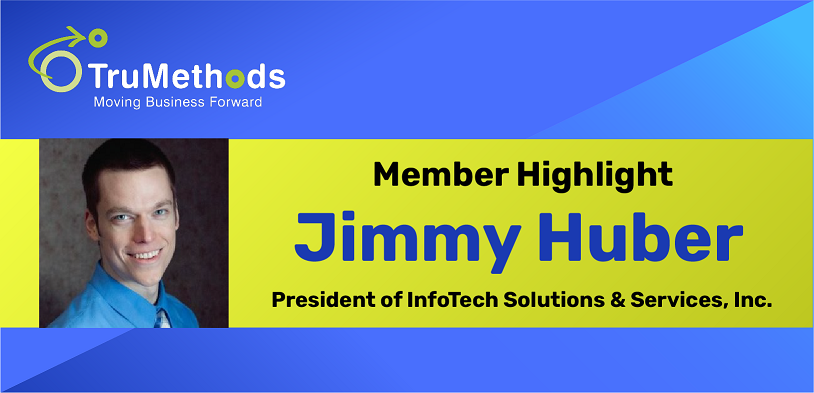
“I went to all of Gary’s breakout sessions at DattoCon 2019,” said Jimmy Huber, president and founder of InfoTech. “His message really resonated with me and made me rethink pretty much everything I thought I knew about the MSP business model. I briefly asked him some questions afterwards and quickly learned that he was basically playing 4D chess, and I was woefully behind in my traditional practices. Once I discovered the reasonable price, it was a no-brainer from there.”

During our one-on-one conversation, he spoke more about how he has implemented what he’s learned from TruPeer, what TruMethods provides that other vendors can’t and how myITprocess has helped him with developing a repeatable client process that is the basis for high-value relationships.

A lightly edited transcript of our conversation follows.

Describe your company before joining TruMethods and after. 

We were an eight-person team, underpriced and undervalued. We had been innovating internally from various resources yet hadn’t figured out how to unlock our full potential. Once we started using TruMethods, we slimmed down to six people, started using TruMethods terminology to better communicate as a team and within several months were on a track to growth again.

What’s your biggest takeaway from TruPeer? 

I learned that there are many business owners that deal with the same problems and have the same questions as I do. I am not alone. An entire community of MSP leaders wants to learn and grow together. That’s something special, and I’m grateful to be a part.

How have you implemented what you’ve learned from TruPeer? 

I’ve started tracking my sales leads, updating a PBR and intentionally connecting with my COIs regularly. I’ve almost overnight increased my warm leads and FTAs just by working the system and getting out of my comfort zone. TruPeer has given me the confidence to try new ideas and refine processes that we were already doing, but not talking about effectively internally. This was huge for us and has literally motivated my entire team to be better. They now know “the why” and I’m a better leader because of TruPeer and my continued relationships in my Pod.

What does TruMethods provide you that other vendors don’t?

TruMethods is a platform with countless resources that all help to further my potential and my business to set and meet our goals. Rather than just try to sell me products, TruMethods helps me be better in my own role and enables me to lead others to do the same. The TruMethods team is full of people that care about others, and it shows. They also have a great way of bringing out the best in me personally since many skills I’ve learned at the office carry over into other areas of my life. Most vendors seem to just want to sell and not force the healthy conflict that gets results. I now know how to do that better in my company and with my clients.

How has myITprocess helped you with developing a repeatable client process that is the basis for high-value relationships?

I’ve realized that I already had good client relationships but was not developing them effectively. I had many excuses for that, but myITprocess is helping us build a process to meet regularly with the right people and discuss the right topics that lead to better decisions that matter. I now have regular meetings with decision makers at most clients and can discuss their business goals and not just burning issues or tickets. The value created with myITprocess also carries over into the sales cycle and allows us to command a higher price, which in turn creates the ability for even more value. It’s unlocked so many doors for us, I wish I’d done it years ago!

MSP peer group

A Metaphor for Continuous Improvement in Technology Alignment & vCIO

How did a parking lot remind me of your Technology Success practice?

Although some people have returned to the office at this point in the pandemic, there are still many people working from home. Of the companies that are still working from home, their office parking lots have not seen nearly the amount of activity that they once did. At one point after TruMethods went to work from home, I drove past an office parking lot in town and noticed mother nature was taking over.

Some context: This particular parking lot was covered with rocks versus having been paved. Underneath those rocks? I can only imagine it was dirt. The previously predictable daily human intervention in the form of cars driving on top of it and people walking over it, along with occasional landscaping was no longer in motion since everyone was working from home. This allowed for entropy (the natural disorder of things) to take its course, and greenery started peeking through.

If you have made it this far, now it’s time to connect this seemingly random observation to your MSP’s service delivery operations. When it comes to proactive activities likeTechnology AlignmentandvCIO, we either continue the discipline which allows for it to stay clean and efficient or we fall off course which results in most of the work that went into it to unravel. The latter tends to take us back into focusing on reactive, lower value activities which permeate through the organization (similar to the weeds in the parking lot) and impact the company’s efficiency and profitability.

Here are some key recommendations that TruMethods makes regularly in order to keep proactive discipline in place as MSPs implement and continuously improve upon the Technology Success practice:

  • Pre-schedule Technology Alignment and vCIO meetings with clients. This lends itself to more predictability internally, and continuous client expectation setting. We recommend scheduling these a year in advance, but even mapping out each quarter would do the job to get started.
  • Put appropriateService Delivery Meeting Structurein place.These are meeting rhythms scheduled internally to keep the team on track and in constant communication. Form a standards committee and have them meet on a regular basis. Depending on the size of your organization, the committee could vary in size but should represent reactive, proactive, and strategic functions of the business in order to add multiple layers of perspective.
  • Regularly re-evaluate the frequencies of theSuccess Rhythms set in place.The rhythms that were determined when you started may not be the rhythms that are needed now, determine what frequencies make the most sense for you and your clients as you move down the path to proactivity.

The way to be successful is to be consistent, and keeping the appropriate disciplines in place (while evaluating/adjusting them on a regular basis) will keep you on track toward building a more successful, proactive MSP. Unlike with an overgrown parking lot, we cannot just occasionally call in the landscapers when our operations and client relationships go sideways. Keep the right disciplines in place, and your Technology Success practice will continue to thrive!

Think about this: What other disciplines do you and your teams put in place to keep continuous improvement efforts alive in your organizations?

Request My Demo

Business Person First, Technology Company Second

We are at an historic point in the MSP and SMB landscape. There’s never been more opportunity or risk. I’ve had a consistent message this year: You need to be a professional businessperson as an MSP in order to capitalize on market opportunities that we are now presented with.

As we watch MSP leaders mature their command, business planning and leadership abilities, the results are coming in big waves. Many had their best trailing 12 months in terms of revenue and profits.

The pandemic and cybersecurity landscape overlay the SMB digital transformation. You need to be a business person first and a technology company second.

For example, MSPs are trying to solve their security issues with tools and security knowledge, when at their core, most have a business model issue.

Solving this problem is as simple as setting time aside every week, every month, and every quarter to work on your business. Scheduling this time in your calendar to keep yourself accountable is key. Use this time to evaluate where your business stands today. Ask, “What is my business lacking?”

For instance, do you have a business plan? If you don’t have one, set aside time to create oneWhat about a mission statement, core principles or a vision? What are your targets throughout the year and the next several years? What about a quarterly action plan? Is one in place or are you just winging it?

Even though you’d like it to be, technology isn’t always the solution to the problems you’re having. (In fact, it’s typically not.) By being a businessperson first and a technology company second, you allow yourself to think about problems with your business differently — and that’s for the better.

New call-to-action

Kaseya Launches Online Collaboration Platform and MSP-Focused Initiatives to Further Empower IT Community

Channel-centric enhancements include new division for high-growth MSPs and compliance-as-a-service content from Kaseya’s Powered Services platform

August 17, 2021 — MIAMI — Kaseya®, the leading provider of IT and security management solutions for managed service providers (MSPs) and small to medium-sized businesses (SMBs), today announced the launch of the Connect IT Community. The collaborative online platform allows IT professionals to network with peers across the globe, share best practices and enhance their knowledge of the 27 modules of Kaseya’s IT Complete suite of solutions.

The company also announced several MSP-focused enhancements to help IT professionals take advantage of the competitive mergers and acquisitions (M&A) landscape and expand their businesses. These initiatives include a new division focused on high-growth MSPs as well as expanded content offerings through Powered Services Pro, Kaseya’s comprehensive acceleration platform that helps MSPs grow monthly recurring revenue (MRR) through tailored go-to-market content and one-on-one coaching.

“Though Kaseya’s customers are located across the globe in a number of industries, they all have one thing in common—the desire to make their IT environments more effective and efficient,” said Mike Puglia, Chief Strategy Officer at Kaseya. “Kaseya’s Connect IT Community, its new business unit and its latest Powered Services enhancements were all created to help IT professionals get the most out of the workflow-integrated IT Complete suite of solutions—allowing organizations to grow their bottom lines while eliminating the time wasted switching between disparate tools.”

Connect IT Community

Kaseya’s Connect IT Community was designed as a global hub for Kaseya customers to engage with their peers and maximize efficiencies through the Kaseya products they use every day. Connect IT Community users can enjoy the following features:

  • Coffee Shop: Users can visit the Coffee Shop within the platform to post about topics ranging from the latest compliance regulations to new product launches as well as learn more about opportunities to meet peers and industry leaders both virtually and in person.
  • Automation Exchange: Users can share, buy and sell scripts through the Automation Exchange, which is now located in the Connect IT Community.
  • Ideas Portal: The Ideas Portal allows individuals to provide feedback directly to product teams and view the status of submitted projects.
  • Exclusive Groups: Individuals can access exclusive groups within the community by attending events, leaving testimonials, and actively participating in discussions within the forum.

MSP-Focused Enhancements

  • Kaseya has introduced a new division to help high-growth MSPs navigate the ever-changing M&A landscape as well as strategically expand their service offerings. Led by Miguel Lopez, Kaseya’s SVP of Strategic Accounts, this division enhances Kaseya’s continued focus on educating MSPs about M&A through workshops, events and networking opportunities.
  • Powered Services Pro recently expanded its offering to include over 85 pieces of digital marketing content per month to help MSPs sell their security, backup and compliance services more effectively. Since compliance regulations continue to evolve, Powered Services Pro has now incorporated exclusive Semel Systems training to help MSPs increase profits through their compliance-as-a-service offerings. Powered Services Pro helped MSPs close over $3.2 million in MRR in the first half of 2021 through its Goal Assist one-on-one coaching program and continues to help MSPs win new business daily.
  • Kaseya’s newly rebranded Powered Services Podcast provides MSPs with crucial insights and commentary from industry experts on key trends and where the market is headed. The podcast is hosted by Dan Tomaszewski, Kaseya’s SVP of Channel and Community and a former MSP CEO who has firsthand experience with the challenges and opportunities that MSPs face every day.

To learn more about the Connect IT Community, visit https://www.community.connectit.com/. For more information on Powered Services and to listen to the Powered Services Podcast, visit https://www.kaseya.com/managed-service-providers/powered-services/.

Demonstrating Value to MSP Clients in a Deliberate and Meaningful Way

Have you recently taken a step back to ask yourself: “What am I doing to deliberately demonstrate the value that I work so hard to deliver to customers?” In the MSP world, “we don’t hear from them much” is simply not an acceptable way to explain an overall client relationship.

Of course, it’s excellent when we are able to explain the reactive nature of the relationship that way. However, there needs to be pre-scheduled, proactive cycles around reviewing technology and communicating the potential ramifications of outdated policies, procedures, and practices.Clients need to hear from us!

This has always been our claim at TruMethods, as there has always been risk (and opportunity) in technical misalignments. With that said, the risk factors have exponentially increased with the current cybersecurity landscape and it is the MSP’s responsibility to tie all the risks they know about back to their client’s business needs. The key point to be made here is “risks they know about.” We don’t know what we don’t know until we do, right? That’s why proactive Technology Alignment is so crucial!

The two highest value delivery areas (in terms of client perception) in the TruMethods framework are Technology Alignment and vCIO. For any MSP, these functions are central to the results that we look to achieve in terms of operational efficiency and strategic relationship management. They are also the key to deliberately demonstrating value to clients on a long-term basis, and if done right, can even help the client become better educated on how technology can impact their overall business goals.

Here are some suggestions that can assist in demonstrating value to clients:

  • Technology Alignment:
    • Pre-schedule alignment reviews (6-12 months in advance) and be sure there’s a calendar invite sent promptly that includes the technical point of contact
    • Set an agenda for the review, include a pre-review and post-review check with a point of contact to begin and end the proactive engagement
    • Make your presence known: If on-site, take a little bit of time to talk with end users. If remote, use Slack, Teams, or email to notify end users about the review and offer technical tips & tricks.This is not meant to collect reactive issues, but could be an opportunity to train end users on how to submit tickets if they experience any issues.
  • Virtual CIO:
    • Pre-schedule Technology Steering meetings (6-12 months in advance) and send out agendas ahead of time to give the client a chance to suggest edits
    • Conductunique touchesin between scheduled vCIO Technology Steering meetings so that the owner/C-Level contact understands how the proactive process continues outside of the larger strategic meetings
    • Periodically take a moment to point out progress: Alignment score improvements, impactful changes to their KPI’s, lower ticket noise translating to better end-user efficiency
    • Translate any technical jargon into language the Owner/C-Level contact can understand, and keep it as simple as possible. After all, this isthe essence of vCIO, isn’t it? Making IT seem less overwhelming and tying it back to what will improve business outcomes directly demonstrates value.

Spoiler alert:This is an inherent side effect of properly implementing and/or maintaining your Technology Success practice. Please be sure to reach out to the TruMethods team if we need to make some adjustments or put more discipline around the process… it’s what we do!

Take in all of the information in this blog post and also think of this: What are other ways you are able to demonstrate value to clients while navigating technical and business relationships?

Request My Demo

Becoming a Data-Driven MSP

It’s one thing to talk about being data-driven; it’s another to actually bring about that enlightened state. Along the way, you’ll run into all sorts of problems – not enough data, dirty data, too much data, and trying to figure out how to use the data you have. Yet, when you start to put into place all the things you need, you’ll find that your decision making becomes sharper, your outcomes start getting better, and you’ll have a lot more confidence along the way.

Becoming a data-driven MSP doesn’t start with our normal means of consuming data. Dashboards and financial statements are fantastic, but they’re garbage in, garbage out (or quality in, quality out, if you’re doing it right). So before you even get there, you have to make sure that your data is as clean as possible.

In data science, there’s something called the 1-10-100 Rule, and that’s about the costs of clean data. The cheapest path to clean data is to make sure it’s clean in the first place. If that costs $1, then the cost of cleaning dirty data later on is ten times that. But if you only discover the data is dirty after it leads you down a bad path, the cost is one hundred times the cost of cleaning the data at the source.

Now think about the role that KPIs, dashboards and financial systems play in your decision making. They’re valuable specifically because they are a shorthand representation of a larger dataset. If there’s dirty data in that larger dataset, you’re a lot more likely to be led by your KPIs, dashboards and financial statements to make a suboptimal decision.

The natural conclusion is that you need to make sure the data you’re using to make decisions is clean. You still have to confront any issues in your decision making heuristics, the biases and fallacies and pitfalls that abound. But at least you’ll have clean data, and it’s clean in the convenient and powerful format it arrives to you in.

If you’re with TruMethods, you’re serious about being the best. You’re smart enough to know that you’re going to work hard no matter what, so you might as well have the systems in place and the attention to detail so that your hard work pays off handsomely with a higher level of operational excellence.

That’s an area where Gradient can help. We’re here to help keep your data clean, and coming soon we’ll be helping bridge the data gap between you and your vendors. Why not come by, plug in and see how we can help make you make better decisions.

You can take a peek at Gradient here. Or just plug on it and get started here.