Better organization is always one of those things that we often leave ‘until later’. At the same time, we understand how crucial good organization can be. To make organization better in myITprocess, we enhanced our IT Glue integration to support flexible assets. Since flexible assets allow you to customize your own workflow processes, we gave you a lens into this area of IT Glue from within myITprocess.
We focus on three key areas for this integration. First is the review process, which we term ‘alignment’. This is the act of assessing your client’s environment compared to your best practices in your standards library and identifying where gaps may exist. Associating flexible assets to a specific question about that client’s environment provides visibility into the details about how that item should be in an ideal setting.
Next, for each client’s template – their individual view of your global standards library where you can omit items that don’t apply to that client – you can now attach flexible assets directly to their questions. The power of having documentation for each organization will now be present for each client in myITprocess and make the alignment process that much more efficient.
Finally, flexible assets can be added directly to strategic roadmap recommendations to provide supporting documentation when you present your findings to your clients. Flexible assets can inform your client of the ‘why’ behind the dollars you’re suggesting they spend.
Since flexible assets improve processes in IT Glue, we now enhance that workflow by joining together excellent documentation with a dedicated alignment process.
MSPs are making cybersecurity sales harder than it needs to be. In fact, I hesitate to use the word “sales” because that is the center of the problem – customers feel like you’re trying to sell them.
You shouldn’t be selling customer security enhancements or projects. Instead, you should be taking your customers and prospects on their security journey. You need to develop a repeatable way of explaining the risks and opportunities that your customers will face.
Here’s an example.
I received a call from a friend who was a customer of both of my MSPs at some point. He has a new MSP now. He told me that his MSP wants to charge him a lot more than he’s already paying, but he didn’t want to change much. He mainly uses a line of business apps that is “secure”, and he’s satisfied with his backup.
I took a couple of minutes to ask him a few questions. I eventually figured out that what they were trying to sell him was some MDR and SOC SIEM. I asked him if I could explain what happens during a breach. In other words, where the bad guys are, how they come in, and how long they stay there.
The exchange went something like this.
What happens if the attackers are in there long enough, and now your backups are infected? “Oh, I never thought of that.” What happens if you have good backups, but the attackers have infiltrated your data? “That’s a good point.” What about if they hold your sensitive data hostage? “Oh, I never thought about that either.”
Basically, I summed up our conversation by explaining that he was already living with these risks. “It probably sounds like you’re going to have to invest another $25 a seat. I know that sounds like a lot, but what’s the other side of this?” I asked. We talked for about five more minutes, but in the end, he understood the importance of the additional investments.
I sat there and thought, “Why am I explaining this to my friend instead of his MSP?”
He came away from meeting with his MSP’s account manager or vCIO feeling like he was trying to be sold something that he didn’t need. And you know what that MSP’s vCIO is going to say when a customer pushes back on additional cybersecurity costs?
“My customers don’t want to spend more.”
This is why there are two realities. There are MSPs that think the issue is the customer. Then there are those of us who understand that it’s our responsibility.
You have a lot of choices as an MSP in terms of priorities. You can focus on trying to be more efficient with professional services or support, reevaluate sales, add tools, standards, and the list goes on and on. But there is one thing that can really make a difference in your business in 2022.
We’ve been busy running our peer groups for the past couple of weeks. It’s been a blast, and we’ve covered a bunch of topics. During one of our sessions, someone asked me an interesting question, one I had to give some thought to before giving my answer.
The TruMethods member asked, “Gary, if you bought another MSP, what’s the first thing you would do?”
I replied simply with, “I would immediately work with vCIOs on their value messaging with customers.”
“Hey, Mr. Customer, let me tell you what’s changed in the security landscape and in the ways that you are using and depending on technology. Here’s how we’ve adapted in terms of not just tools, but more importantly, roles and process. You pay me $4,000 a month now, and that needs to be $5,200. Based on our conversation, do you care?”
I would roleplay this, go on a few meetings, and hone the conversation until the vCIO team had complete control. Once price is not an objection, everything changes. And here’s the best thing: customers don’t care what you charge them within reason either. They may tell you they do, but when you explain what you need to do, and put their monthly fee in comparison with their total monthly cost and revenue, it changes their frame of reference. That’s why we call it reframing.
Once you have success here, your conversations with prospects will also change because with customers, this conversation creates value; in the sales process, it creates separation.
If you can master this one thing, your business and your life will change.
I think I’ve mentioned this before, but I like to archive all the notes from my audio messages. I’ve been doing this since I started recording weekly audio messages for TruMethods members back in 2009. At the beginning of this year, I decided to time travel.
I created a new folder for January 2022, scrolled through the folders over the years, and opened the folder I created in 2009. I browsed through it and found the notes from my very first audio message. I want to share just a little piece of that message and then provide some reflections on it.
Here’s the message:
“Today, I want to speak to you about having balance in your life, between striving for your business goals and enjoying your life. The older we get the faster time seems to move on.
I have a son who’s going to college this fall. Eighteen years went by like the blink of an eye. The same thing happens in our business. The days, weeks, months, quarters, and years fly by. Time can be our friend or our enemy. I sometimes end my live presentations with a story, and I’d like to share one with you.
There was a guy I met years ago when I was installing my company’s first toolset. My company was looking at packaging and pricing, and he was in a similar place, so we would speak once a week. Over time, we both got busy. And years and years went by before we spoke again.
I eventually ran into him at an industry event. He asked me how I was doing. His business was in the same place as mine the last time we spoke. And when I told him where I was — 7,000 endpoints under management, recurring revenue, profitability. He was dumbfounded for a second. And finally, he said to me, ‘What have you been doing? My God, Gary!’
I paused for a second. And I said, “No, I think the question is, ‘What have you been doing?’”
A lot has changed since my first audio message. Since I recorded it, we at TruMethods have built our peer groups, created Schnizzfest, and developed myITprocess. My son Gary Jr., went to college and then joined TruMethods. I feel pretty good about how I’ve used my time.
Here’s something to remember: All you have is each day, and each day goes by. Make sure you have the right priorities in place. Think about where you want to be in three or five or 10 years. Then focus on how you can use your time to get there. Time can be your friend or your enemy.
As the saying goes, “What you put into life is what you get out of it.” The same can be said about gym memberships, music lessons, and TruPeer.
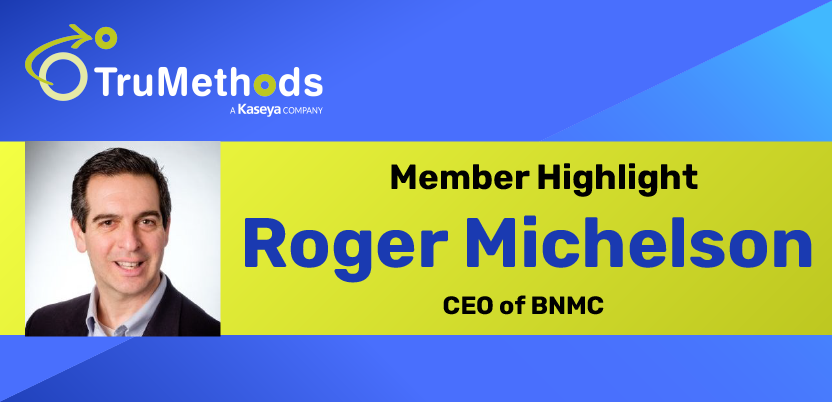
“You first and foremost have to make time for TruPeer and it has to be a priority in your calendar,” said Roger Michelson, CEO of BNMC, a Woburn, MA-based MSP and TruMethods member. “We have assignments and special projects to get done and we have regular meetings to attend. Second, you have to participate in TruPeer and be valuable to your group and other business owners. Leadership and value go both ways and you have to demonstrate that value to your teammates.”
During this interview, he shared how TruMethods and its TruPeer program have helped him overcome business challenges, what MSPs should know about Smart Numbers, and the importance of proper business planning.
A lightly edited transcript of the conversation follows.
When and why did you join TruMethods?
BNMC joined TruMethods in January 2016 in order to change our business strategy and get some much-needed sales, marketing, and operations coaching to help grow our MSP. We were struggling in 2014 and 2015 to get beyond the $2-million revenue ceiling, and we were losing money in our business. We worked with Gary, Bob, and the team across several years and not only doubled the size of our business but have been profitable over the last four years.
How has TruMethods helped you with overcoming challenges in your business?
We first adjusted our pricing to an All-In Seat Price model and changed our sales strategy to adopt the TruMethods Framework. We worked hard to understand our numbers, costs, and leverage in the business and started tracking and reviewing our Smart Numbers on a monthly basis. This allowed us to make course corrections along the way and to slowly bring customers at the new price who were more profitable and a better fit for our business. We also had to work on our legacy customers to change their pricing models over a period of several years. Finally, we focused on business planning and worked to change a lot of the operations, introducing new processes and procedures and making sure we had the right team.
What is the value of TruPeer?
We joined TruPeer at the beginning of 2021, though I wish I had done this earlier. I have attended industry conferences for years, and I always valued meeting with other MSP owners to discuss their MSP business as well as share BNMC’s story, what is going right, what is broken, and what we have all done to help grow our businesses. TruPeer allows me to take this to the next level and work closely with a dedicated group of similar MSP business owners where we can discuss our challenges, achievements and struggles on a biweekly basis and work together to improve everyone’s business. Everyone is held accountable to achieving their rocks (goals), and we work inside and outside the meetings to collaborate and help each other.
What should MSPs know about Smart Numbers?
It is important to understand what is going on in your business, and Smart Numbers helps the business owner take command of their operation. For example, it is important to understand the Reactive Ticket Hours Per Endpoint (RHEM) in your helpdesk. If the RHEM is too high, then your help desk team is drowning in tickets and your operations and company will suffer. As you work to improve efficiency and lower the RHEM, your existing staff can complete more tickets and you can take on new customers with the same staff. This allows your company to grow and become more profitable. When we first started with TruMethods, our RHEM was quite high and we did not understand how destructive that was to the business. As we were able to take command of the help desk and become more efficient, we were able to improve our growth and profitability.
How has proper business planning helped your business?
We introduced Gino Wickman’s EOS business strategy (based on the book “Traction”) around the same time as joining TruMethods and learning on how to properly create and manage a business plan. We now have a process, a vision, and business strategy, which we follow based on the EOS and TruMethods frameworks which allows us to meet our goals. Without a business plan, you are really just shooting at the hip and you don’t always have the staff working together to meet your goals. The business plan allows you to figure out what you want to accomplish and then you set rocks and work through issues, both financially and operationally, to meet those goals. You also need to share your plan and vision with the entire team, so everyone is working together on the same plan. Business Planning is a process which you do consistently throughout the year to allow you to make adjustments as needed.
The vCIO process is one of the most important aspects of the TruMethods framework we teach to managed services providers (MSPs). The vCIO is responsible for relationship management, client education, life cycle budgeting, and more. Putting the wrong person in the vCIO role could prove disastrous for not only you, but also your customer.
While we’ve covered many topics on the TruMethods blog for vCIOs over the past year, a few stood out for a variety of reasons, including their timeliness. After reading the blog posts below, browse through our library of blog posts from over the past year to review other blogs you may have missed!
When creating strategic initiatives in the myITprocess Strategic Roadmap, it’s common to get pulled in the direction of creating initiatives that reference technology versus plugging into clients’ business initiatives. Recommendations can and should be a blend of business and technology suggestions, but should always reference a business case as to why the recommendation should be accepted.
When it comes to proactive activities like Technology Alignment and vCIO, we either continue the discipline which allows for it to stay clean and efficient, or we fall off course which results in most of the work that went into it to unravel. The latter tends to take us back into focusing on reactive, lower value activities which permeate through the organization (similar to the weeds in the parking lot) and impact the company’s efficiency and profitability. Here are some key recommendations that TruMethods makes regularly in order to keep proactive discipline in place as MSPs implement and continuously improve upon the Technology Success practice.
A lot of the business world for many years has revolved around the idea of being efficient and robotic to ensure we are as profitable as possible. And don’t get us wrong, being efficient is great and necessary to have a good business, but for so long the ‘softer’ skills have been neglected, especially in the tech world. The idea of understanding how we work as people and using that as a context to help others and ethically make money is relatively new.
When it comes to keeping clients’ data secure in the face of increased ransomware attacks, cloud backup can provide a significant value. Properly configured, housing redundant data in the cloud can help an MSP’s customers weather cyberattacks with confidence that they can quickly and easily restore their data in the event they get locked out of their files and folders.
However, clients often don’t see the value in leveraging cloud backup for cloud applications such as Microsoft Office 365. That’s because they may not be aware of the limits of Office 365 backup capabilities or the importance of housing their data in a secondary location separate from their primary servers (cloud or on-premises).
SMBs may also not fully grasp just how vulnerable they are in the current cybersecurity climate.
For example, smaller companies are increasingly the target of ransomware and other attacks precisely because they often lack dedicated security personnel and technology resources.
For MSPs to succeed in selling cloud backup services, it is important to clearly articulate the following to clients during the sales process:
First, clients may think that their data is protected via existing applications and processes. For instance, Microsoft Office 365 does offer some redundancy, but the built-in retention period is only 93 days for email and 30 days for SharePoint and OneDrive files. Many clients don’t understand that their data is discarded within a few months. Office 365 also has limits on data storage. As such, Microsoft recommends that customers regularly backup their content and data using a third-party application. Adding a cloud backup service can augment any limitations from the vendors. Similarly, clients who subscribe to archiving services for compliance purposes may mistakenly think that their backup needs are already being met. However, archiving typically only preserves data needed to meet regulatory requirements; other files and data aren’t held in those archives.
Next, lay out the value in backing up all the client’s business-critical data. For example, folders and files in OneDrive and SharePoint can be deleted or changed accidentally. Having a cloud backup can ensure the valuable data can be easily restored and provide access to quickly again. For some solutions, this rings true even if an employee is no longer with the organization and their Office 365 license is removed.
Explain the value of cloud backup in the context of current cybersecurity threats. Ransomware and other attacks are increasing, and SMBs are finding themselves in the crosshairs. Email-based attacks remain the most common method criminals use to gain network and application access. Ransomware attacks can lead to days or weeks of downtime and significant financial losses, along with the cost of paying the ransom when necessary. A cloud-based backup provides an additional layer of security and assurance that the data can be restored in the event of an attack.
Emphasize the ease of use from the client’s perspective. The MSP is responsible for backing up and restoring data from the cloud, saving a significant amount of time and resources for the client. Furthermore, the MSP does this at significantly less expense than the potential costs associated with a cyberattack.
List the additional benefits of cloud backup. These include having a reliable backup of all critical data that can be quickly restored and accessed from anywhere, improved regulatory compliance, and eliminating data management bottlenecks.
Provide real-world examples of how cloud-based backup could help avoid ransomware disasters. Of course, there’s no shortage of high-profile instances of costly attacks, but MSPs can also use examples from their client base (provided they eliminate identifiable details).
Closing Thoughts
Backup and disaster recovery are bread-and-butter IT services, but they have gained significant importance as ransomware attacks have grown to epidemic proportions. Cloud backup protects against a real and imminent threat to SMB clients while simultaneously reducing the data management burden on their already stretched IT resources.
By making a strong case for leveraging the cloud to back up Office 365 and other data, MSPs can create real value for their clients while initiating conversations about other security solutions that can be implemented to develop a holistic cybersecurity environment.
Scott Bennett is Senior Director of MSP Sales for Barracuda MSP, a provider of security and data protection solutions for managed services providers, and he plays a key role in the development and growth of partner relationships.
From key acquisitions to new regional data centers, the company has continued to put its customers’ needs first—and has seen expansive growth as a result
Jan. 10, 2022 — MIAMI —Kaseya®, the leading provider of IT and security management solutions for managed service providers (MSPs) and small to medium-sized businesses (SMBs), announced today that the company grew by over 25%. Its continued revenue growth was driven by multiple strategic acquisitions and a continued focus on helping MSPs expand their businesses through sales and marketing enablement.
As MSPs and internal IT teams adjusted to new hybrid and remote work environments, Kaseya provided hundreds of deep workflow integrations that allowed IT professionals to work more efficiently and overcome business challenges around cybersecurity and compliance that grew in complexity throughout 2021.
“While 2021 saw economic recovery in certain parts of the world, IT professionals still faced incredible uncertainty as they navigated ever-evolving IT environments on budgets that continue to be stretched by a growing volume of new technologies,” said Fred Voccola, CEO of Kaseya. “We made two acquisitions that addressed key pain points for MSPs and SMBs, launched our Connect IT Community and released innovative new products like VulScan—all with a focus on helping our customers eliminate wasted time and stretch their budgets further. The IT Complete suite continues to be the gold standard for IT professionals in need of solutions that are truly automated, secure and priced right to ensure maximum profitability.”
The Kaseya family will continue to grow in 2022, with plans for over 1,300 new hires worldwide across its Miami headquarters as well as its offices in Dublin, Krakow and Sydney.
Corporate Momentum Milestones
Acquisitions of RocketCyber and TruMethods further strengthened Kaseya’s IT Complete suite of solutions. In February 2021, Kaseya acquired managed security operations center (SOC) solution RocketCyber to help its customers cut through the noise and respond to threats across endpoints, networks and cloud attack vectors. Through its integrations with Kaseya’s VSA, BMS and Passly solutions, RocketCyber users can easily deploy the solution across their environment and quickly create relevant incident tickets. In May 2021, Kaseya acquired the MSP industry’s leading business transformation organization TruMethods to allow MSPs to build more strategic relationships with their customers and increase monthly recurring revenue (MRR). Through the myITprocess ™ virtual CIO (vCIO) solution, the TruMethods Framework and TruMethods Peer ™ groups, MSPs can use proven methods to grow their businesses.
Connect IT Global hosted thousands at the MGM Grand in Las Vegas. Kaseya held its annual Connect IT event in October 2021 with a jam-packed schedule that included keynotes from experts like Kaseya CISO Jason Manar, cybersecurity management sessions and even a few laughs from popular actor Nick Offerman.
Kaseya launched the Connect IT Community to allow IT professionals to share best practices across the globe. The Connect IT Community is an online collaboration platform that enables individuals to use Kaseya products more effectively and network with IT professionals around the world. The Connect IT Community is the new home to Kaseya’s Automation Exchange, which includes hundreds of scripts that users can share, buy and sell.
2021 Innovations and Integrations
Compliance:
Compliance Manager for UK GDPR: This new module in Kaseya’s award-winning platform simplifies compliance with the UK’s sweeping privacy regulation and allows organizations to comply with both UK and EU GDPR requirements.
Security:
VulScan™ by RapidFire Tools: The newest solution from RapidFire Tools provides technology professionals with the ability to better protect their organizations from the growing threat of cybersecurity attacks. VulScan is a modern vulnerability scanner that automatically identifies and alerts users to critical security issues, enabling them to take action before they are compromised.
Enhanced protection against business email compromise from Graphus: Graphus introduced a new capability that uses artificial intelligence to stop both internal and external business email compromise attacks, enabling IT professionals to protect against the most common email exploit of 2021.
Customized emails and training kits in BullPhish ID: Because industry-specific phishing attacks continue to plague businesses, BullPhish ID allows IT professionals to create customized emails and training kits for simulations that mirror the types of attacks that are targeting their employees.
Backup and Disaster Recovery:
Canadian data centers for Unitrends and Spanning Cloud Apps: Kaseya began utilizing two data centers in Ontario and Quebec in 2021 to locally store data from its Canadian Unitrends Endpoint Backup and Spanning Office 365 customers, making it easier for them to comply with data sovereignty regulations.
Unitrends BackupIQ™ Integration with BMS and Vorex: This integration of BackupIQ’s artificial intelligence alerting with BMS and Vorex’s ticketing workflow automation enables organizations to cut wasted time on false alerts and backup remediation by up to 50%.
MSP Enablement
TruMethods’ myITprocess Reporting API and Default Initiative Templates: The reporting API allows users to extract data from myITprocess into a third-party reporting tool, providing MSP owners with the ability to drill down even farther into key metrics. Default Initiative Templates allow MSPs to use myITprocess to deliver strategic recommendations to new clients more easily using pre-populated strategic roadmap initiatives.
Powered Services Pro: New sales campaign kits and “done for you” social media posts as well as one-on-one coaching helped MSPs drive over $6.2 million in new MRR in 2021.
IT Documentation
Enhanced IT Glue Ticketing Experience Through Kaseya BMS and VSA: IT Glue has strengthened its integrations with Kaseya BMS and VSA to streamline the ticketing experience. MyTickets allows users to begin addressing issues directly within IT Glue, and the Affected Hardware feature pulls information about assets and their operating environments from across IT Glue, VSA and BMS so technicians can diagnose and resolve issues without leaving the ticket in IT Glue.
RMM/Endpoint Management:
VSA 1-Click and IT Glue: The VSA 1-Click and IT Glue integration allows individuals to use credentials stored in IT Glue when accessing remote devices, enabling technicians to avoid copying and pasting sensitive log-in information when initiating remote sessions.
PSA/Service Desk
myITprocess Integration with BMS: The integration allows myITprocess users to generate BMS tickets from within the myITprocess platform, removing the need for MSPs to switch between solutions when evaluating client environments.
Industry Recognition
Throughout 2021, Kaseya was awarded with top industry honors that highlighted its best-in-breed products, forward-thinking leadership and high-performing work environment:
Kaseya CEO Fred Voccola and CFO Kathy Wagner were recognized by The Software Report as a Top 50 SaaS CEO and one of the Top 50 Women Leaders in SaaS, respectively.
Kaseya Senior Vice President of Channel and Community Dan Tomaszewski and Unitrends Vice President of New Sales and Channel Management Adam Larrabee were recognized as 2021 CRN Channel Chiefs.
The Cybersecurity Excellence Awards provided 5 awards to Kaseya and its family of companies, including Unitrends, Spanning Cloud Apps, ID Agent and Graphus.
Kaseya received multiple Gold, Silver and Bronze commendations in the ChannelPro Reader’s Choice Awards for its Passly, VSA, BullPhish ID and IT Glue solutions.
Both the Stevie Awards and the Globee Awards recognized Kaseya as a top place to work in 2021.
We change as the needs of our customers change. And for MSPs, their world has changed significantly over the past couple of years.
Some of these changes are easy for customers to understand, while others are not. It’s important to remember that your customers are dealing with and depending on more technology than ever before. More of the products they’re using are in the cloud. Your customers also have critical data on numerous platforms. There is a lot for them to digest.
While I think customers understand that their relationship and dependency on technology has changed over the past 18 months, they are still not quite sure how to manage it all — and that’s where you come in. For example, your customers may or may not understand the changing security landscape and how it affects their risk profiles. They may also not understand the concept of an assumed breach mentality. This is where you as an MSP can assist with reshaping the way your customers do business. But they are not the only ones who need to reevaluate where they are today.
How have you reacted to these changes in your business? How different is your approach today? Have you added new tools to your stack? Have you added new roles or added process to your current roles? Have you evolved your vCIO role and relationship with your customers? Do you have truly proactive roles? Which roles are responsible for all the things you need to do today that were not as critical a few years ago? How do you convey value to customers and prospects?
This is a journey for all of us.
You are all at a different point in your maturity in terms of meeting these changes than your peers. The challenge you have is that while you need to evolve your service delivery model in the coming year, the tickets, projects, pricing issues, and employee challenges still need to be managed.
As we head into 2022, develop a plan to address the needs of your customers, especially the needs they have today. Whatever your current planning and execution results are in terms of your business planning process, they need to improve for 2022.
Today you’re presented with an opportunity to move your business forward.
Even though cyberattacks are hitting the news nearly every day, many businesses still aren’t taking cybersecurity seriously, which is bad news for them, but good news for MSPs.
The number of cyberattacks continues to rise. For example, there has been a 62 percent increase in ransomware globally since 2019, and a 158 percent jump in North America, according to the 2021 SonicWall Cyber Threat Report. There’s an ample amount of opportunity for MSPs to capitalize on selling managed security services.
Here are five blog posts on cybersecurity you may have missed in 2021.
When we think about risk, we treat risk with mitigations controls and safeguards, but a safeguard has differing levels of effectiveness. Strength of control needs to be much different depending on the risk. Understanding their behavior and emulating it. Are your controls operating effectively? Strength of control needs to map the capability of your threat actor. Using threat profiles is one of the top ways to figure out how your enemies operate.
Ask yourself this question: Who’s responsible for your customer’s cybersecurity? You or the customer? Does your customer expect that since they have you as their MSP, they won’t have a security incident? If so, you may have set very unrealistic expectations.
New TruMethods Framework Content: MSP Cyber Security
We added a new content track to our TruMethods Framework training portal called MSP Cyber Security. We’ve been talking here at TruMethods about having defined delivery areas and functions about process and metrics for a long time. Now, you can’t secure yourself or your customers without this level of command and without having a concrete MSP framework. This is a great opportunity for every TruMethods member.
MSPs are getting creative with their sales conversations. For example, some MSPs are offering qualified prospects free risk assessments in an attempt to move their sales discussions along. While this is a potential strategic tool to use with qualified prospects, be careful making assessments a part of every sale, as there could be unintended consequences.
With enough information gathered freely online or via low-level breaches of email accounts, criminals can craft email messages that are convincing enough to trick even somewhat skeptical employees. That means security awareness training must be part of a holistic security offering. This ensures that the investment the client has made in advanced security technology will pay off and generates revenue and business opportunities for the MSP.