
Know Your Enemy: Creating Threat Profiles

If you know your enemy and their tactics, you not only can prevent more attacks, but also be better prepared to respond.

Cybersecurity maturity is a journey for MSPs and their customers. While it’s a share-risk relationship, you’re the one leading the way. It’s your job to build an assume breach mentality and understand what you need to do.

When we think about risk, we treat risk with mitigations controls and safeguards, but a safeguard has differing levels of effectiveness. Strength of control needs to be much different depending on the risk. Understanding their behavior and emulating it. Are your controls operating effectively? Strength of control needs to map the capability of your threat actor.

Using threat profiles is one of the top ways to figure out how your enemies operate. 

Above all, know your enemies. Cybercriminals are successful because they do their homework; in other words, they are prepared. They must be, in order to outsmart their adversaries and exploit vulnerabilities. They know what they are looking for and who has it. They also understand how to overcome hurdles and typically know more than their victims. If cybercriminals are doing their research to come out on top, why aren’t you?

Many MSPs tend to rely solely on their vendors to protect them and their customers. While there are tools you can use to better protect your clients’ IT infrastructures, you can’t rely entirely on technology to help you with understanding your enemies. You must be able to dig deeper to find out who your enemies are.

What are they doing? Who are they? Are they financially motivated?  Start at the end of the maze if you want to know how to defend against your enemies.  Then put processes in place to protect yourself. Understanding your enemies is informs you of how to put a defensive strategy in place.

Building threat profiles. Have you ever seen or built a threat profile? If I had to take a guess, probably not. Threat profiles are used by cybersecurity professionals to keep track of their enemies. Many MSPs don’t use them, but they should.

A threat profile outlines the very finite things that threat attackers do, threat vectors they use, where they’re from, etc. If you spent your day looking at the tactics, you wouldn’t necessarily know what to do in order to protect against threat actors, so threat profiles provide you with a quick overview of who they are.

It only takes about 30 minutes to develop a threat profile.

You have more than one enemy, but there are similarities among many of them. There is no need to double your efforts. Each threat actor is different, but if you compare a group of them, you’ll find similarities. For example, several actors may use to same threat vector to attack their victims. That information may help you with creating a defense strategy for your clients.

Building threat profiles are necessary to protect yourself and your clients from malicious actors. Using tools isn’t enough to prevent cyberattacks. You must get to know your enemy before creating a solid defense.

cybersecurity ebook

Unlocking the Power of Technology Standards in Your MSP

Now is the time to unlock the power of technology standards in your organization. Standards can be the key to increasing your perceived value with customers and fostering a more strategic business relationship.

First and foremost, what is the definition of an MSP Standard and why are they so powerful?

MSP standards are defined as a set of best practices and provide an objective view of a customer’s technology environment by aligning them against those standards. Standards are a powerful tool because they allow an MSP to set the bar on what and how technology should be used in a customer’s environment. Aligning a customer to those standards reduces reactive noise (tickets) and generates recommendations to advance the customer’s business goals.

Will your company’s standards look the same as others in the industry?

Standards come in many forms and are sourced from different providers, from statutory laws, private compliance, and industry best practices. It is common for standards and best practices to overlap in the industry, mainly due to compliance or government regulations enforcing the use of industry best practices. For instance, the National Institute of Standards and Technology (NIST) provides numerous standards, frameworks, and best practices for organizations in every industry. And, since federal and state objectives for security have recently become more strict, NIST frameworks are most commonly the backbone of these rules and regulations.

How will these standards help you to scale your business and become more profitable?

Implementing and aligning your customers to a set of standards will generate numerous benefits to your MSP. For one, technical alignment drives down reactive noise by assessing problem areas, resolving those gaps through recommendations, and decreasing the number of support tickets. When a Technical Alignment Manager (TAM) performs their onsite technical assessment, they pass their findings to the virtual Chief Information Officer (vCIO), your customer’s strategic partner, to make those recommendations a reality. As part of the technical alignment process, the vCIO performs business impact and strategy with each client, addressing how standards alignment affects their business goals and assists with developing a short- and long-term strategy. A strategic roadmap helps your clients plan for future expenses and to visualize their business goals, increasing the intrinsic value provided by your services.

Will customers be affected by these standards? Will they be valuable to them?

When a customer is aligned to your set of standards, they gain the competitive advantage by using technology as a strategic asset. Developing a strategic roadmap and budget months—or years—in advance allows them to concentrate on their business goals rather than maintaining their technology. Customers who can focus on their business rather than day to day support tickets will see the value in the standards and alignment process.

How can you get started with creating and eventually maintaining your Standards Library?

Getting started with standards is easy! As a myITprocess subscriber, you will have access to the myITemplates repository, filled with over 3000 questions from popular frameworks like NIST Cybersecurity Framework and CIS Controls, as well as numerous federal and state compliance and industry best practices.

Plus, myITprocess comes preloaded with the default template containing 150 questions to get you started out of the box. Want to implement your own standards? You can easily move, add, and change sections, categories, and questions directly through the web interface or upload them in bulk using our easy export/import feature. Additionally, you can tag sections and categories for easy sorting and filtering to designate specific uses like onboarding or quarterly assessments.

Request My Demo

Return on Luck: How Do You View ‘Luck’ Events?

You’ve heard me talk about the concept of ROL, or return on luck, over the years. I first read about the concept of return on luck in the book “Great by Choice,” where Jim Collins discusses the long-term impact of luck events, both good and bad. He found that companies had the same amount of these types of events over a decade. But the companies that were able to react differently to both good and bad luck events got to the top of the industry. I feel the biggest turning points in my business career came from what others called “bad luck” events.

We’re getting to the other side of the Kaseya vulnerability issue, unless you’re one of the MSPs that were breached. Now, this is being portrayed as a bad luck event for MSPs. This story lit up the worldwide news cycle. I already saw an industry article saying that this will change the MSP industry because customers will lose faith in MSPs. I get why this is the reaction.

But, it made me think of one of my favorite lines from Apollo 13. When someone said that this will be the biggest disaster in the history of NASA, Gene Kranz replied with, “I believe this will be our finest hour.” This is your chance to decide if this story becomes a good or bad luck event for you.

I believe that there will be winners and losers in the MSP market. In fact, it’s already begun. How will this event and others impact you? Whether you’re a VSA customer or not, I don’t think it matters. Will this have a negative, neutral, or positive impact on your business and your relationship with your customers?

If I wasn’t currently between MSPs, here’s what I’d be doing:

  • Developing talking points for my team to be prepared to talk to your customers by arming vCIOs with a playbook to use to push my customer security posture forward. 
  • Meeting with my leaders about maturing my security posture.

And here’s what I wouldn’t do:

  • Make knee jerk reactions. 
  • Start changing my technology stack by adding technology in a rush manner.

Step back and be sure you have perspective on the situation. Many security vendors are trying to “FUD” (Fear, Uncertainty, and Doubt) you into sales before this leaves the new cycle.

Luck events — good or bad — are what defines a business over time.

ROL is a critical equation for top companies in every industry. Can you recognize this event and can you react in a way to maximize your return?

New call-to-action

TruMethods Member Q&A: Checking Back in with Fuse Networks

Finding what makes your business unique is what puts you ahead of your competitors and in a better position to generate monthly recurring revenue (MRR) at the right price. What makes an MSP stand out is its Super Power.

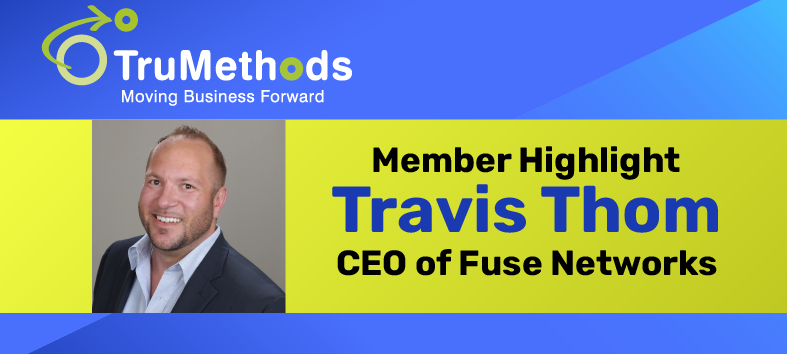
For this Q&A, I chatted with Travis Thom, CEO of Fuse Networks, a Tukwila, WA-based MSP. In July 2019, I interviewed Travis for a previous blog. Now, I check back in to see where his business is today.

“Since joining TruMethods, we’ve retooled our business processes to better define our Super Power, which we refer to as “The Fuse Advantage,” said Travis Thom.

During our one-on-one conversation, he spoke more about The Fuse Advantage, revealed how his business has evolved since joining TruMethods, and what he’s learned from being a TruMethods member.

A lightly edited transcript of our conversation follows.

What type of shape was your business when you first joined TruMethods? What challenges did you face?

We were a company in transition. We had just received notice that our largest client was going to be acquired and they would be leaving. We continually found ourselves needing to adapt to our clients’ requests and react to their needs; baseline standards were set but varied by each client, causing more reactive time be spent by our support staff. This was counter-productive when it came to our service offerings, company culture, and our company way.

How has your business evolved since joining TruMethods?

Leveraging the Technical Alignment Process and IT Strategy process has proven to build more inclusive relationships with the clients we support and as a result the Service Desk’s reactive noise has decreased. It’s awesome seeing continuous positive feedback from clients on how we’re doing via CSAT and NPS submissions as it validates the maturity the TruMethods framework is providing.

What have been some of your biggest takeaways from TruMethods?

First, clearly define the roles and responsibilities when it comes to the different pillars in the TruMethods framework. This allows reactive hours to be measured and compared against proactive activities. Doing this enabled everyone at Fuse to see the leverage we were creating, which played a big part in the shift in culture we experienced. Second, use the standards library and tools that are available within TruMethods and myITprocess. When we were getting started with the TAM process, the team put a lot of emphasis on making it perfect which caused delays in moving forward due to paralysis by analysis. Start with what’s provided and appoint a standards committee to review the process, after you’ve went through the a few cycles it will be easy to identify what should be modified or added.

How would you describe your business today?

Fuse is a rewarding place to work. We have a team that understands customer services is the cornerstone of our success and our IT standards are the pillars that guide the decisions being made. Because of this, everyone at Fuse understands our mission, and we can deliver on the essence of each role being filled. We sell a solution that goes beyond traditional managed IT services or cloud services; we leverage IT systems, so they can be used as an asset for the business instead of the perceived encumbrance associated with IT.

Request My Demo

Continuing Education for MSPs: Who Are the Stakeholders?

Professional development shouldn’t be an afterthought in your organization.

It’s something that should matter greatly to not only you, but also your managers. Developing a plan for continuing education is essential for any MSP looking to generate monthly recurring revenue (MRR) at the right price.

Before developing your company’s plan for continuing education, take inventory of the certifications, knowledge and skill sets you, your employees, and your customers already have. Then think about where you’d like everyone to be in the future.

Ask yourself this question: “What would they need to know and what type of skills would they need to acquire to get there?”

Your people matter, so help them progress to where they’d like to end up 

Many of your employees are looking to grow and develop in their careers. One of your responsibilities as a leader is helping them get to where they’d like to be in a month from now, a year from now, and a decade from now. Look at it this way: They are investing in you and your business’ future, so you should return the favor by investing in theirs.

One way to help your employees with advancing in their careers is by providing them with continuing educational opportunities. If you cannot offer these opportunities internally, then there’s nothing wrong with seeking outside help. For example, there are industry organizations you can turn to for assistance. CompTIA’s a popular one; the association offers events, training, and certifications for IT professionals.

While partnering with industry organizations is important, you may also have to allocate funds for employees seeking continuing education opportunities. Use this investment to attract new talent to your organization, too.

Empower your clients by educating them  

Many MSPs forget about offering continuing education opportunities for their clients. MSPs can empower their clients by educating them (your clients are your first line of defense after all). The more educated they are about what you do and how they can help, the better off everyone will be.

Even though it takes time, create content for your clients to consume. Host monthly webinars, publish weekly blog posts, and deploy monthly newsletters. Keep them informed about what you’re doing and what they should be staying up to date on to protect their systems and networks.

How can you improve yourself as a leader? 

Everyone in your organization can benefit from continuing education, including you. While your technicians may want to focus on the technical aspects of what’s expected of them, you may want to take classes on sales and marketing, management, or cybersecurity. There are also online leadership courses you can take at your own leisure if you’re interested in learning how to improve your leadership skills.

Continuing education is necessary for you, your organization, and your customers if one of your goals is to improve business outcomes. Develop a plan that incorporates all of your stakeholders and watch your organization grow.

New call-to-action

After-Hours Support: What Should an MSP Do?

Nobody likes fielding phone calls in the middle of the night, especially after a full day of work. But when a client pays for after-hours support, you better be ready and willing to deliver that service, even if your mind and body is elsewhere.

Smaller MSPs tend to struggle with managing after-hours support. That makes sense when you think about it, doesn’t it? The smaller your business is the less help you’re going to have available to you. It’s just the way it is — so to be successful as a small MSP, you must be able to manage your time effectively if you want to succeed.

Your resources are oftentimes limited when you’re smaller in size. You don’t have the luxury of focusing all your efforts on a single service delivery area when it’s just you and a couple of employees. You’re typically juggling unrelated tasks and hoping for the best. But after-hours support isn’t something you can just ignore until you get to it. When a client needs help, you usually have to react quickly.

Before determining the best way to deliver after-hours support, you must first ask yourself the following question, “Should I offer after-hours support?” Even though many organizations, especially larger ones, are looking for on-call support, it doesn’t necessarily mean you have to offer it. If you don’t offer after-hours support, don’t be surprised if it puts you at a disadvantage.

If you decide to have it as an offering, there are a few options for you as a small MSP.

One way to deliver after-hours support successfully is by extending your support hours to a few hours before and a few hours past standard business hours. From my experience, most support calls come in between seven in the morning and seven at night, so by starting a little earlier and ending a little later, you can respond to the bulk of your support calls.

Even though it’s not convenient for your support team (if your MSP is mature enough to have a support team), another way to handle after-hours support is to designate an on-call tech. However, if you go this route, ensure that it’s easy for your support team members to schedule, view, and rotate their on-call hours.

Lastly, you can outsource after-hours support. Your options are to contract with an individual outside of your organization or partner with a call center.

It’s usually necessary for MSPs to offer after-hours servicing to their clients. If you decide to, don’t make things complicated. Pick a direction and go with it!

New call-to-action

Is Your MSP Ready to Hire a Marketing Firm? Here’s What to Consider

Marketing has always been an area that MSPs have struggled with (that and sales). In fact, this is the reason why many MSPs look for outside help for their marketing efforts, but oftentimes, they don’t know what to look for when evaluating marketing companies.

Finding the right marketing firm requires not only time, but also knowledge. If you don’t know what you’re looking for, you may end up paying for it in the end — and marketing firms aren’t cheap (some charge thousands a month while others charge tens of thousands).

At some point, you’re probably going to either hire someone to do your marketing or contract the work out to a marketing firm. If you decide on the latter, there are a few things to keep in mind.

What are your marketing objectives? Identify them.

Sit down with your team to determine how a marketing firm can assist you. Ask the following question: “What would we like a marketing firm to accomplish after we hire them?” In order to give an accurate answer, figure out your company’s overarching marketing objectives. Would you like a marketing firm to help you with lead generation? Is increasing brand awareness important to you? Also, identify your marketing goals, which should be different from your marketing objectives. Lacking direction when interviewing marketing agencies could prove disastrous.

Does the marketing firm specialize in any industries? 

Some marketing firms are generalists, while others are specialists. From my experience, it’s probably best to go with the latter, as you won’t have the time to educate generalists about the services you provide as an MSP. It’s a lot easier to collaborate with a marketing firm that understands your business, industry, and customers. Also, having worked with businesses similar to yours in the past, a marketing firm that specializes in your industry may already have experience with successfully marketing MSPs to relevant audiences. If anything, that gives you confidence in the firm’s ability to deliver for you.

What’s the marketing firm’s plan for you? Does it fit what you need?

When interviewing marketing agencies, having someone with you who understands marketing, even at a basic level, can be a big help. You want to be able to get a sense of what the marketing agency can offer you, and that can be challenging if you don’t know the questions you should ask. Is the firm set on building you a new flashy website? Great! But how will that website help you and your sales team with generating and converting leads? You may also need the agency to develop a social media marketing strategy and manage your social media platforms. Again, great! That’s fantastic! But what does successful social media marketing look like to you and your company? You don’t want to sign on the dotted line for empty promises. You want to ensure you and the marketing firm you sign with are in agreement about what short and long-term success looks like for the organization as a whole.

Hiring a marketing agency or a marketing individual can be very beneficial to your MSP. Knowing what to expect when evaluating companies is key to ensuring your marketing efforts bring forth positive results.

New call-to-action

Emotional Intelligence: The vCIO’s Secret Weapon

A lot of the business world for many years has revolved around the idea of being as efficient and robotic as possible to make sure we are as profitable as possible.  And don’t get us wrong, being efficient is great and necessary to have a good business, but for so long the ‘softer’ skills have been neglected, especially in the tech world.  The idea of understanding how we work as people and using that as a context to help others and ethically make money is relatively new.

Using emotional intelligence as a vCIO can come in quite handy; once we know the communication tactics available to us on an emotional level to connect with others, we can more easily frame our technical findings into a business recommendation that the client will actually listen to.  Gary has learned if you don’t cater to emotional pain, things often don’t close or don’t get accepted.

We are also in an odd social climate right now.  Companies are going back to work more normally and opening up and meeting in person, and it feels strange after 15 months of being almost entirely sequestered.  People are starting to understand more how valuable and comforting human connection is, so many TruMethods members are starting to reach out to their customers in more of a ‘how are you doing as a human’ way as opposed to just a straight business meeting.  Additionally, we are all interested in going out and doing SOMEthing with some semblance of normalcy, and in a group, and this can be something we can take advantage of to get our customers to see us in a more human way.  People are going to be much more likely now to be a part of your wine tasting or movie night and do other activities that make it easier to build a relationship than they were before everything closed down

Additionally, sometimes efficiency can actually get in the way of the relationship.  If the only interaction we have with our clients is jumping straight into the agenda and only entirely task-driven it can actually put some people off.  While no one wants to stereotype, oftentimes the people who are drawn to technical work are not always the same people who like to chit chat, check in, and to whom small talk comes naturally.  We have to remind ourselves that our jobs will be easier and more enjoyable (especially from the customer end) to soften those edges and appeal human to human.

So how do we quantify this? We can still put a process with edges around the process of reaching out casually to our customers.  Playbooks can have vCIO unique touches, dashboards can be created, and tasks can be made in PSAs to remind us to reach out and keep track of when we last spoke to someone.  Just because a ‘softer’ skill is involved doesn’t mean we can’t have ‘harder’ edges around the activity required.  It will also benefit the entire team if there are copious notes taken about the relationship in some kind of program so if the current vCIO is incapacitated in some way, another team member can take up the relationship.

How do we actually talk to people and start that conversation? The easiest way to start a conversation is to find something in common with the person you are speaking with.  Most people are going to light up by talking about their kids, pets, or sports.  We could even go on their LinkedIn and see the things the DM posts about or is interested in and try to work those things into the conversation.

Another thing to consider is to reflect the way the client communicates with your own style. People like people that talk the same way that they talk.  If you’re a fast talker and the client talks more slowly, slow your pace down. Try to reflect your body language to look like theirs.  All of these things will build familiarity in the client’s mind (whether they realize it or not) and not only foster a more personal connection, but soften them to the idea of a larger project they may not have been open to before they got to know you as a person.

While people skills might be something that doesn’t come easily to all, everyone benefits from having a few things up their sleeves to connect with their fellow humans.  Understanding yourself, understanding a bit how others work, and paying attention to the personality of the person you are speaking to will go a long way to ingratiate others to you and your ideas.  While it may seem a little nefarious to use tactics that are basically manipulative to sell something, sometimes it is necessary to get the client to see the value in what we have to offer and the projects we are suggesting.  It is with great care and delicacy that this writer says in this case, the end justifies the means.  As long as we continue to keep the client’s needs and wants in the forefront of our conversations, our minds, and our suggestions, all these tactics are helping us do what we do, but better.  Emotional intelligence will only help you as a business person be the best team player you can be.

Request My Demo

Summer Treat Wave 2021: Are You Joining Us?

Summer is a time when many of us would rather have our feet in the sand while soaking up the sun, but that’s not always possible. And even if we do get to enjoy  some time in the sun this summer, there is usually still a pile of work waiting for us back at the office. That’s why it’s so important to treat yourself whenever you can — and we’ve teamed up with other IT leaders to help you do just that!

We know you work hard, so 19 of us in the IT space, including Addigy, CompTIA, ConnectWise, and Datto, decided to join together to reward you! We’re sponsoring a special summer sweepstakes that is 22 days long. (That’s nearly a full month of giveaways!)

It’s called Summer Treat Wave 2021! 

There will be one giveaway each business day for the entire month of July. Every day, we’ll draw a winner for one of our amazing prizes. It might be headphones, gaming equipment, or a tablet. There are all kinds of cool and helpful items available. The earlier you sign up, the more chances you’ll have to win!

You can sign up for the Treat Wave anytime between now and July 30 at 8:00 p.m. ET by clicking this link.

Good luck, and have an amazing summer!

Mini-Rules:
NO PURCHASE NECESSARY TO ENTER OR WIN. A PURCHASE WILL NOT INCREASE YOUR CHANCES OF WINNING. Open to entrants who: (i) are an age of majority resident of Canada (excluding Quebec), the 50 United States (and the District of Columbia) or the United Kingdom. Starts July 1, 2021 at 12:01 a.m. ET and ends July 31], 2021 at 11:59 p.m. ET, and consists of twenty two (22) giveaway days. 22 prizes available in total at promotion start (ARVs range from $250 CAD to $2500 CAD). Number of prizes available will decrease as prizes are claimed. Limit 1 entry per person. Odds depend on number of eligible entries received prior to the end of the applicable giveaway day. Math skill-testing question required for Canadian residents. Void in Quebec and where prohibited or restricted by law. SPONSOR: Auvik Networks Inc., 451 Phillip St, Waterloo, ON N2L 3X2 (see term sheet for list of co-sponsors). Official rules and term sheet available at: Treat Wave 2021

Moving Beyond Commodity Tech Support

The rapid pace of technological innovation, focus on digital transformation across industries, shift to cloud computing, and a shortage of qualified IT professionals have led to an increased demand for third-party technical support across several sectors. Organizations need their IT infrastructure and networks to run reliably and securely so they can focus on their core business. But having full-time staff to handle those responsibilities is beyond the budget and means of many companies. For some, there simply aren’t enough skilled staff available to do it, even if they have the budget.

As a result, the IT services market, in general, is expected to experience a CAGR of 8.87% through 2026. According to some estimates, there has been an attendant increase in the MSP market, with the number of MSPs in the U.S. now surpassing 40,000. Per Mordor Intelligence, the global managed services market reached $152.05 billion in 2020 and is expected to reach $274.20 billion by 2026.

Many of these MSPs were launched to meet the demand for tech support services. However, most of the services they provide are considered commodities by customers, leaving many of these MSPs to compete primarily on price. That drives down revenues and profit margins for everybody and makes it difficult for these MSPs to grow without constantly expanding their customer base at a large scale.

Turn Customers into Clients

To grow profitably and sustainably, MSPs need to move away from selling commodity products and services. Instead, MSPs must create managed services packages that allow them to turn customers into clients, establish true partnerships with those clients, and create recurring revenue streams that help fund additional growth. There are a few strategies necessary for this transition.

Bundle solutions, limit choices. Following the tech support-only model, MSPs often let customers mix-and-match services and solutions in ways that are appealing to cost-conscious buyers. If you want to grow, you need to provide well-bundled services at a price premium that reflects their value. You may initially lose business from the bargain-hunters, but those customers are not very profitable and are even less loyal.

Providing a full suite of IT services via a handful of packaged offerings allows customers to offload the management and security of their networks and applications to your MSP. The client benefits from a turnkey, reliable solution at a fixed monthly cost, while the MSP gets a steady revenue stream with a much better margin.

You’re selling results, not products. Value-based pricing/selling is gaining traction in the market, and for a good reason. The value MSPs provide is often invisible to clients, especially if the MSP is doing a good job. That’s why the value-based approach requires several changes to the traditional model.

First, MSPs need to sell clients on the results of their efforts: network uptime, the number of security incidents detected and avoided, and reliability, just to name a few. The cost of a network outage for most companies is a lot more than the cost of a VPN solution and your labor hours. Second, MSPs should provide regular reporting to clients to demonstrate their continued value. Third, this regular contact with clients brings opportunities to sell additional services and tweak existing agreements to reflect clients’ changing needs.

Growth in managed services revenue is healthier growth. Increasing your managed services revenue will provide more significant annual growth compared to project/product-based sales revenue. Companies that were dependent on one-off project revenue suffered in 2020 because of the effect of the pandemic. Managed services revenue provides a buffer that can insulate MSPs from the impact of periodic downturns.

Security and remote work solutions are going to be critical investment areas. Security is a top priority for companies of every size, and security-centric MSPs are poised to thrive because of this. Even for companies with strong internal IT groups, security-related tasks have become overwhelming.

Remote work is a growing priority, particularly in the wake of the COVID-19 pandemic. Companies need help setting up secure remote access solutions and getting them to work reliably. Service providers focused on tech support alone are going to miss these opportunities.

Commodity tech support providers are in a race to the bottom regarding service pricing and profit margins. Growth-minded MSPs must become results-oriented service providers, who can engage with their clients regularly and provide everything they need to manage their networks, security platforms, and applications.

Scott Bennett is Senior Director of MSP Sales for Barracuda MSP, a provider of security and data protection solutions for managed services providers, and he plays a key role in the development and growth of partner relationships.  

New call-to-action