
A Tale of Two MSPs: Which One Are You?

You always hear me say that time can be your friend or your enemy, and that we need to change the tires while the car is rolling down the highway. So many people I’ve worked with are always waiting to deal with one more issue or one more crisis before they begin to make the changes that will put them in a different place down the road.

Last week, in the same day, I spoke to two MSP owners that I’ve known for more than a decade. Having these two conversations in the same day really made me think.

The first conversation I had was with someone who joined TruMethods early on. Since then, he has come and gone. His business has gotten a little better, but not enough to give him the choices he wants or maybe needs at this point in his life. Truthfully, he’s basically where he was 10 years ago.

The other business leader I spoke with is one of our early peer group members. This individual worked hard to become a professional businessperson and build a team of leaders around him. His business had no intrinsic value when we first met, and now it’s valued at more than $10 million!

And he isn’t just making more money today. He has transformed his life, team, and self-image.

Here’s the thing. The business owner with the more valuable business isn’t smarter and doesn’t work any harder. He just took the first step. He didn’t wait until he dealt with a big customer leaving or key employee quitting or a big project to end. Like so many of you, he took the first step, and each quarter made some progress and believed a little more that great things were possible.

Ten years went by for both these business leaders, and today, they are in different spots. Always keep in mind this famous Chinese proverb: “The best time to plant a tree was 20 years ago. The second best time is now.”

If you are not exactly where you want to be with your business or your career, start making a new plan. Try staying disciplined for one day, then one week, then one month, and then one quarter. After that — it’s just rinse and repeat. And let time go by.

Make a new plan and start today.
MSP peer group

Hearing ‘I’ve Got a Guy’ Doesn’t Mean You’re Dead in the Water

If a prospect tells you that he or she has “got a guy” for IT, you’re not dead in the water. It’s just another objection for you to overcome.

As a salesperson, you’re used to objections by now, aren’t you? In fact, you’ve probably heard many of the common ones time and time again. “I’m happy with my vendor.” “I’m not looking to make a change.” “You’re too expensive.” And when a prospect tells you that “I’ve got a guy for IT,” simply categorize it as an objection and overcome it, even if “that guy” is the brother or nephew of the decisionmaker you’re meeting with.

You do that by taking a similar approach to other common objections. Tell the prospect that the purpose of the meeting is simply to show how companies of a similar size are investing in technology and the results they’re seeing as a result.  Always try to sell the value of the meeting.

For example, try this, “Everyone that meets with us says they make at least one change that makes a positive impact on technology, even if they never do business with us.” That will at least snag them for the time being. Then, it’s up to you to figure out what your prospect’s “IT guy” actually does.

When you don’t know something during the sales process, it’s your responsibility to ask questions to find out the answers. For instance, you may not always know immediately what that “IT guy” does for the prospect you’re meeting with, but you can sure find out by continuing to ask questions.

Does he or she simply fix hardware when it breaks? Is anything being done to protect systems and networks? Have cybersecurity best practices been implemented? What about education and training? Being willing to dig deeper for answers enables you to make better decisions during the sales process.

Now, you may feel a bit uneasy about prying into your prospect’s relationship with “that IT guy” but it’s necessary. You’re simply doing your job as a salesperson. You’re moving the conversation forward and trying to determine if there’s a fit.

When you’re doing this, your goal shouldn’t be to come off as superior. (That’s an approach that will certainly get you into trouble.) There’s no need for you to be confrontational or combative during this process. You don’t need to show that you’re more knowledgeable in IT services to win over the business.

You, as an MSP, have process, experience, and experience on your side. It’s nothing against your prospect’s “IT guy.” You’re just naturally on a different level, and if you’re a good salesperson, you can get your point across without actually saying it.

The next time a prospect tells you that “I’ve got an IT guy,” identify it as an objection, ask the right questions, and close the deal.

MSP Sales Mistakes

PE Explained: What MSPs Should Know

With private equity (PE) firms continuing to have a major impact on the MSP business, you should understand what’s going on.

So, what’s going on? First of all, I think it’s clear that generally PE markets across most industries have exploded in recent years — and there are two main reasons for that.

The first is cash. There are trillions of dollars (or what we’d call “dry powder”) on the sidelines that need to get put to work, and investors are looking for big returns. The second is low-cost money. You can borrow money at such low rates that you can afford to leverage a bigger percentage of an acquisition.

So, these factors, along with segments like SMB tech (which has a growing total addressable market (TAM)), are why we’re seeing PE’s interest in the MSP space.

Unlike other companies, such as software vendors, why are MSPs valued at multiples of earnings before interest, taxes, depreciation, and amortization (EBITDA)?

Mainly, this has to do with the business model, Software companies have very low COGS (cost of goods sold), which means they have high-gross margins, so they spend a lot more on sales and marketing. Because of this, investors don’t care as much if you burn cash, as long as other metrics like your client acquisition cost (CAC), net retention, and gross margins are sound.

How and why are MSPs valued? 

The simplest form of a company’s value is impacted by financial arbitrage. For instance, if I’m an equity company, and I can buy a company at a 5x multiple and sell it for 10x, there’s a spread there (I have the potential to make money). I can also boost stakeholder value by increasing efficiencies, accelerating organic growth, and strategic synergies that add value. Things like profit percentage, vertical focus, customer distribution, culture, management, team strength, sales results, seat price, geography, and more all play a role on the MSP side. Then, there’s all the factors I mentioned on the buyer side.

Why can PE firms afford to pay what they pay?

Some of the acquisitions you read about sound outrageous, but the main driver is the multiple. The multiple that a five-million-dollar MSP would command is much lower than a $50- or $100 million MSP. If you take this multiple spread, the cheap money, and the ability to add value to the asset, you have the basic logic.

One opportunity that MSPs have today is that they can roll some equity into the deal. Let’s say your MSP sells for $6 million, and you roll 20 percent of the equity into the deal. You would take $4.8 million off the table, and you would roll $1.2 million into equity in the new deal. Now, you’re alongside the investors, and you’re making the financial arbitrage work for you. Although there’s some risk, the upside is huge. In many cases, your 20 percent will be worth more than your original 80 percent.

As an MSP, it’s important for you to have some awareness of the market forces at play, the impact of PE, and some other PE basics if you want a better understanding of your business.

New call-to-action

Who’s Really Responsible for Your MSP Customer’s Cybersecurity?

Ask yourself this question: Who’s responsible for your customer’s cybersecurity? You or the customer? Does your customer expect that since they have you as their MSP, they won’t have a security incident? If so, you may have set very unrealistic expectations.

Many of the MSPs I work with don’t understand the concept of a shared-risk relationship. Ultimately, your customer is responsible for their security posture. Your role is to educate them on the best decisions and deliver on the part that your actually responsible for.

As most of you know, I co-host a weekly cybersecurity podcast called “The Weekly CyberCall.” We’ve asked our audience the following question a couple of times now: “How many of you have had a cyber insurance conversation with every one of your customers?” Typically, between 75 and 85 percent of our audience responds with a resounding “no.”

This is a huge red flag! There is no scenario where you have a shared-risk relationship with a customer and not talk with them about their cybersecurity insurance. Not having these kinds of conversations is a bigger risk than the actual risk of breach.

I was talking to Chris Loehr of Solis Security, an incident response company, and he said that there are a couple types of incidents that he gets involved with: MSPs that are prepared, and those that are unprepared. Those in which the client is aware of what is going to happen and needs to happen, and the ones where the MSP is having those conversations for the first time.

Your customers need to understand that they are on a security journey, whether they like it or not, and you are their guide. You can’t absolve them of risk. Just help them manage it effectively. You need to teach them what an assumed breach mentality is and deliver this message clearly and often. Instead of being afraid to discuss their risks with them, use it as a way to forge stronger business relationships. This approach works not only with customers, but also with prospects.

In sum, start defining the role you should play in your customers’ cybersecurity strategies, and making sure all team members and customers have the same view. 

cybersecurity ebook

Hiring an MSP Salesperson in 2021: What to Know

Hiring more salespeople for your MSP business may be on your wish list for 2021, but if you don’t already have processes in place and don’t know what to look for during the hiring process, you may not hit your sales goals for the remainder of this year. 

One thing to remember before moving forward with hiring another salesperson to your sales team is that you need to have your ducks in a row. Do you have a well-developed Technology Success process? Have you sold MRR at the right price? What results do you expect? What involvement do you expect to have? How mature is your lead generation process? Do you know your sales math? These are just some of the questions you should ask yourself before even writing the copy for the sales position you’re looking to fill.

Setting your salespeople up for success by implementing tried and tested processes is key to generating more MRR at the right price. Now, once you’ve ensured that the right processes are in place, you can move forward with the sales position itself. What type of sales position do you need? An inside salesperson? An outside salesperson? Sales support? If you already have a sales team in place, which I’m sure you do, to some extent, sit down with them to determine their immediate needs. 

Nailing down the type of sales position you’re looking to fill is only the beginning. Your expectations for the role you’re looking to hire for may be different than a candidate’s, so it’s important for you to know exactly what your expectations are from the beginning and be upfront about them with any candidate you interview. Also, think about your expectations and if they are aligned with reality and historical result.

Something else to consider is how success will be measured. What are your key performance indicators (KPIs)? Are you judging inside salespeople by how many calls they make per day? How many leads are in the pipeline? Candidates and your employees need to know what you’re looking for from them. If you don’t provide them with that information, expect a revolving door of employee turnover at your company.

When you’ve finally gone through all of that, it’s time to interview your candidates. If your business isn’t large enough to warrant an HR department, you’re probably the one doing the interviewing, which can be a bit overwhelming at times if it’s something you haven’t done frequently in the past.

Here’s the thing: There’s nothing to be fearful of when your interviewing candidates if you know what to ask and look for.

So, what should you focus your efforts on during any interview? Start with reviewing past performance. It’s a strong indicator of future performance. Did the candidate meet sales goals at previous jobs? If there are gaps on the resume, ask about them. You want to find out if the candidate is a job hopper. Ask, “What do you think makes a top performer?” to learn more about how the candidate measures success.

Finding the right salesperson for your organization takes time if you do it correctly. You first need to ensure your sales processes are designed to help your salespeople with meeting their goals before doing any further hiring. Once you do that, you can evaluate candidates based on how they can add value to your organization.

MSP Sales Mistakes

When Standards Collide: Choosing the Best for your Clients

Choosing the best standards for your clients is difficult. Many questions arise when deciding what standards are worthy: Are these the best? Can we do better? Are these proper for their industry? I sat down and thought about this conundrum and came to this conclusion: it depends.

I find myself responding with this answer very often in conversations. Cable or a streaming service? It depends. Ice cream or gelato? It depends. CIS Controls or NIST Cybersecurity Framework? It depends. My reply of “it depends” is not my inability to make a decision, but a stop-gap before answering with what is best from my personal experience.

Our myITprocess software has many templates available out of the box. One set provided to members is by default and, aptly named, the Default Template. Upon first login users are greeted by a standards library preloaded with six sections containing 150 questions. The purpose of these standards is to provide a starting point for your alignment process and use them moving forward as long as they align with customer technology goals. They may not be the best standards to use, but they provide you with a content baseline.

So how do you know if you’re using the best standards for your customers? Ask yourself these questions:

  • Am I skipping the same questions every time? – If you find yourself marking questions as N/A on multiple reviews, you probably do not need that question. If you cannot or will not answer it, or just “putting it off until later”, it is probably not that important.
  • Is this question relevant to my customer’s business? – Some questions—especially in the default template—may be too generic or too complex for your clients. If it does not seem to fix their business goals, replace it with something relevant.
  • Why am I married to this standard? – Whatever you do, get rid of that toxic relationship. If you have standards you are trying to make work no matter the outcome, cut it loose.
  • Should I ask for help? – Yes! If you seem stuck or unsure which direction to move in, ask for an outside opinion. If you are running a standards committee be sure to bring this up and ask for direction.

Finding the right standards will not occur overnight. There are many factors an MSP needs to consider before finding the sweet spot. The process of selecting, testing, modifying, and repeating will inarguably take some time, but how long? It depends.

Request My Demo

TruMethods Member Q&A: Process is the Key to Success

Processes must be put in place if you want your business to succeed. We at TruMethods work with you to accomplish just that.

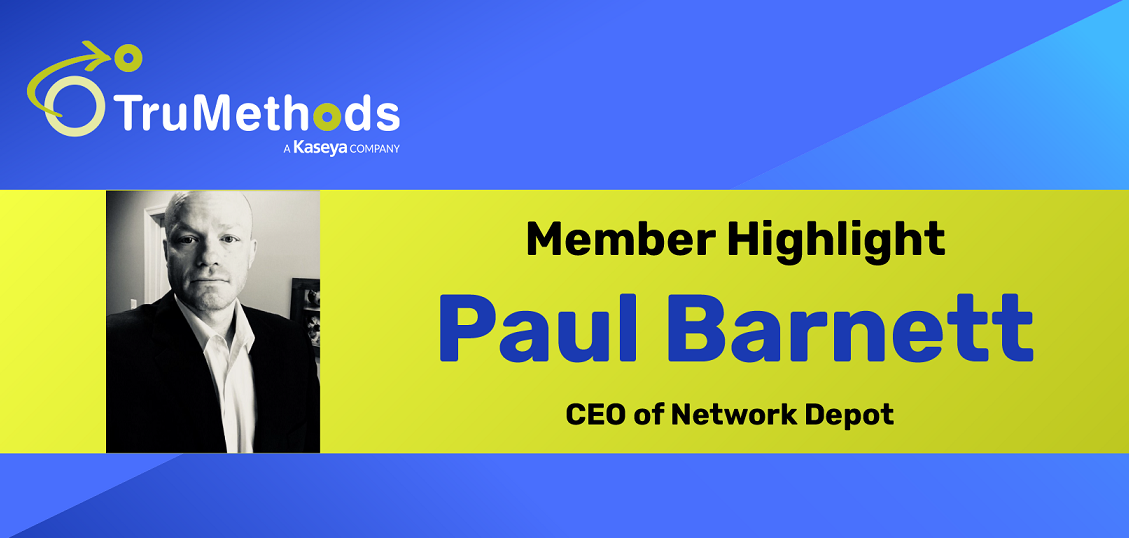
“We had our best year ever through the pandemic,” said Paul Barnett, CEO of Network Depot, a Reston, VA-based MSP and TruMethods member. “We attribute that to continuing to follow the process and sticking to the plan.”

During our one-on-one conversation, Barnett revealed why he believes TruMethods is so valuable, shared his thoughts on the TruMethods methodology, and highlighted his favorite feature of the myITprocess software.

A lightly edited transcript of our conversation follows.

You have been a TruMethods member for quite a few years (since 2010). What is it about TruMethods that you find to be so valuable?

Insight and guidance on the sales process. More specifically, the review process, driving efficiency by tamping down recurring tickets, and selling projects. Also, originating new managed services sales through the inside/outside sales process.

Do you feel that having a Member Success Advisor and having regular check-ins has been impactful?

Yes, they have been very helpful and keep us accountable to the process.

Have you found that the TruMethods methodology has impacted your business through the COVID-19 pandemic?

Staying engaged with our clients has allowed us to sell more projects, moving people to remote work and cloud services, during the pandemic.

What is your favorite feature of the myITprocess software? How has your team been involved in the software?

We use the review templates quite extensively with our clients. It’s part of our account management process to drive project work, and to tamp down reoccurring tickets and driving efficiency.

Request My Demo

Want to Fill Your MSP Standards Library? Try These!

Aligning your customer’s to a set of standards seems easy. You create questions around privacy, security, and infrastructure and ensure they meet business goals. What if you have outdated, too broad, or non-existent standards? What if you need more and are unsure where to look?

If you are looking to begin or build on your standards library, there are good options included with myITprocess. These templates refer to popular industry best practices and frameworks. Even if you need generic, non-compliance standards, the default template is a great place to begin.

myITprocess Default Template

  • Consists of six sections containing 150 questions.
  • Covers core and server infrastructure, security, and backup and disaster recovery.
  • Generic questions that do not conform to a particular framework or regulatory authority.
  • Great for general technology, security, and disaster recovery.

Center for Internet Security Controls 7.1

  • Contains 171 questions within 20 “Controls”.
  • Covers incident response, account monitoring, malware defense, and more.
  • Plain English descriptions and guidance.

Cyber Essentials (UK)

  • Straightforward requirements for security and privacy.
  • Includes incident response, endpoint security, asset management, and more.
  • Sponsored by the UK government, but relevant to anyone.

NIST Privacy Framework 1.0

  • Minimize adverse consequences for individuals’ privacy and society as a whole.
  • Fulfill current compliance obligations and future-proof products and services to meet these obligations.
  • Facilitate communication about privacy practices with stakeholders.
Resources:
www.trumethods.com/myitprocess
https://www.cisecurity.org/controls/
https://www.ncsc.gov.uk/cyberessentials
https://oag.ca.gov/privacy/ccpa

Request My Demo

A Different Take On What It Means To Be ‘Proud’

After we announced IT Glue’s acquisition of TruMethods, many people reached out to congratulate me. (For those of you who did, thank you.) Some even suggested that I must be proud of my accomplishment — launching, growing, and selling yet another company. While I appreciate their thoughts and understand their intentions, I actually have a different take on what it means to be proud.

You see, I have a sense of pride that I feel about my team, our customers, and what I would call “the TruMethods effect in the industry”. However, personally, I’m much more thankful than proud.

I was born a white male in the United States during an era of economic and technological growth. I never had to go to war. I was raised by parents that loved me, supported me, and valued education. Although I didn’t come from money, my dad was a blue-collar worker, this put me in a very favorable starting point, compared to most people on the planet.

I realized that while many others have had the same or a better starting point, they never took advantage of it. It’s true: I’ve worked hard. I feel like I have talents and skills that are unique and I’ve taken risks that others haven’t.

But I can’t help but think that there are many, many people raised in inner cities or less fortunate countries, women, and minorities that are just as smart and determined as I have been, and they simply haven’t had the same opportunities that I’ve had.

So, again, I have some pride, but I’m a lot more thankful.

What I’m most thankful for is that I’ve been able to really have a big chunk of my career on my own terms. I get to pursue goals that I’m passionate about and leverage my unique talents. The best part is that I get to do it with people that I like and admire, including our team members, the vendors and channel partners that we have, and our customers. It makes me look forward to the next phase of my career.

In many ways, that’s what the TruMethods acquisition is about, giving me and my team the opportunity to really think about, pursue, and continue making an impact on entrepreneurs, their teams, and their customers.

What’s New with Our IT Glue Integration in myITprocess

By now, you’ve heard the news: IT Glue, a Kaseya company and the industry standard for automated IT documentation, recently acquired TruMethods. Even though we’ve now officially joined forces, we’ve been working alongside each other for a while now. As a result, there’s some more news to share.

Last year, we announced a myITprocess integration for IT Glue (news that we at TruMethods and our members were thrilled about), and since then, our team, in collaboration with IT Glue’s developers, has enhanced the integration for vCIOs and is ready to officially roll them out to MSPs.

Our goal at TruMethods has always been to help vCIOs be more effective at work, so our decision to partner with IT Glue, late last year, and in the middle of a pandemic, was an easy one for us at TruMethods to make. By collaborating with IT Glue, by allowing myITprocess users to use IT Glue data as part of their reporting, we set out to provide vCIOs with powerful insight into client IT infrastructures that would allow them to better align standards and prevent problems from occurring in the future.

At a high level, the integration with IT Glue provides vCIOs with the additional information they need to create strategic IT roadmaps quickly and efficiently with myITprocess. For instance, the integration assists vCIOs with product lifecycle management (PLM), as vCIOs can now view when operating systems and other solutions are set to expire, and cuts the time it takes a vCIO to prepare for a presentation with a client.

What’s new? We’ve recently deepened the integration with IT Glue by adding the ability to search for configurations in both the review process as well as in the client template. By being able to search for IT Glue integrations in the client template, a vCIO can easily assign assets (configurations, currently) to specific client template questions. These linked items will then be available during quarterly business reviews (QBRs) with your clients.

Together with IT Glue, MSPs have a one-two punch that synchronizes all their IT Glue configurations and assets within myITprocess. In doing so, documentation details are seamlessly updated within myITprocess to accurately guide client quarterly business reviews (QBRs) for vCIOs.

Request My Demo