Q&A: Why Joining an MSP Peer Group Can Help Your Business Grow

If you are looking to take your business to the next level, joining an industry peer group may be your best option. Surrounding yourself with your peers can work wonders when you’re trying to determine what to do next. But without the right framework in place, you and your peers are left looking for direction. That’s why joining a peer group with a tested curriculum is key to your success.

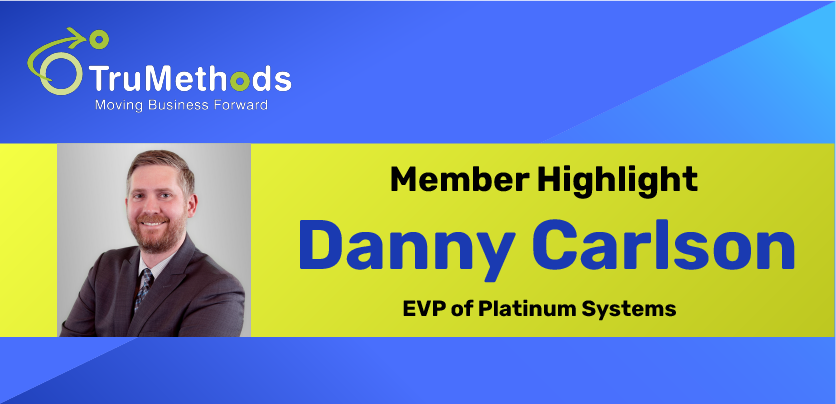
“Many small and medium sized companies do not have a board of directors or stockholders to report to, so the only person keeping you accountable is yourself,” Danny Carlson, EVP of Platinum Systems, a Kenosha, WI-based IT services and managed cloud solutions provider, told me during a conversation we had on why more MSPs should join peer groups. “A peer group can help you fill that role by holding you accountable to your action items and goals while also giving you the responsibility of playing that same for the other members in your group.”

During our conversation, Danny revealed why he decided to join TruMethods’ TruPeer (which offers its members in-person meetings, webinars, educational content, ready-to-deploy documentation and more), stressed the importance of MSPs joining peer groups, and also shared how his business has benefited from TruPeer.

A lightly edited transcript of our conversation follows.

Why did you join the TruPeer accountability peer group?

Our company had recently gone through an acquisition, which brought a lot of change. As a result, I had noticed we were slowly getting away from our core values, processes and standards. When looking at other successful and growing companies, I noticed there was a common trend: They were all a part of a peer organization for their industry. We had been a TruMethods member for many years. We had implemented many of the TruMethods processes; however, we were not keeping ourselves accountable or always following the process. When I heard about TruPeer, I knew we needed to sign up.

What were your expectations when joining the peer group?

We have long believed in the TruMethods process, but for the last 2 years, we have not been fully living it. I was excited at the opportunity to become reengaged and focus on the business rather than the day-to-day busy work. I was looking forward to not only reviewing the areas of the business we already had in alignment, but to work with a peer group on areas we need improvement. I wanted to learn if other companies were having the same issues we were having and what they have done to overcome them. I was also hopeful that some of the areas we have been successful would be beneficial to the group. Finally, I wanted an outside group to help keep us accountable for our goals and tasks so we can start seeing progress made on our ultimate path as a company.

What did you enjoy most about the peer group?

So far, the process of just getting started has been very enjoyable. The group has done a great job helping us identify some key measurables, especially as we are going through the COVID pandemic. The timing of starting in the group could not have worked out any better. Just like many companies going through the pandemic, we have struggled with our 2020 business plan. Being a part of this group has helped us focus as a company on a dynamic 90-day business plan. We have identified new priorities to help us not only protect our existing customers and business, but also to look beyond and be aware of how to take advantage of our current situation to come out of this as a stronger company.

Why do MSPs benefit from peer groups?

It is easy to come up with a goal or to know where you want to be in three years. What is not easy is actually getting there. You can read books, attend webinars, watch training videos all day long, but until you actually start implementing and holding yourself accountable to achieving your goals, you will continue to just operate the way you always have. Being a part of a peer group helps you focus on what is important and the areas of the business that really matter. It allows companies to compare themselves against their peers and see how they stack up.

How are you implementing what you have learned into your business?

The first step we have taken is to set new measurables for each of our departments. This has helped us to put priority and the correct focus on the areas we are looking to improve. It gives our employees a clear target and understanding of how their role is important. In our company wide meeting, we have shared with the entire company our current plan and goals so each employee knows what path we are on and we are all aligned and working towards the same goal. It has helped them understand why their new measurables are important and gets their buy-in to the process.


New call-to-action

Pivoting in Crisis: Improve MSP Meeting Efficiency Today

This is the time to make some operational pivots in your business. While there are several adjustments you can make today to better your tomorrow, evaluating how, why and when you hold meetings can make a world of difference to your business results.

If you find your meetings usually don’t go so well, there are a few ways you can make them more efficient.

Do you have a goal in mind? If not, don’t hold a meeting

Every meeting should have an objective. In other words, what are you looking to achieve during the meeting? What’s the meeting’s goal? What are you hoping to accomplish? If you don’t have an objective clearly defined, a meeting probably isn’t necessary. There’s a finite amount of time in the day. In business and life, time is your most valuable commodity. Meetings take time away from you and your employees. When employees are stuck in meetings, they’re not servicing customers.

What’s on the agenda?

Ever been in a meeting where people were going in different directions and off on tangents? If I had to take a guess, there probably wasn’t an agenda to keep everybody on track. Without structure, people tend to do their own thing. They talk about what they want to talk about and focus on what matters most to them. That’s why having an agenda is so integral to running an effective meeting.

You’re not going to accomplish anything meaningful or be productive if your meeting doesn’t have a direction. A meeting without an agenda serves no real business purpose. You might as well huddle around the watercooler and talk with your employees about whatever comes to mind instead. If you’re holding a meeting, develop an agenda ahead of time to ensure everyone participating stays on track.

How often should you meet?

Figure out your meeting cadence as soon as possible. Simply put, determine the frequency of your meetings. Your meeting cadence may take some time getting used to and you may need to adjust accordingly (especially in the beginning), but after a while, you and your team will get into a nice rhythm. The right meeting cadence will increase not only participation but also engagement.

You don’t need to invite everyone to the “party”

Meetings are designed to advance business initiatives in one way or another; they’re not social gatherings. Before sending invites for a meeting, review your meeting’s agenda and objective. Only invite employees who you think can provide value to the discussion you’re expecting to have during your meeting. When it comes to meeting attendance, the truth is this: Sometimes less is more.

How are you holding people accountable?

If you’re running meetings correctly, each one will have action items to complete afterward. Keep record of who’s accountable for executing them, then follow up on progress the following meeting. If those responsible didn’t do what was asked of them, find out if they need help. By holding meeting participants accountable, you’re ensuring your meetings aren’t wasting everyone’s time.

Running efficient and productive meetings isn’t easy, but the sooner you implement the changes above, the better off you and your MSP business will be on the other side of the COVID-19 pandemic.

New call-to-action

Wanted: Trustworthy Guidance from a Security Professional

In the wake of the COVID-19 pandemic, companies are facing the dual challenges of supporting employees working from home while absorbing the fallout from the associated economic downturn. Although economies are slowly re-opening around the world, it’s unclear just how long it will take to get back to where it was before the shutdown.

Work-from-home is going to be a reality for many through the end of summer, and possibly the end of the year. Security will remain a critical challenge as companies struggle to ensure data safety in a distributed computing environment, while keeping a handle on budgets.

A recent Barracuda survey found that many companies are struggling to fund data protection and security, while also maintaining their workforce. More than half of respondents would consider making workforce reductions to support security adequately, but 40 percent have already cut their cybersecurity budgets as a cost-saving measure during the pandemic.

For MSPs, this means demand for managed security services is likely to increase. The global managed security services market is expected to grow from $31 billion in 2020 to more than $46 billion by 2025.

Those market dynamics are also reflected in the annual Evolving Landscape of the MSP Business report (developed by Barracuda), which found that 91 percent of partners were planning to increase their services capacity this year, and 69 percent cited managed services as the most significant opportunity for increasing sales.

The survey also found that 88 percent of partners believed demand for security services was set to increase over the next 12 months. A total of 79 percent felt customer security concerns were an excellent opportunity, particularly with the rise of remote work, and 72 percent said their client’s lack of in-house security resources was also creating new revenue opportunities.

According to the report:

“Security has bubbled to the top of many end users’ OpEx lists over recent years, mainly because of the increasingly complex nature of threats facing the average business ranging from ransomware to phishing attacks. Coupled with the fact that firms have been slowly moving towards a more fragmented and remote workforce over recent years, this shift towards security-based services will just continue to ramp up because of the number of companies forced to change their working practices almost overnight. Many should be operating on a ‘zero-trust’ basis, not only because it’s the best way to protect against cybercriminals and human error, but it’s also an opportunity for the service partner to offer a range of solutions and services to protect customers.”

Trust Drives Managed Security Business

How can MSPs take advantage of these emerging opportunities? In the Evolving Landscape of the MSP Business report, endpoint security, email security, and network security made it into the top five spots this year (only email security ranked that high last year).

A more significant asset, however, is trust with your clients. The survey found that 52 percent of respondents felt that trust had increased slightly between suppliers and their customers.

According to the report, “End users expect their IT service provider to act as a trusted advisor, and to guide them along the right path. This means offering advice and selling technology and services that benefit the end users, not just generating extra profit for the service provider.”

End users are more vulnerable than ever, so MSPs that have gained their clients’ trust and can provide the right mix of security services will have an edge. Clients need to have faith in the solutions and services you’re offering as well as your employees providing and managing the solutions and services.

To gain a foothold in this rapidly growing security market, MSPs need to regularly communicate with their clients to ensure their solutions are up to date, and to gauge whether all of their security needs are being met. If you’re already providing backup and disaster recovery (BDR) services, security is the next logical step in extending your client relationships. It’s not just good for your business, but it’s also critical for your customers. MSPs will find that a robust security offering will save them endless headaches on the BDR side as well because there will be fewer breaches and lost data.

End users were already struggling with security issues due to a lack of skilled workers and increasing overhead costs of maintaining their cybersecurity products. Current conditions have only made things more challenging. MSPs that have established themselves as trusted advisors can help themselves and their clients by providing the managed security support these companies need to survive in an uncertain economy while cyber threats continue to multiply.

Michael Mowder is the Senior Director of Global Partner Success for Barracuda MSP, a provider of security and data protection solutions for managed services providers, where he is responsible for the partner journey from on-boarding, to implementation, through professional services and finally, renewal.

cybersecurity ebook

MSP Leadership: The Magic of Expectations

What determines our expectations in life and business is very complex. Some of it is based on what we’ve experienced. We then turn our experiences into laws and allow them to govern our decisions and behaviors. And often, there’s a wide gap between these laws and reality.

One common example of this for MSPs is price. I think I’ve spoken with more than 1,000 MSP business leaders over the years who’ve told me they could never command prices I knew already existed in their markets. According to them, based on their experiences, which were purely anecdotal, it just wasn’t possible. Now, of course, this is just a small example, but here’s the thing: Until expectations change, results can’t change.

The bigger issue is what we see in business and life over time. Here’s where it gets even more complicated. I’ve learned that we don’t just develop expectations from our businesses, careers or experiences. Expectations are tied to self-image, which we usually develop somewhat during childhood and throughout life. Some of this is also how we’re wired. When you think about it, these are very difficult obstacles to overcome for many of us.

In his book “The Big Leap,” Gay Hendricks calls this the “upper limit problem.” We all have a level of success, money or love that we think we deserve. When we reach those levels, we find a way to blow something up. For example, you start making progress in your business and then you lose your biggest customer or tech. It seems like there’s always a new obstacle out of your control.

This is very hard to recognize in life. I’ve watched this play out with some people time and time again for more than a decade. I tend to call this the “banana peels syndrome.” Just when things start to go well, you slip on a banana peel.

So how do we raise our upper limits, increase our expectations and recognize what’s possible in our lives instead of being restricted by our self-limiting beliefs?

In my opinion, it first takes awareness that this plays out in all our lives and then a dedication to learning the process of continually raising expectations. Setting goals, joining peer groups, reading, listening, watching everything you can about self-improvement and self-acceptance is a great start.

I believe that choosing who you spend time around is also very important. I see some business people that have team members who have been with them for a long time but are negative and self-defeating. These business leaders get stuck because of a misplaced sense of loyalty or they are worried that something bad will happen if they let that person go. I’ve got some good news for you: Nobody has ever gone out of business because they parted ways with someone who was holding them back.

Now, it’s a given that some people must work even harder to overcome their upper limits. Some people have had success with therapy or meditation. But when you’re passionate and enthusiastic about pushing your upper limits and overcoming your self-limiting beliefs, you’ll reach your full potential.

New call-to-action

Is Now The Right Time for MSPs to Sell to Prospects? You Bet It Is

Many MSPs are having a tough time selling in the current climate. They fear they are being insensitive by reaching out to businesses during these unprecedented times. Here’s the thing, it’s simply not true.

Now is the time businesses need you the most. If you reach out to your customers and leads correctly, when this crisis is over, your sales pipeline will grow significantly.

There are several reasons why you should continue to sell during the COVID-19 epidemic.

Decision makers are now more accessible than ever before

With mostly everyone in the country on lockdown, decision makers are chained to their desks. They’re not traveling or leaving the office for sales calls. They are more than likely sitting at home, answering calls, video conferencing with their employees and counting down the days until they are able to return to their offices. Now, more than ever, is the time to pick up the phone to call leads in your sales pipeline. The decision makers you’ve been wanting to talk with are now at the other end of the line. Use this opportunity to get to know them and have meaningful and valuable conversations.

Have the right conversations

You have to be able to adapt to the situation at hand. Even though decision makers are more accessible than ever before, they won’t have just any conversation with you. You must communicate to them how you can assist them with their current issues. In other words, what are their pain points? How can you help them with the challenges they’re facing in their businesses currently? Despite how you may feel, you are not being insensitive by reaching out to prospects during this crisis.

You’re not coming across as insensitive if you’re genuinely concerned
There’s nothing wrong with checking in on leads to see how they’re doing during these uncertain times. In fact, many of them will thank you for reaching out. Some of them may even take you up on what you’re offering. Your goal for these conversations should be to not only help, but educate your leads. Remember the following: You’re there for them. You’re lending a helping hand. When you position yourself as someone who can help, decision makers are more likely to respond positively to your calls. When reaching out to leads, you should have a strategy in place — not all leads are equal.

Which leads should you start with?

Begin reaching out to the leads at the bottom of your sales funnel. You’ve worked so hard to get them there, so start with them. Work your way up to the top and contact everybody in your pipeline who has passed on your services at some point. These leads may change their minds now. Now is the time to educate prospects on how they can properly navigate today’s choppy waters. By educating instead of selling, you put yourself in a better position to close more sales once we get past this crisis, which we will. This isn’t the time for the ‘hard sell’. Now is the time to check in with prospects to see how they are doing and provide valuable services to make their business more successful.

You’re not doing anything wrong by selling during the COVID-19 pandemic. Change your messaging up, be genuine, and by the end of this crisis, you’ll be in a great spot to convert your leads to customers.

MSP Sales Mistakes

Creating a Culture of Innovation in your MSP

Change drives innovations. With all of the recent changes brought on by COVID-19, it’s time for your MSP to innovate.

Innovation at its core is fairly simple to understand: It’s the creation, development and implementation of a new product, process or service, with the aim of improving efficiency, effectiveness or competitive advantage. But the challenging part of innovation is discovering how to use innovation effectively and efficiently to grow your business — and that’s where MSPs need guidance.

There are several ways you can become an innovative MSP.

Join a peer group

It’s difficult to innovate when you’re trying to do it alone. Joining a peer group is a great way for you to find ways to innovate and grow your business. Your peers can help you with moving your business in a new direction if you simply take the time to listen to them. It’s a lot easier to innovate when you can bounce ideas off other people operating under the same conditions and limitations as you. While I may be a little biased, I recommend you look into TruMethods’ TruPeer, which combines strategic training with support. Learn how to work smarter, not harder by joining a peer group in our industry.

Build an innovation team

Encourage employees to offer ways to innovate your business. Your team can bring an understanding of how to innovate from an operational perspective. Remember: They’re following the processes you put in place for them, so you’re probably too close to your operations to recognize its faults. If there’s an operational issue, your employees can probably not only identify it but also correct it for you, so be open-minded to all.

Show your employees you’re serious by building an innovation team. This team should include employees from all departments. By doing this, you open up new possibilities across your organization. Sometimes someone from one department knows how to innovate another department. This also helps you with avoiding tribalism within your organization. Ideas can come from anywhere.

Listen to your customers

Build strategic relationships with your customers. Listen to what your customers are telling you. They will always point you in the right direction. Take the time to understand their goals. When you do, you can get a better sense of where to invest money in your business for innovation.

Profitability and command

You have a greater chance of innovating when you know your business metrics. It’s hard to innovate when you don’t have command over your business. If you don’t know your numbers, you won’t be able to make decisions when ideas are brought to you or come up during team meetings. You must know your business inside and out if you want to fully understand where you can take it in the future.

To be an innovative company, you must encourage innovation at all levels of your organization. When you create a culture of innovation, you give your organization the power to become innovative.

New call-to-action

Your MSP’s Customers Are Getting Upgraded

While MSPs have always focused on customer satisfaction, the COVID-19 crisis is changing the way MSPs are evaluating the services they’re delivering.

MSPs traditionally evaluate delivery performance by reviewing various metrics, including customer satisfaction (CSAT) scores, help desk metrics, etc.

But the COVID-19 crisis is forcing MSPs to reassess how they’ve been measuring their efforts with clients.

Here’s the thing: You need more information now than ever before from your customers to make better business decisions.

You must understand how changes made to their businesses during the coronavirus pandemic will impact your MRR, accounts receivable, cash and backlog. You must know what their unwinding and recovery processes will look like (when business plans change, so do technology roadmaps).

After finding out these answers, you can then develop a new strategic roadmap for each one of your customers. Every plan should reflect the client’s business and technology needs now and for the remainder of the year.

As an MSP, you must focus on metrics, process and accountability if you want to take your client relationships to another level moving forward in a post-COVID-19 world.

Ask yourself this question: “Do I have a process for building and maintaining business relationships with my customers?”

If so, consider the following:

  • What metrics do you use to be sure?
  • Do you have activity measurements (e.g., strategy meetings held, recommendations made) or result metrics (e.g., recommendations accepted, MRR generated)?

Do you have weekly vCIO meetings to review progress towards goals, weekly activity and results? If so, think about the following:

  • What did you learn about their businesses?
  • What recommendations did you make?
  • What was accepted?
  • What was not accepted?

Then, what meetings are upcoming this week? Determine the answers for the following questions:

  • What information will you still need to get about the changing aspects of a customer’s business?
  • What recommendations will you make and why?

This is the level of discipline you need. If you’re not there today, you must get there.

In the coming weeks, I’ll ask you to raise your game around profitability as well as security.

Are you beginning to see a theme here?

The level of business command that worked before is not sufficient now.

Look at this crisis as an opportunity to grow and fulfill your potential. I want you to be motivated by the opportunity to grow in ways that you may have wanted to in the past, but now need to.

New call-to-action

Eliminate Tribal Knowledge in Your MSP

For those not familiar with the age-old classic of ‘whisper down the lane’, here is a refresher. Whisper down the lane is a game when someone whispers a phrase into someone’s ear and their job is to whisper it to someone else who then whispers it to someone else and so on. The more people there are the greater the chances of the message becoming altered during transmission. It’s a fun game that makes people laugh for hours—or days—depending on your sense of humor. Information passed down between generations is referred to as Tribal Knowledge; someone did something one way, then passed it on.

How does this relate to standards? Building standards around industry frameworks and best practices are essential to your customer’s technical alignment. Best practices are often provided by an authoritative or regulatory body, a vendor, or a third party. When a technician acquires them for the first time they naturally pass their knowledge along to the next person. Herein lies the problem.

When knowledge is transferred from one person to the next it is often altered—intentionally or unintentionally—causing the next in line to follow what was passed along to them. Eventually, the next person shares their knowledge with further alterations. Sometimes, these alterations are based on personal experience or opinion and will affect the outcome. An example of this is a family recipe that is passed down between generations. Every so often the recipe is altered due to available ingredients, improvements, or personal taste.

Best practices ultimately become fairy tales because they are so diluted from the actual account, making it vital to maintain a written Standards Library. I have personal experience with this type of situation. I worked with a technician who wanted to make sure a server I was ordering for a customer had a NIC with 4 Ethernet ports since the server was to be a Hyper-V host. Here is how the conversation went:

Technician: Be sure to order a 4 port NIC with that server.

Me: Why is that?

Technician: Because we need to assign each port to an individual virtual machine.

Me: Why is that?

Technician: Microsoft recommends it as a best practice.

Me: Did you read this or did someone tell you?

Technician: Someone told me it’s what is best.

It may be a Microsoft best practice, but it is a prime example of why not to transfer knowledge verbally. When it comes to standards, ensure you are referencing best practices provided by an authoritative or regulatory body, a vendor, or a third-party source. And write them down!

Request My Demo

QBR Meetings: Are Your MSP’s Customers Not Participating?

If your customers aren’t looking forward to participating in quarterly business review (QBR) meetings, you need to rethink your approach.

Your customers should want to sit down with you regularly to evaluate their business needs and learn how you can improve business performance by uncovering technical risk and implementing a process of technical standards and alignment reviews. When they’re not interested in what you have to say, there’s a disconnect somewhere, and it must be fixed immediately.

Think of it this way: You hold strategy meetings with your customers for them, not you. That means the content you deliver during these sessions should be packaged with value. Determine the information your customers would find useful and deliver it in a language they can understand. Focus more on educating them on how technology can be used to make better business decisions.

Basically, keep things simple. The information you deliver during strategy meetings shouldn’t be overcomplicated or too technical in nature. When you communicate your points clearly and concisely, and consider the specific needs of your customers, you’ll prove your worth by consistently delivering significant value. That’s how you get your customers to think of you differently.

Instead of telling customers how well they’re performing, use your QBR meetings to show them. Highlight how your strategic roadmaps have improved business productivity and efficiency. During QBR meetings, refrain from going overboard. Review metrics with your customers, but don’t get too far into the weeds.

What your customers want to hear is how you’ve been going beyond technology by understanding their business needs, providing recommendations based on those needs and delivering tangible results. That’s what separates you from your competitors and elevates you to the role of a strategic advisor, someone who can make the connection between customer technology and business goals (consider productivity, business risk and opportunity costs when reviewing business impact).

If you can’t have a face-to-face QBR meeting with a customer, don’t be discouraged; there are alternatives. Even though in-person QBR meetings are ideal, they’re not always possible, especially during the COVID-19 crisis, so try switching things up by hosting a virtual session with a customer. Many TruMethods members are having success with virtual QBR meetings.

When customers don’t want to meet with you for QBR meetings, there’s usually something you can do on your end to change their view. Review what you are doing to determine how you can deliver meetings of value to your customers. If you’re able to provide strategic insight, your customers will change their tone.

Request My Demo

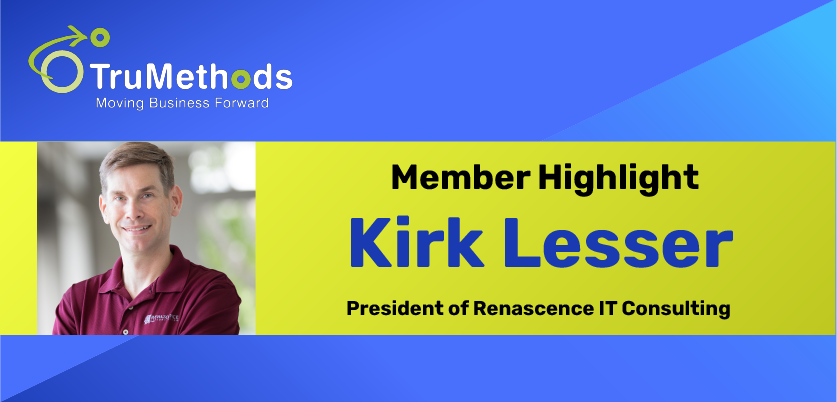
A Conversation with Kirk Lesser, President of Renascence IT Consulting

Nobody planned for the COVID-19 pandemic. While MSP owners didn’t get the chance to proactively prepare for the crisis itself, some are in better shape right now than others. Why is this the case? Those who are seeing success during these challenging times began implementing solid frameworks long before the COVID-19 outbreak.

“I was struggling with metrics and being hit with reactive work,” said Kirk Lesser, founder and president of Renascence IT Consulting, when discussing his business challenges before having adopted the TruMethods framework. “I felt like I was the same as every other provider out here in the Bay Area and knew there had to be answers out there somewhere.”

He briefly examined the TruMethods framework in 2014 but didn’t act — at least not immediately. “It was in 2016 when I was up to nine people and buried in tickets that I decided to see if TruMethods could help,” Lesser said. Today, he’s operating his business with only six employees but has more clients in his portfolio than he did in 2016. He now also has a better grasp of his company’s key performance metrics.

As is the case for many of our members, his transformation didn’t happen instantly; it took some time. “It is not a quick change, but I like to say, it is like turning a cargo ship — you take it slowly,” he said.

Even though Kirk has been busy during this period of uncertainty, he found the time to provide his thoughts on how the industry has evolved, what he’s taken away from myITprocess and give his perspective on where the MSP space is heading.

What follows is a lightly edited transcript of our conversation.

How have you seen the industry evolve over the past 20 years? 

This is the age of cloud-based services and approaches. I have employees in other states doing my service desk and automation, and that would not have been possible 10-12 years ago. MSPs need to always keep an eye on what they are doing and what they could be doing better.

What has your biggest takeaway been from the TruMethods framework?

Know your business metrics. It’s essential to know them right now. When you know your business metrics, you can make adjustments, increase pricing and plan for your future.

How have you used myITprocess to improve your service delivery?

I’ve been able to create more transparent and honest relationships with my clients by showing them where they can decrease risk or increase productivity, and letting them make the business decision of accepting that risk or making the change. It’s easier to have that conversation than trying to shove hardware down their throats. They appreciate our talks on a quarterly basis and having a give and take that goes beyond just a checklist of old hardware and being a Captain Obvious.

What’s the future of the MSP space?

More remote- and cloud-based. Having better security tools that are not dealing with a perimeter of an office. SD-WAN, socially engineering tests, and backing up cloud (and on-prem services) will continue to evolve as more people move (and stay) in the remote workforce. I also see being more of a resource to COI relationships, especially with cyber liability insurance becoming a necessity.

Request My Demo