
It’s Selling Season, And It May Be Your MSP’s Most Successful One Yet!

If youve been around TruMethods for more than a yearyou know what time of year it is: It’s selling season. 

Selling season is the time between September and the end of the year when the conditions are especially good for adding new MRR at the right priceBusiness leaders during this period are evaluating people, reviewing processes, and assessing  vendors to ensure they finish the remainder of the year strong and prepare  accordingly for the following one.

We’ve watched many of you achieve your sales goal this year during a pandemic. But there’s something special about the psychology of this time of yearas business leaders turn their attention to the end of the year and start thinking about 2021. 

Decision makers are more open to consider change. They’re ready to make decisions.Ive seen the impact of selling season over the last several decades. I believe that COVID will exaggerate the effect of this year’s selling season.Every SMB has a new business plan. All decision makers are more open to talking and listening. They’re also more available. We have great wedges with security and collaboration.Our messaging around the Technology SuccessProcess is resonating even more because of all these changes.

New customers at the right price are the lifeblood of any profitable and thrivingMSP. When I owned my MSP, I had a selfinstruction card that I read at the start of each day. And it went like this: “Every day, I stay focused on finding new customers. I don’t let busy work get in my way. Success is too important.

If you had a good year in sales, this is the time to make it great. If you’ve struggled,  there’s still time to make your goals!

Let’s do it. It’s go time! Go time means that you must do something different to increase time, attention, activity and accountability around new logo sales. If you don’t have a plan and daily and weekly activities, then start now. If you have a plan, look at it again and be sure that it’s dialed in.

Remember this: 2021 doesn’t know when yousold the MRR. Q4 MRR may not have a big impact on 2020 revenue, but it has a full impact on 2021.

Now is the time to actMake this selling season your best one yet!
MSP Sales Mistakes

MSP Compliance is a Turbo Rocket Sled to Technology Alignment

I recently wrote a blog post titled “Why Regulations are a Good Thing for Technology Service Providers“. The concept was simple: regulations and compliance benefit Technology Services Providers. Customers providing products and services within their industry usually have compliance requirements like protecting credit card information. Most business owners are not trained or prefer not to deal with these obligations and rely on third-party vendors. I wanted to revisit this topic now that the business environment has changed overnight.

When businesses sneer at compliance and regulations, this is an MSP opportunity. The COVID-19 pandemic altered our business environment and threat actors are taking advantage of security flaws. Financial records, health information, and personally identifiable information are vulnerable while businesses attempt to solve problems with personnel and loss of revenue. As our President, Gary Pica says in every webinar, “the environment has changed and will not return to normal.” Within this new—and constantly changing—environment, we can continue to look for opportunities that benefit our customers.

How does compliance benefit you and the customer?

  • Compliance requires extra effort and those costs can be rolled into your All In Seat Price (AISP). Rolling the maintenance cost of a compliance program into an AISP prevents the addition of other monthly fees and retains a single price per seat.
  • Compliance objectives have additional requirements for security and privacy. For a standard business, those safeguards are most likely not in place and require separate implementation. These projects add to and provide Non-recurring Revenue (NRR) opportunities.
  • The addition of a compliance strategy is added to the customer’s strategic roadmap. A vCIO can add recommendations and initiatives centered around compliance and cybersecurity programs. Doing so leverages the need for products, services, policies, and procedures that meet and retain compliance status.
  • It is always a topic of conversation. Modern business practices likely fall under regulation, compliance, or statutory law and these topics are good to keep in mind when having discussions with a decision-maker. Some decision-makers are not up to speed on the latest requirements and informing them regularly has its benefits.

The message isn’t to “prey on the weak” or take advantage of a customer while they are down; it is to perform the heavy lifting while they concentrate on the day to day. After all, one purpose of an MSP is to remove the burden of Information Technology from the customer.

The pandemic changed how we work and how we support those who require help with their technology. Now is the time to adapt and accept the new normal for Technology Success.

Request My Demo

Are You Fulfilling The Essence of Your MSP Role?

Are you really doing everything in the scope of your position for your MSP’s customer? In the TAM and vCIO roles in particular, doing every facet of the role is incredibly important for the TruMethods model to work as well as it can.  Luckily, what each of these roles do can easily fit on one graphic representation.

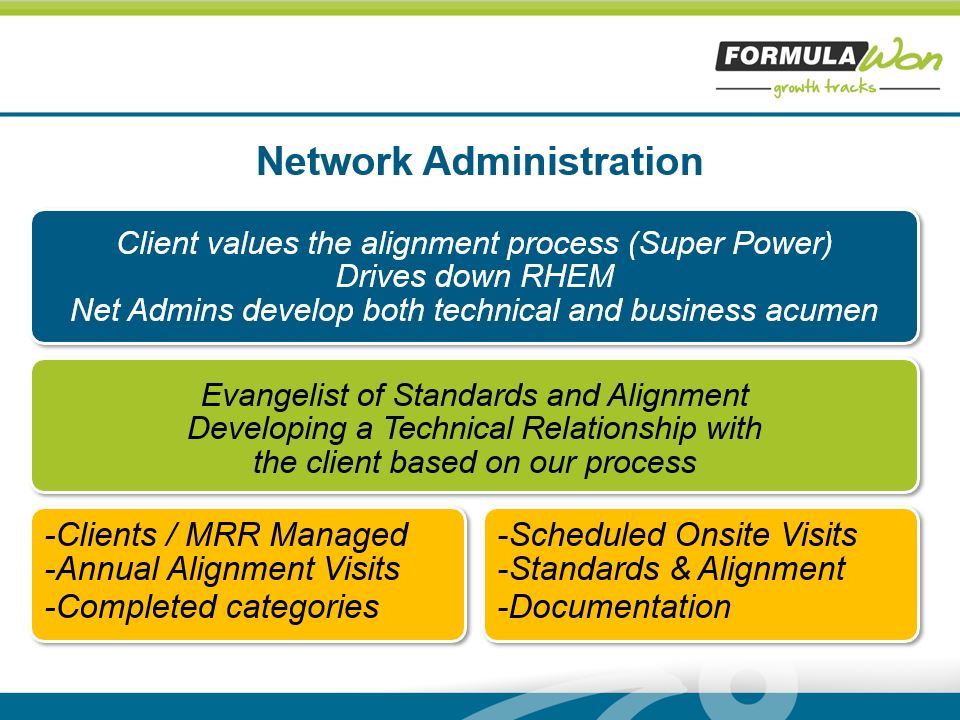
network administration

Let’s take a look at the TAM slide (which used to be called the Network Administration role). The top blue box describes the impact the role should have on the client, the business, and the impact the role has on the person fulfilling it.  The Technology Alignmeny Manager fosters the value of the alignment process, brings down RHEM, and they themselves learn both technical and business communication skills over time. Is this something you’re always doing? Are you letting your clients direct you to reactive work while doing your TAM visit? Are you always learning more about your client’s business and the tech world? Are you always focused on bringing down RHEM?

The green box is the essence of the TAM role; how what they do ties to the core of what Technology Success really is.  This is also the spirit of the role. Do you love standards and alignment? Do you tell your clients about how important standards and alignment are? And while it may seem like you are only there to gather information, you really are the front line in starting and maintaining a technical relationship with your clients.  Do you talk to them like this is part of your job?

Finally, the yellow boxes below discuss the metrics (left) and processes (right) involved with this role. Are you hitting your numerical goals? Do you have all of your visits scheduled out for the next year? What does your documentation look like? Have you been working with the standards committee to make sure we are checking standards on a good cadence?

The TAM role is only one of the main pieces of the Technology Success Process.  The vCIO role is incredibly important to Technology Success and how (and if) your client values an MSP’s services the way they should. How are you doing with the vCIO role? Let’s take a look at the slide:

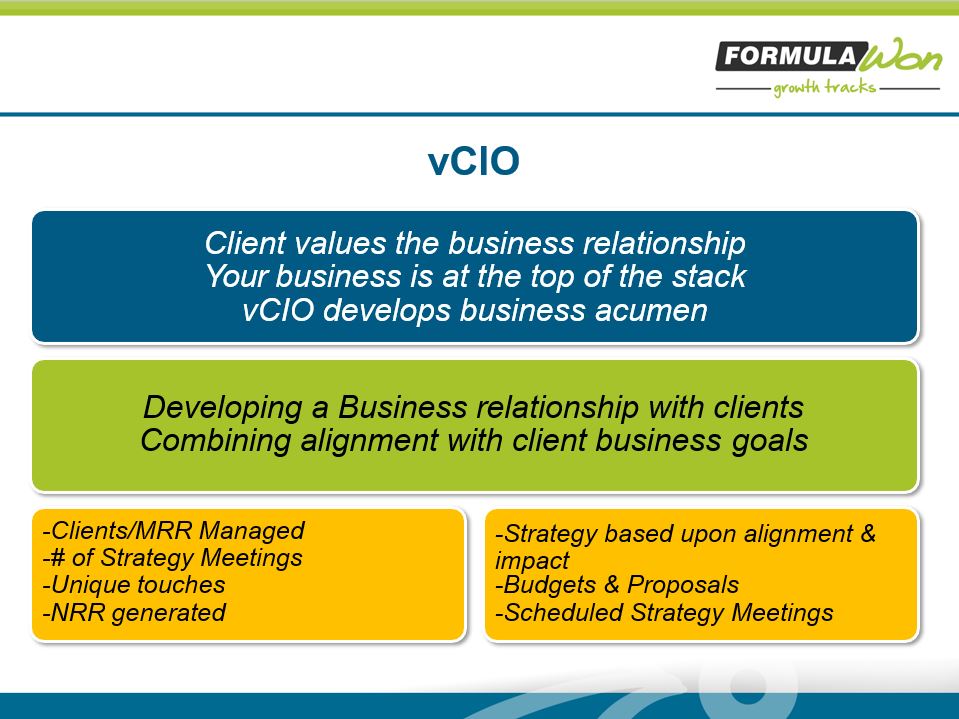
vcio role

The vCIO has a huge impact on the business and the clients you work with.  They are the main inflection point of the Strategic Business relationship that every MSP should have with each of their clients.  Is this what is actually happening? Are you doing VCO things (Virtual Captain Obvious) instead of vCIO?

The Essence of the vCIO role is to really develop that business value-added relationship.  How does your client see you? Do you get a seat at the table with their landscapers and building cleaner, or a seat at the table with their accountant and their lawyer? Are they saying ‘yes’ to most of your recommendations? Do clients see the connection between the technical data the TAM has collected and your recommendations?

Finally, there is a strong cadence needed for an effective vCIO.  How many clients are being managed? While there should not be a hard and fast number for a vCIO to meet, how much NRR is being generated? Is every client having a Strategic meeting when they need to, or are other things getting in the way?  Are scheduled meetings being kept and attended?

While there are a lot of facets to being a successful MSP, we find that a focus on Technology Success (the TAM and vCIO roles, to not put too fine a point on it) leads to success for all of our TruMethods members.  Once noise is controlled and the client has a business relationship with your company, everything else seems easier.  As customers continue to evaluate their vendor relationships and rely more heavily than ever on their technology needs, it is critically important to evaluate these roles on a regular basis to ensure sustained success.

Request My Demo

Staying Disciplined In Your MSP: Do You Have What It Takes?

The most successful people in life and business are certainly disciplined. Discipline is what keeps you on track, leads you to success, and helps you focus on achieving the goals, aspirations and milestones you set for yourself throughout your life. But not everybody has what it takes to build self-discipline — it’s a struggle for many.

No matter what people try to tell you, self-discipline is a learned behavior. It absolutely takes time and dedication to develop. But after you build it, life almost always changes for the better.  As Teddy Roosevelt said, “With self-discipline, most anything is possible.”

So many good entrepreneurs fail because they’re not disciplined in life and business. That’s the unfortunate truth. While these entrepreneurs are capable of acquiring and sharing knowledge, they’re usually unable to fully execute on what they learn from the countless number of books they read, podcasts they listen to and webinars they watch. Some of these entrepreneurs undoubtedly suffer from what’s widely known as analysis paralysis, but many others simply are incapable of implementing systems designed to keep them on track and focused on what matters.

The underlying culprit? You guessed it: It’s almost always discipline.

One area where discipline is of the utmost importance is goal setting. Without discipline, hitting milestones in your life and business is nearly impossible. Often, you’re going to run into problems if you’re not disciplined enough to execute your plans.

There are two main types of goals: long-term goals and short-term goals. While many people immediately think about long-term goals when setting goals, achievable short-term goals are just as important. Without short-term goals, you’re simply dreaming.

But it’s important to remember this: It doesn’t matter how small or big your personal and professional goals are. If you’re not disciplined, the likelihood of you achieving them is slim to none.

So, how do you build self-discipline to excel in life and business?

Even though it’s a lot easier said than done, begin by focusing on yourself by assessing where you can improve as an individual. Remember: Self-discipline is not only a skill, but a mindset. You’re the one who must commit to changing. It takes time to discover how you can gain self-discipline.

Sometimes focusing on the fundamentals is necessary. For example, self-discipline is difficult to maintain in the long term if you’re not healthy. Are you maintaining a healthy diet and getting enough sleep? What are you doing to stay physically fit?

Then, move on to your temptations. Is Facebook, Twitter or other social media platforms distracting you from what you need to accomplish throughout your day? Limit your access to them and turn your attention to what matters.

Identify your shortcomings and commit to overcoming them. Are there classes you can take? What about webinars? Order books or listen to audiobooks when you’re on your way to work or seeing a client. You can’t have self-discipline without self-improvement.

Self-discipline takes lots of time and dedication to build, but once you’ve developed it, the opportunities are endless.

Become A Top Performing MSP: Learn How To Provide Profitable IT Solutions And Become World Class

MSP Sales: ‘No’ is the Sweetest Sound You’ll Ever Hear

An initial meeting with a prospect doesn’t have to be unpredictable.(In fact, it shouldn’t be.)The process of “setting the stageduring the initial conversation with a prospectincreases the likelihood of you being able to control the discussion from the onset, includinggetting the prospect to tell you no, which, believe it or not, isn’t necessarily always a bad thing.

Most people avoid saying no when talking to asalesperson. You avoid it. Prospects avoid it. Everyone avoids it. It’s natural for us to avoid conflict by staying positive. Plus, we don’t want to get stuck listening to a salesperson trying to overcome our objections.

However, you’re better off getting a “no than a “let me think about it.”The former is definitive while the latter is more of an openended response.

When a prospect gives you an open-ended answer, you’re no longer in control of the conversation. It usually means you’re going to be left wishing and hoping.

I can’t tell you how many times I’ve heard people tell me, “The meeting went well. They took a liking to us.” While it’s great you made friends, don’t expect them to call you for a contract to sign anywhere in the near future. It’s not likely going to happen.

When setting the stage with a new prospect, your goal should be to create an environment where the prospect is comfortable with saying no. “No” isn’t the problem in sales. It never has been, and it never will be. “No” is actually the sweetest sound you’ll ever hear.

A clear answer is what you should strive for during an initial meeting with a prospect. Setting the stage helps you accomplish this, but it requires you to do a few things first.

First, avoid coming off as a salesperson.Define the business relationship upfront by acting as a businessperson, not a salesperson. As I’ve said in the past, nobody likes to be sold to.

Next, review the agenda and reinforce your expectationswith the prospect. For example, thank the prospect again for taking the meeting and if you said the meeting would only take 30 minutes, reiterate that point. This puts you in control right off the bat. 

Then, discuss possible outcomes with the prospectThe key to setting the stage is to explain that there are only two possibleoutcomes to the meeting. The first is that there is no reason to speakany further at this time. The second is that they have an interest in learningmore and you’ll schedule a next step that you control.Let them know that if there is no reason to speak further, they should be comfortable telling you no.

You do all this to take the pressure out of the situation and keep yourself in control. The further along in the discussion you go, the harder it will be for you to stay in control. By setting the stage, you set the boundaries and the rules.

You’re going to fail from time to time. Expect it. Embrace it. But don’t look at a “no” as a missed opportunity. When someone tells you no, you’ve been given the go-ahead to explore what else is out there. Take advantage of it.

MSP Sales Mistakes

Is Your MSP Using FUD or Being a Fearmonger? There’s a Difference

When it comes to MSP sales, who doesn’t like a little FUD?

Many sales methodologies were founded in FUD (fear, uncertainty and doubt). Certainly, selling IT services today offers a big opportunity for MSPs and their vendors to create fear, uncertainty and doubt.

Now more than ever, MSPs rely on using cybersecurity as the “F” in FUD. Channel vendors that sell security tools and services want MSPs to use their solutions, and, in some cases, scare prospects into buying those products by running scans and audits that produce thick reports highlighting technical risk in IT environments. But this tactic can oftentimes go beyond FUD to fearmongering.

Now, if you’re using this approach, and it’s working for you, stay with it. But let me be clear on this: When I say working, I mean you’re actually having the result of new customers buying at the right price. More often what I see is customers and prospects pushing back on the relevance of the details or getting overwhelmed and becoming paralyzed.

I’m not saying that audits, scans and reviews are bad. I mean, I personally have invested a few dollars in the building of a little-known MSP tool called myITprocess, which is based entirely on the process of technical review. So, believe me, I’m a fan.

All I’m suggesting is that all business leaders need you to do is simply distill down technical assessments into usable data. What are the gaps? What risks do these vulnerabilities create? What’s a reasonable plan to reduce risk to some reasonable level?

Decision-makers can’t get there from a 10-page technical report. In fact, if they can understand a technical report, it’s more than likely you’re dealing with the wrong person.

So, think of it like this: Technical alignment or compliance data audits is only one piece of the process. The threat landscape is the second piece and understanding your customer’s business is the third.

Explain the changing security or threat landscape to your customer. Use stories and examples. Explain how hackers are maturing their business models and processes, then relate any gaps in a prospect’s environment or enhancements in your approach to their business. Finally, use the investment — whether it’s a one-time or monthly payment — to close the gap and remove that risk.

Too often MSPs run into a situation where a customer is taken aback by a risk assessment. “I thought you were taking care of everything!” is a common response. When this occurs, simply explain that you were, but over time, the threat landscape changes, and when it does, updates are necessary.

My point is you can have meaningful business conversations, build closer relationships with decision makers and move customers to action without using scare tactics. You can still be firm in your recommendations as a way of stressing the critical nature of the situation.

A little FUD is good, but too much can backfire, so always keep that in mind!

MSP Sales Mistakes

Priced to Sell

In the current economic climate, conversations around service pricing are often going to be tense and possibly even counterproductive. When an MSP receives a call asking for a quote, odds are the prospect is price shopping. MSPs that have built their pricing around the actual value they create may not fare well in a price-only comparison.

That’s why it’s important to shift those inquiries into a different type of conversation that focuses on the solutions the potential client needs, and the value the MSP can create for them.

These types of conversations not only help improve an MSP’s likelihood of winning the business, but it also allows MSPs to weed out prospects that aren’t a good fit for their business. They may be too small or not have the budget to afford your services.

How can you shift the conversation away from price and toward value? Here are a few strategies that can help:

Make sure you understand your pricing. Don’t hesitate to quote a ballpark figure to a prospect, even if you think you might be charging more than what they’re initially willing to pay. The key here is to fully understand why you charge what you do and to be able to explain that to prospects. Whatever pricing model you use, it should be based on real costs and client value, and you should be able to communicate that clearly.

Don’t let prospects self-diagnose their problems. They may have some idea of what challenges they need to solve, but may not be accurately diagnosing the cause of those problems. Those inaccurate diagnoses will affect client expectations around services and pricing. Help them with the diagnoses, so that everyone is on the same page when it comes to developing a solution. This also ensures that as an MSP, you are showcasing your consultative approach and positioning yourself as a trusted advisor to your prospects.

Qualify the prospect before providing a quote. In the early stages of the conversation, get data from them that will help guide your diagnosis and quoting activities. Find out how many users they have, how many locations, what they spend on IT currently, and which systems they have in place. If there are other factors that will affect the scope and cost of the solution, ask about those as well. It will be easier to determine whether the client is a fit for your MSP business before you start delivering services.

Guide prospects through the value conversation. Once you’ve qualified a prospect and determined their business challenges, use data from other clients’ experiences to spell out the type of value you can provide (e.g., headcount reduction, faster response times, fewer failures, more uptime or other relevant metrics). By questioning the prospect about their needs and using appropriate examples from your own experience to define potential improvements, you can keep them focused on value.

Link their needs with your value. Quantifying potential value is another critical part of the conversation. You also have to make sure the prospect sees the link between their needs and the importance of their resources, such as network uptime and data availability. Aligning these points makes the price conversation much easier.

Don’t get roped into price-only discussions. Prospects are always going to be able to find a cheaper provider. Your goal is to show them that they need to focus on their actual needs, not a price tag.

If you’re confident in the value of the services you provide and take charge of a prospect call by asking the right questions to qualify the client, it will be much simpler to talk about pricing. Prospects that only want to talk about price may not have a firm grasp on what it takes to secure and protect them, and to keep them productive. Helping them identify the right steps involved with this will give your quote the proper context and will ultimately lead to a more successful client engagement in the long run.

Scott Bennett is Senior Director of MSP Sales for Barracuda MSP, a provider of security and data protection solutions for managed services providers, and he plays a key role in the development and growth of partner relationships.

Get Your MSP Packaging And Pricing Guide

Being Valuable – What Does This Mean for MSPs?

Since Covid-19 hit, every business in the world has had some sort of struggle.  Many businesses had to shut down entirely, and some had to go into overdrive to provide for demand.  For the Managed Services world, we all saw an uptick in tickets and issues while people scrambled to work from home, and after that many just heard radio silence.  When everyday feels like Groundhog’s Day how do we figure out how to move forward?

A common thread throughout all businesses, even during non-pandemic times, is the need to provide value.  This might seem like an obvious statement, but for many it doesn’t immediately come to mind.  What does being valuable mean to an MSP? One perspective is to boil it down to the idea of always having transformational interactions. But there are also the realities of doing business, which could be seen as a transactional interaction.  What is the right balance between these two types of interactions?

Transactional interactions happen all the time.  Billing for monthly licenses, installing a new server, ordering a laptop, these are all things that need to be done but are mostly mundane.  Many of these things can be put under the umbrella of ‘Virtual Captain Obvious’.  And again, it’s not to say these things are not important or necessary, but to say that these suggestions don’t really transform your client’s business or the important relationship that the vCIO needs to have with the client.

But what if they could? A transformational recommendation is often in how we talk about the recommendation, not necessarily just what it is.  If one were to put it in just one sentence, then yes, it is just ‘get a new laptop on the network’.  But at the end of the day, we have to know what our job actually is; we are here to help our clients use technology to do what they do, but better.  If the client’s ultimate goal is to be able to have the entire team work from home so they can save on overhead and allow their employees to travel and work flexible hours, then getting a new laptop on the network is incredibly important.  If we frame that humble recommendation as a way to help transform their business, that recommendation becomes transformational.

This extends not only from the recommendations suggested, but to every day facets of life for both the MSP and the client.  Giving time back is transformational for so many people and in so many ways, so if the client knows the best way to get an answer to their question is to send in a ticket, that can help transform that employee’s day.  If we can get one prospect to see what our message really is and agree to meet with our outside sales person, we have already transformed that prospect’s thinking on what an MSP could be.

It really shouldn’t be surprising that the words ‘inspiration’ and ‘transformation’ sound so similar.  When we inspire ourselves to think bigger we help achieve our own goals as well as the client’s.  We get a win-win scenario, which doesn’t happen quite as often in our world as people think it does.  The more of those win-win situations we can provide, the better it is for ourselves and everyone we work with.

Be inspirational.  Be transformational!

Request My Demo

The Four Steps to MSP Success

Ideally, there should only be two steps to success: learning what to do and doing it. But, like everything else in life, becoming successful isn’t that simple.

The road to success is oftentimes full of unexpected potholes. For example, there are setbacks, failures, false starts and external factors (the COVID-19 pandemic, for instance).

While overcoming obstacles isn’t easy, you can plan for many of them. And if you do the work ahead of time, you’ll be in a lot better shape down the road than many of your peers, especially your competitors.

Now, identifying potential challenges may seem like a daunting task at first, but by taking a step back and studying the map ahead, you’ll get a better grasp of what’s in store for you and your business. But what if there’s nothing on your roadmap because you don’t know what success looks like or how to succeed?

Like I mentioned earlier, there’s more to success than just learning what to do and doing it. Many MSP owners become TruMethods members to simply apply the knowledge they acquire from us about becoming a world-class MSP, but soon after joining one of our many peer groups, they realize that success is more than just a two-step process.

Despite what many people believe, there are actually four steps to success (and they’re all equally important): desire, knowledge, discipline and belief.

Desire is the gap between your current results and your expectations. Your goal should be to close the gap between the two. You can narrow the gap by simply changing your expectations. Remember: Desire fuels change.

Even though knowledge isn’t everything (I attribute only 10 percent of success to knowledge), it’s a necessary step to success. We need to know what to do, right? But too many people focus their efforts entirely on acquiring knowledge. If all you needed to do to succeed was follow a spreadsheet, we at TruMethods would be selling that instead of our training, software and peer groups to MSPs.

Self-discipline is another key to success. It’s what keeps you focused on your goals. The most successful people in life and business are incredibly disciplined. Without self-discipline, you won’t be able to plan, execute and deliver results to your customers consistently (consistently is the keyword here).

Believing in yourself, your plan, your team and how you operate as a company is the final step to success. You must believe in everything you’re doing, especially when you’re pitching to prospects. They should feel like the money they’re about to spend with you is the best decision they’re ever going to make. The belief you have in your company’s ability to deliver results should come across strongly when you’re speaking with your team members, customers and prospects. It’s this belief that will get you to the finish line.

Success takes time, but once you understand the steps you’ll need to take to get there, your roadmap will become evident, with many of the potholes highlighted.

Request My Demo

MSPs ‘Looking Beyond’ Are Winning, Are You?

When the COVID-19 pandemic hit the U.S., we at TruMethods began carefully assessing the rapidly changing situation to determine the best way for us to assist our members through what was quickly shaping up to be a challenging time for all of us.

The TruMethods team eventually developed a strategy designed to not only protect our members but also guide them to the other side. The approach we came up with was a simple one: protect, look beyond and thrive.

While we’ve been delivering an enormous amount of content around how MSPs can protect themselves in today’s volatile business landscape, we began directing much of our focus last quarter to helping our members look beyond the coronavirus crisis. What we’ve learned since then is they’ve been listening to our advice, implementing it and making money.

A week or so ago, we held our quarterly peer group meetings. For Q2, we had more than 120 MSPs in our peer groups (you can learn more about our peer groups here). At the end of the quarter, we asked our peer group members to upload their smart numbers into a platform that provides analysis and benchmarking.

The results were as follows: In terms of adding new MRR, the group added as much new business, in terms of new logo MRR, as in Q2 the previous year.

Even more impressive was that nearly 35 percent generated net profits of more than 20 percent. That’s 20 percent of the bottom line after true owner salary — in a pandemic.

The moral of the story is it’s time for all of us to look beyond. Command, discipline and execution yield results. COVID and the changing economic cycle have created a window of opportunity for quality MSP business operators to shine.

So, what if you’re reading this and asking, “Well, Gary, what should I do differently?”

Well, first, if you’re a TruMethods member, reach out to your TruMethods Member Success Advisor to have a conversation about where you are and your goals (if you’re not a TruMethods member, contact us today to learn more what we can do for you).

Your advisor will guide you through the key resources in our program to help you with developing an actionable business plan, ensuring you’re making progress toward alignment using the TruMethods framework and gaining command over key business drivers in your business.

I told our peer members last week that investments in improving your command delivery, discipline and efficiency sales process will pay much bigger dividends today than they would have pre-COVID.

Use the next three to four weeks to reset your business and sales plans (we’re closing in on the beginning of selling season). Review your TruMethods smart numbers and set priorities that will make an impact during the remainder of 2020.

Request My Demo