
Organizing Yourself for MSP Sales Success

When it comes to MSP sales, I love the things that I have control over. Preparation, organization and discipline are some of those things that we can not only control, but will lead to success in the sales process. If we don’t control the things we can, we are being a mediocre version of ourselves. Success and results will come from properly organizing yourself.

Organizing Yourself

We at TruMethods have loads of content on the sales process to help you achieve success, but sometimes you need to go back to basics. You need to organize yourself so you come into your home office or physical office with the right mindset and have your list set for that day. Time management is key! For example, don’t do your sales research during your ‘golden hours’ of making calls. Have your calls lined up, so that you can hit your daily activity goals. To help with this, try to find a balance between cold calls and follow-ups each day as well.

Gut Check

It might be time for a gut check. MSP salespeople should ask themselves questions like these:

  • Do you feel in control of the process?
  • Are you having fun?
  • Are you landing great appointments?

Your attitude, expectations, belief in yourself and the process, and determination all impact the questions listed above. As a salesperson, you need to assume 100% responsibility for your results, so you have to organize yourself in a way that you can come into the day feeling like the best version of yourself.

Covid-19 Impact

You may be thinking that going back to these basics and talking about organizing your day is not important in the grand scheme of things. Although the pandemic has made us adjust our sales process and tactics, organization has never been more important. MSPs have an awesome opportunity to help customers and prospects during the pandemic. It’s time for you to double down on discipline and plan out your day so that you can provide the most value you can. Pick up the phone and start making those calls because people will want to talk to you!

Setting activity goals, developing your sales playbook, coming into work prepared, and managing your time effectively, will change your MSP sales results. Trust me! Take a step back and make sure that you are organizing yourself effectively to bring positive outcomes.

MSP Sales Mistakes

The Sales Funnel’s Role in Managing Your Prospect Database

Building and maintaining a well-organized prospect database takes hard work and dedication, but over time, your salespeople will reap the benefits. But in order for them to do that, they’ll need to know where their leads are in the sales process at all times.

I cannot stress enough how important your prospect database is to your success. Always remember this simple fact: Your database is gold. It’s the list of all your prospective clients and essentially your stockpile of market information. It’s made up of your in-house list, all the prospects currently in your database, and acquired lists, lists you’ve either purchased or been given.

In order to sell successfully, you must have access to a well-organized prospect database, one where your leads are divided into the following categories:

Suspects. You don’t know suspects, and they really don’t know you. They’re typically from a list you purchased at some point. Your goal with suspects should be to put them in a bucket as soon as possible. From an inside sales standpoint, you don’t want to call a place 20 times only to find out that the person you’ve been calling isn’t a decision maker or the company isn’t in a vertical you support. When you’re making calls, make sure your time’s spent on qualifying or disqualifying leads.

Prospects. A lead becomes a prospect when you know something about the lead. It could be a contact name, number, size, industry or geography. You may even know how the company is supporting IT currently. A prospect is someone you could potentially do business with in the future.

Warm 250. Businesses in your Warm 250 you know a lot about. They’re a great fit for your client portfolio. They’re aware of who you are, what you can provide, and have been reframed. These are the accounts you should spend some marketing dollars on.

PBR. You’re so close to closing the accounts in the PBR part of your sales funnel. Any business under a 60-day close belongs here. Your salespeople should pay extra attention to these accounts, for some may move in and out, depending on how prospects move throughout the last leg of the buyer’s journey.

While the above buckets are the main segments, there are other buckets in your sales funnel to consider, including Not a Fit, Could Not Reach, and Customer, Vendor, Partner, or Competitors.

Keeping your prospect database up to date and clean is key to selling more at the right price. If you’re not keeping up with your prospect database, you’re leaving money on the table.

MSP Sales Mistakes

Why MSP Standards Are Important To You And Your Customers

Today we will discuss the topic of standards and why they are important not only to your customers but to you. It is easy to assume that everything you do as an MSP is to benefit your customers, however, you must take care of yourself in order to take care of others.

Standards—and the alignment of those standards—play an important role in both your company business model and your customer’s IT environment. Not only do they keep your clients consistent across services and products, but help align your business model to do the same. Let us see how this comes together.

Standards show preparedness

Standards have multiple functions, primarily as a method of keeping your customers in line with technology and compliance. Another important purpose is they reveal how prepared you are to handle issues and concerns. Along with the TruMethods process of streamlining the Technology Alignment Manager (TAM), vCIO, and Centralized Services roles, standards persuade them you are prepared, well-organized, and have done your due diligence. Arriving at a technology steering meeting unprepared only sets you up for failure.

Keep you organized

Managing many customers in separate locations following various rules can get hectic. It is tough to create personalized support for each client, supporting them how they want to be supported, and having a completely different ruleset altogether. Standardizing your process will keep you organized and prevent reinventing the wheel every time you meet with your customers. Standardization grants you the flexibility to create a service and support baseline across your customers and plan around their individual needs.

Shows responsibility

Arriving at your TAM meeting with well-prepared and fully-researched solutions exemplifies superb responsibility; not only for the TAM but the MSP. The purpose of an MSP is to alleviate the burden of IT from businesses that neither have nor want to have in-house IT staff. Preparedness proves you are taking responsibility for your role and removes the doubt of being an effective Technology Solutions Provider.

Efficiency

There is no efficiency in reinventing the wheel from day-to-day. Efficiency provides positive advantages to your MSP and your customers.

  • Produces less waste and generates more time to concentrate on issues that need attention.
  • Less waste allows you to employ a lower number of highly-trained personnel rather than a high number of entry-level positions.
  • Higher efficiency is passed along directly to your customers because they will not feel the repercussions of disorganization.
  • Staying efficient conclusively increases your bottom line.

It may be difficult to find your starting point and find a flow that works best for your company and your customers. After a while, you will find your niche, discover Technology Success, and be successful.

Request My Demo

TruMethods Member Q&A: Keeping Yourself Accountable with TruPeer

Keeping yourself accountable is challenging, but when you‘re in a peer group, your peers are the ones keeping you in check. It’s one of the big reasons why MSPs join peer groups, but everyone’s journey and what they take away from peer groups are different.

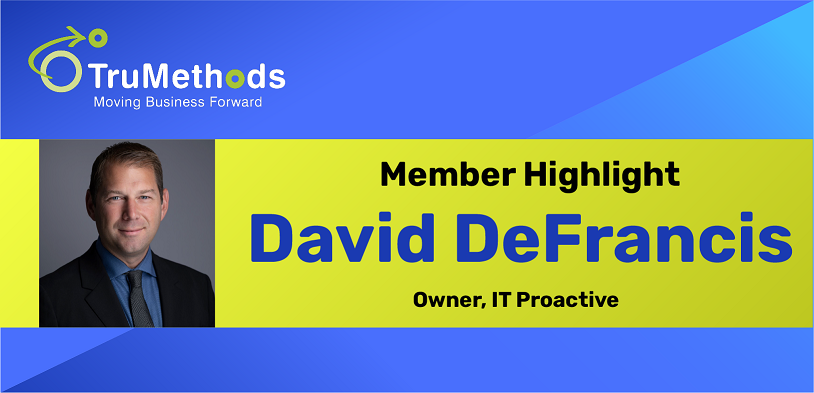
“In 2018, I attended my first MSP-focused event and heard Gary speak about the TruMethods framework and was instantly intrigued,” said David DeFrancis, owner and founder of IT Proactive, a Costa Mesa, CA-based MSP. “Shortly after we became a member and started with myITprocess and quickly realized that there was a lot more to the framework than just some softwareOver the next year, we slowly started implementing the five delivery areas but didn’t have peers to bounce ideas off and compare notes. When Gary announced TruPeerat Schnizzfest 2020 in Orlando, I was immediately sold and couldn’t wait until it started.”

During our one-on-one conversation, he revealed whathis biggest takeaway from TruPeer has been, what he’s learned from other TruPeer members, and how new TruPeer members should approach the MSP accountability group.

A lightly edited transcript of our conversation follows.

What has been your biggest takeaway from TruPeer?

The biggest takeaway from the groups is the accountability on a regular basis, the ability to compare notes, struggles, services offered with owners of similar size MSPs. The training and guidance that we get from Gary, Peter Briden and the entire TruMethods team has been invaluable.

What have you learned from other TruPeer members?

I’ve learned that I’m not alone in my challenges and struggles. The group has given me confidence in process. I’ve been able to bounce package and pricing ideas, employee engagement, service delivery, tools and most importantly — Smart Numbers. 

How should new TruPeer members approach the program? 

New TruMethods members should come in with an open mind with the understanding that some of us have been doing this for years and to not be intimidated by the use of TruMethodsacronyms. TruPeermembers love to help, it’s the way we learn and grow. One of the most important things will be ability to carve out time in their schedule.

If you would like to learn more about our TruPeer accountability group, click here.

New call-to-action

New to TruMethods? Here’s What You Should Know

If you’ve recently joined the TruMethods community, welcome! While we’re excited to have you on board, there are few things you should know about being a TruMethods member before beginning your journey to becoming a top-performing MSP.

By joining TruMethods, you’ve decided it’s time for you to drive better business results and are willing to do the work to get thereBelieve it or not, the latter is what’s most important. As I’ve always said, if you want to be somewhere dramatically different, then you must do something dramatically different to get there.

We at TruMethodsare going to help you with that. When joining TruMethods, you can expect to be involved with a team of people who are truly awesome and really care about your success. Also, your peers are like-minded in terms of how they approach and think about business, their expectations, and their willingness to share and help each other out.

Expect to roll up your sleeves on day one. You’ll be assigned to a TruMethods Member Success Manager (MSA)who‘llassist you with our onboarding process. It’s a process that we’ve built and honed over the past decade, and it will allow you to see your current situation a little differently, so that the right priorities and changesyou need to make will become more obvious.

But a word of advice: Above all else, focus on understanding the TruMethods framework.

All too often I see new members picking and choosing the lessons they feel like taking and implementing, rather than focusing on fully understanding our tried-and-true framework, which is unfortunate, for implementing the TruMethods framework successfully is key to closing more sales, improving client retention, and growing overall monthly recurring revenue (MRR)If you take the time to learn and understand our frameworkyou’re going to make amazing progress as a TruMethods member.

When you begin seeing the determination and hope that comes from knowing that you not only have a plan, but one you can executethat igoing to get you different resultsThat is going to impact you,your team members and your customers.

And that’s an awesome feeling!

Become A Top Performing MSP: Learn How To Provide Profitable IT Solutions And Become World Class

How Unleashing Your MSP Superpower Gets You Unstuck

Every business needs a competitive advantage that sets them apart. But, with so many MSPs in the industry today and all of them offering the same basic set of services – how do you differentiate yourself?

The answer is simple: Use your Super Power.

Recently, TruMethods CTO Bob Penland and I held a webinar for our members on how an MSPcan add new monthly recurring revenue (MRR) by unleashingitsSuper Power, the unique skill or service an MSP offers to its clients.

We started off talking about the concept of Impact Zones, low pointson your entrepreneurial journey where you feel like you can’t advance from where you are. Your profit margins aren’t where they should be. Your noise levels are high. Maybe you have some cash restrains. You can’t add new MRR at the right price

Put in another way — you’re stuck.

Fortunately, you can get unstuckby becoming a World Class MSP; however, as you know, or should know, that takes time. What if I told you that there was one thing that would impact your belief, results, sales, leverage and culture a lot faster?

First, start by thinking aboutthe reasons why people do business with you.(Hint: It has nothing to do with youryears of experience,your best-in-class technology or your client-focused organization.)How do you deliver better results than the other alternatives? And more importantly, how do you do it uniquely and be able to explain it to customers and prospect? 

In other words, ask yourself: “What’smySuper Power?

Your Super Powerhas to be unique to you. It’s the reason why your clients get better results with you instead of a competitor.Each one of your clients must experience your Super PowerIt’s got to impact your customers’ businesses, not just their technology.It has to be part of your culture. It has to be based in roles and processes. Every company needs Super Power.

Do you have defined roles and process that you highlight to every customer and every prospect so that your results become more tangible? 

Let’s go people! Identify what your Super Power is, and use it to justify charging more for your services.

Becoming A Top-Performing MSP

Closing the Gaps in Your MSP

Every TruMethods member knows by now the importance of their Technology Success Process. Completing Technology Alignment visits (virtually or in person) and having vCIO meetings is the core of what we teach to make sure our operations run smoothly and we provide the most value possible. But there are of course other members of the operations team less directly involved with Technology Success, but no less important to the triumph of the process. How do we communicate to these other sectors and departments to make sure things continue to run smoothly?

First, TruMethods always recommends having meetings interdepartmentally to make sure that communication stays open, but also to make sure that no one is stepping on any toes. Each role should have defined edges and margins, which helps to manage team expectations and decrease tensions among team members. It’s a whole lot easier to ‘stay in your lane’ when you know exactly where that lane begins and ends.

Another thing MSPs can do is have presentations to their team members about the operations and relevant details of their clients.  If the team is aware of the client’s priorities and their operating structure, when tickets and other problems arise it will be much easier for you as the MSP to prioritize those issues appropriately.  Showing our priorities match our client’s priorities demonstrates higher value.  This can also force the vCIO to ask the right questions in their technology steering meetings to be able to communicate back to the rest of the team.  Think of it as real-time business canvassing.

The importance of communication in a company, fittingly, cannot be overstated.  While no one needs to know all of the minute details of someone else’s role, a comprehensive understanding of your clients, your team members, and proper communication channels between all parties is paramount to success as an MSP.  Continuing to have team conversations, combined with strict departmental edges, will facilitate each department completing its role to the fullest, which in turn raises your value to your customers.

Request My Demo

The Core Elements of an MSP Standard

At TruMethods, we talk about standards a lot. When implemented properly, they’re how MSPs lower ticket count, reduce reactive work and have more time to focus on strategic relationships with clients. While every MSP has its own set of standards, each standard should follow the same elements.

For the moment, think about when you go to the doctor. The doctor probably begins their examination by asking some high-level questions. How are you feeling today? Does anything hurt? These questions get the conversation going, but if you answer them a certain way, they will probably dig deeper.

Your standards must be set up in a similar way.

Each standard should fit into a broader category, essentially the technology area (e.g., core infrastructure, security). By doing this, you make it easier for your technicians to identify the location of a standard.

Once a category is identified, your technician can then plunge into the details by answering a series of questions when evaluating a client’s IT environment. These questions typically vary depending on the MSP, but they should mainly revolve around aligning your client’s environment with your standards.

For example, when one of your technicians is evaluating a client’s firewall, there may be a question or two about the type of firewall your client is using. A more common question about a client’s firewall would be the following: Is it a consumer- or an enterprise-grade firewall?

All the questions your technician should ask when visiting a client should be prioritized. Of course, since every MSPs has its own standards, the prioritization of those questions often varies. What’s important to you may not be as important to one of your competitors.

Even though these questions typically vary from MSP to MSP, they should always have purpose and meaning. Always consider this when evaluating your questions: Why are these the questions you’re asking? What are you looking to achieve by asking them when assessing a client’s IT environment? But your technicians aren’t asking these questions every day.

What is even more important than the questions your technicians ask when evaluating a client’s IT environment is how often your technicians seek the answers to those questions. Setting a cadence ensures you’re differentiating yourself from your competitors.

Finally, your standards must provide your technicians with “how-to” links. For example, a technician isn’t sure how to configure a firewall, there should be a way for him to find out how. There must be a process in place to ensure your technicians can deliver for your clients.

While MSPs have different standards, the core elements of those standards should be consistent across the board.

Request My Demo

Your Clients are a Long-Term Commitment

Attention and appreciation are critical to any successful relationship, including the relationships that MSPs have with their clients. And creating a successful relationship means prioritizing activities that will increase customer loyalty.

Below are six tips to help keep your MSP practice on the right track when it comes to customer satisfaction and commitment:

  1. Be a good listener. Odds are, you may have initially begun working with a client to help them address a specific business need. But, there are likely other services and products in your portfolio that they might need, whether they know it or not. Schedule regular calls and visits (even if only virtually) with your customers, find out how their business is changing, and actively listen to the challenges they’re facing. These conversations lead to more upsell opportunities and show your customers that you want to be an active partner.
  2. Deliver on your promises. Establish customer expectations at the beginning of every sales agreement or project, and make sure you deliver on your promises in a timely and reliable fashion. An MSP should avoid over-promising on any given project, as it can result in  under-delivering. This requires conducting thorough due diligence on the front end to make sure you fully understand the scope of the client’s needs and which of your services and solutions will best match their needs.
  3. Demonstrate the value of your services. Once an MSP begins providing services, clients can sometimes start to take them for granted. This can especially be true if the MSP is doing a good job. In that case, the odds are that their success is relatively invisible — clients are going to notice (and remember) system failures more acutely than a network that’s humming along with no disruptions or security breaches. Provide reports regularly, outlining the value your company has provided through backups, troubleshooting, diagnostics, patch management and other services (e.g., helpdesk), and periodically review those results with the client. Further, conducting periodic security assessments can identify security gaps, and enable the MSP to address this gaps which further helps to demonstrate value over time.
  4. Ask customers how you’re doing. Measure client satisfaction through periodic surveys and reviews, not just anecdotal evidence. Automatically send surveys after service tickets are closed, and conduct quarterly surveys/reviews to gauge satisfaction. It’s much easier to identify and fix any issues in their immediate aftermath rather than letting problems fester undetected.
  5. Treat every client like a new client. It’s easy to be excited when a new customer joins the fold, but over time that initial glow can fade and your team may devote more of their attention to chasing new prospects rather than nurturing their existing relationships. Make sure you stay engaged with existing clients through calls, surveys, visits, and regular communications (like client newsletters) so they know they aren’t being taken for granted.
  6. Reward their loyalty. Retailers have found great success using customer loyalty programs, and MSPs can benefit from a similar strategy. Find ways to add more value for long-term customers by offering special package offers, training, add-on services, discounts, and other rewards. 

Healthy client relationships require attention and nurturing. If you ignore your existing clients until there’s a problem, they’re less likely to remain loyal to your company. Take an interest in their operations, provide reliable service, and communicate regularly. Your customers will reward you with their continued business, additional sales, and valuable referrals.

Scott Bennett is Senior Director of MSP Sales for Barracuda MSP, a provider of security and data protection solutions for managed services providers, and he plays a key role in the development and growth of partner relationships.

New call-to-action

MSP Business Owner Psychosis

Even before the pandemic, as a business owner, it was easy to get caught up in always being focused on the future — the next month, the next plan, the next hill to climb. Now, with everything going on in the world today, living in the moment and appreciating everything life has to offer can be even more of a struggle for MSP owners. Because of this, it can be hard to enjoy the present.

This could also bring up some regret as well. Think about the entirety of your career as a business owner. Could you have enjoyed time with family and friends more if you had been able to be more present? If these feelings sound familiar, you may be experiencing this too.

I call this “business owner psychosis,” and it’s all too common.

How you can live more in the moment

I think many of us can relate to these feelings of regret — I know I can.

When I became a business owner for the first time, I always had a general feeling of impending doom, but over time, I learned to shift my mindset by continuing to educate myself on two things: strategic business planning and life planning.

To be successful in business, your life needs to be in order. Your business goals shouldn’t be far off from your life goals. In fact, they should complement each other. The only way to determine what you want out of life is by evaluating where you are now and where you’d like to end up.

In your personal life, I suggest working with a financial planner to help you lay out a long-term plan for yourself and your family.

Creating plans helps you figure out what you want from your business, gives you a sense of direction, and offers you a sense of ease to allow you to better enjoy the present.

How TruMethods can help you

We at TruMethods do our best to prepare our members for a successful year ahead. Our team develops, publishes and promotes blog posts, webinars, whitepapers and podcast episodes on how MSPs can better position themselves for greatness in the new year.

I encourage all TruMethods members to review the awesome content we have on our members portal. For non-members, we also have some great free content on our Resources page. We want to help you prepare for this year ahead and give you some guidance during this crazy time we are all going through. There’s a lot to review, but if generating more MRR, reducing reactive noise and increasing your profit margins sound like goals you want to achieve, you must dedicate some time to educating yourself on strategic business planning — start now.

With the proper planning in place, you can focus more on living in the moment.

New call-to-action