Hope is Not A Strategy

To achieve your goals for 2021, you need to truly understand your current situation. Are you being truly proactive and creating leverage in your business model? What are your drivers of success? What will you be doing differently this year to increase your MRR? Do you have a well thought out plan on how to change things?

If you think that you can achieve new results by doing the same things you’ve done for years in your business, you’re kidding yourself! In the end, you are just hoping things get better — and hope is not a strategy. This mentality can be seen in all types of business leaders in mature and immature businesses.

Hitting sales, revenue and profitability numbers are the result of having command, choosing the right priorities, and executing on those priorities. In other words, having a plan and working that plan.

The reality is if you want dramatically different results, you must do something or more likely many things dramatically different. I always say that everyone makes exactly what they’re worth — like it or not. Every business is exactly where the leaders have taken it.

Hope is not a strategy. But strategy is a strategy.

Here’s the other side of the coin. Each of us in our careers and businesses have opportunities. We all have unlocked potential. We can begin to unlock that potential starting today.

Hopefully, you’ve completed a plan, either a personal plan for yourself, or if you’re a business leader, your 2021 business plan. If not, come on, man, that’s not a strategy!

If you have a plan, be sure you share it with others inside and outside of the organization. If you’re a member of our TruMethods Peer Groups, your peers have already taken a look at your plan. If you’re not in a peer group, find someone outside your organization with knowledge of your business to review and check the plan.

I love when teams set aggressive goals, ones that they really have to stretch to meet. Goals that even if you fall short, move the business forward in significant ways. However, I love these goals only if they’re driven by a plan that is founded in facts.

Only then can we truly hope for dramatic results.

Become A Top Performing MSP: Learn How To Provide Profitable IT Solutions And Become World Class

Business Planning: Are You and Your Business Partner Aligned?

As you well know, I’m a big proponent of business planning. At the end of every year, I’m out in the industryenthusiasticallyencouraging MSPs to develop their business plans sooner than later. While the business planning process is fairly straightforward if you’re the sole owner of your business (especially if you’re a Trumethods member who’s been listening to what I’ve had to say about the topic over the years),the business planningprocess gets a little bit more complex when you‘reonly one of two owners.

Now, I’m not suggesting that you own a business alone. In fact, there are many benefits to having a business partner, including potential tax advantages, additional business opportunities and complementary skillsAlso, you can divide roles and responsibilities. 

But there are going to be times when you disagree with your business partner on number of issues. What’s important is you work out your differences respectfully, professionally andin a timely manner.If you and your business partner can’t reconcile your differencesyour business (and your customers) will certainly suffer in the long run.

Big issues can arise later when you and your business partner fail to align on how to operate your business. I’ve seen plenty of businesses succumb to this unfortunate defect. There absolutely must be alignment between you and your business partner around the expectations for your business.

When developing your business planuse the time together with your business partner to deal withany disagreementsbetween the both of you immediately. Also, get specific with where there’s conflict. Pinpoint the issues instead of trying to avoid them. It’s absolutely critical for you and your business partner to be aligned on your company’s goals, mission and visions

Use the business planning process to ensure that you and your business partner are aligned on the way forward for your businessEach of you should begin by outlining personal and professional goals. Figure out why the both of you are in business. Then, come together on your company’s goals and vision. Remember: You can’t have conflicting values.

Even if you have disagreements with your business partner, you can develop a business plan. You just need to work through them first. Use the business planning process to overcome any obstacles and move your business forward.

New call-to-action

TruMethods Member Q&A: ‘The Number One Thing I Hoped to Change was Me’

Joining a peer group takes a lot of courage. While being in a peer group can benefit you in many ways, the process usually isn’t for the faint of heart. Peer groups are designed to give you tough love when it’s warranted. Being open minded is key to your success in any peer group.

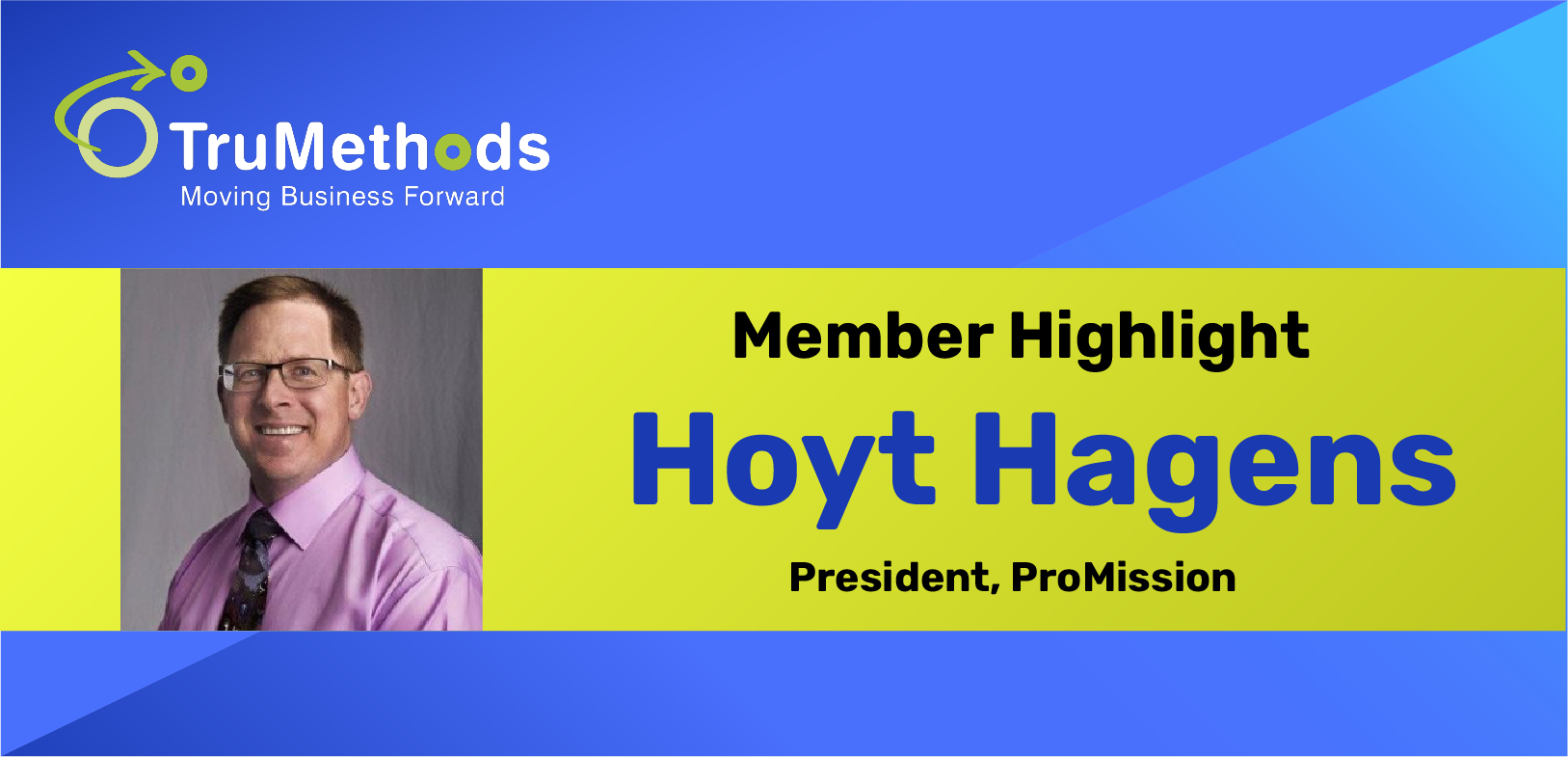
The number one thing I hoped to change was me,” said Hoyt Hagens, president of ProMission, a Meridian, Idaho-based MSP with customers in several industries, 

including healthcare, manufacturing, legal and education. “For ProMission to be successful, I would have to make the change from technologist to businessman, from a guy working in the business to a guy working on the business.” 

During our one-on-one conversation, Hoyt revealed how he was willing to be vulnerable and make changes to improve business results, how TruPeer (TruMethods newest peer offering) has made him more accountable, and what MSPs considering TruPeer should know about the industry-leading peer group. 

A lightly edited transcript of our conversation follows. 

Why did you decide to join TruPeer? 

There were a number of things that contributed to my decision to join TruPeer. I attended Schnizzfest 2020 in Orlando and spent time with other owners that had achieved amazing success. The number one recommendation I walked away with was “join a peer group.” I came to realize that in order to change, in order to achieve the kind of results I saw other owners achieving, in order for me to turn ProMission into a successful business, I had to gain access to people smarter than me who were willing to hold me accountable.

As a technologist, I made a good living. I created a great job for myself that I called a business. I came to recognize that if I was going to have any hope of building something of value, something that did not require my presence to function, then I needed some help.

Where was your business before joining TruPeer and where is it now? 

It is important to note that I am in the midst of the journey. I have by no means arrived. When I came to TruPeer, I honestly did not know where my business was. I rarely looked at my financials; I made enough money that I could afford to keep my head in the trenches. But after splitting off a portion of the business in 2017, it became apparent that the managed services side of the business, what was left after the split, was not pulling its weight and I had no idea how to fix it. I joined TruMethods in an attempt to gain knowledge, thinking knowledge was the answer, but soon found that knowledge without discipline and accountability only resulted in good ideas.

At this point in my six-month journey with TruPeer, we are still incredibly chaotic, I struggle with priorities, and we are not anywhere close to achieving the profit I hope to achieve. But, for the first time in my business career, my financials are in line with a (TruMethods) standard, I have a budget, and a one-year business plan. There is a lot of work to do yet. The difference now is that I have a driving force behind me. The success and encouragement of my peers provide proof that all I have to do is keep chipping away at it.

How did TruPeer make you more accountable? 

TruPeer helped make me more accountable by my choosing to be held accountable. There is something about submitting your will to a group of professionals in your field that makes you want to achieve. I’m human. I procrastinate. I let other urgent items align my priorities. When you ask someone else to hold you accountable, they help align your priorities, sometimes through gentle encouragement, sometimes through well-deserved peer pressure (public shame).

What should MSPs know about TruPeer? 

I am gaining all that I had ever hoped for and more from a peer group. I get to ask questions of others in my field that I was never able to ask anywhere else: What tools do you use? What works? What doesn’t work? How much do you charge? How do you charge? How do I hire? How do you fire? The list is endless.

This peer group is so much more than aligning your methodology with TruMethods. It is also about finding out that you’re not nuts. This is a hard business with some good news attached. It is possible to succeed and be as good at business as you are at technology. And to top it all off, you end up building friendships with folks that you would have never had the opportunity to otherwise.
MSP Cyber Resilience

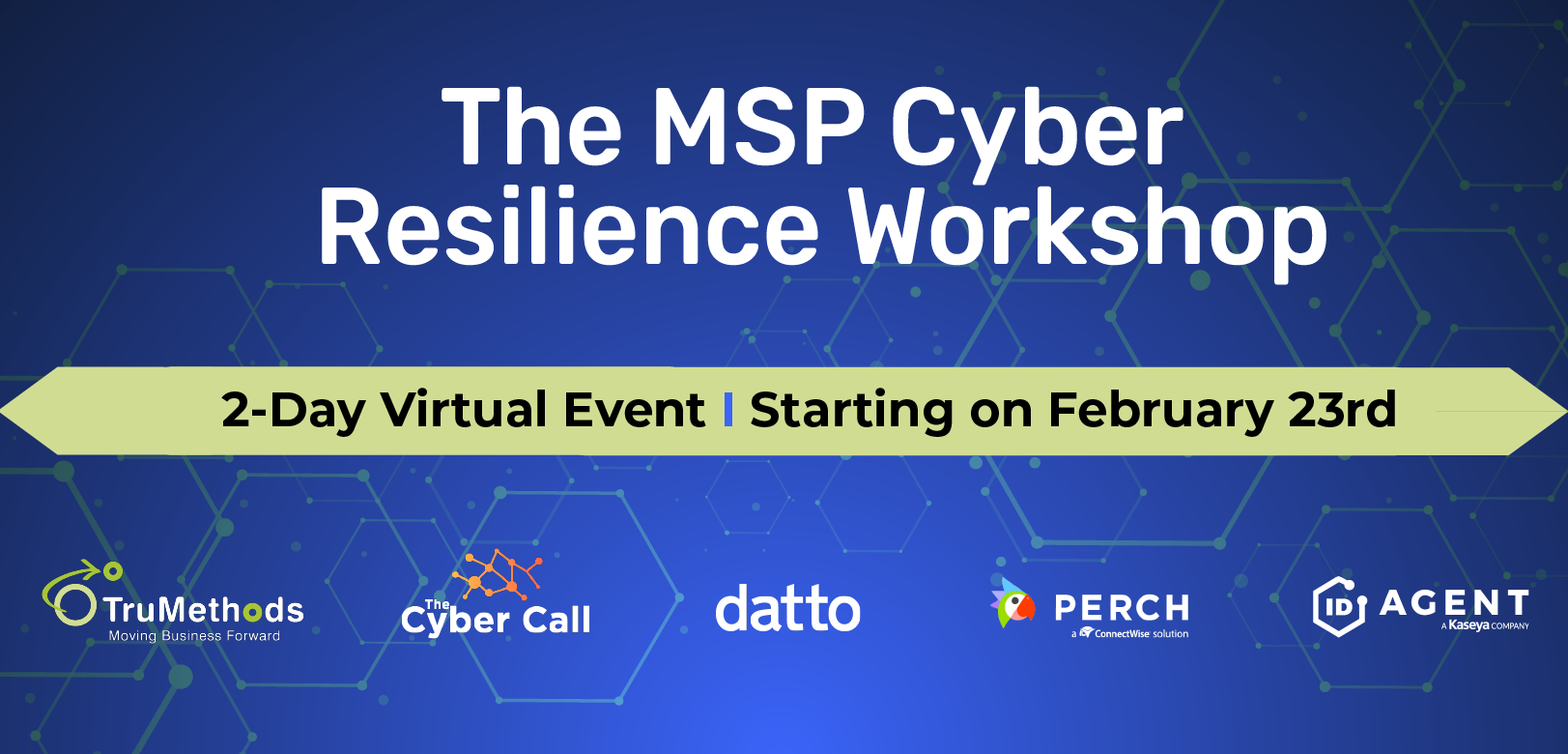
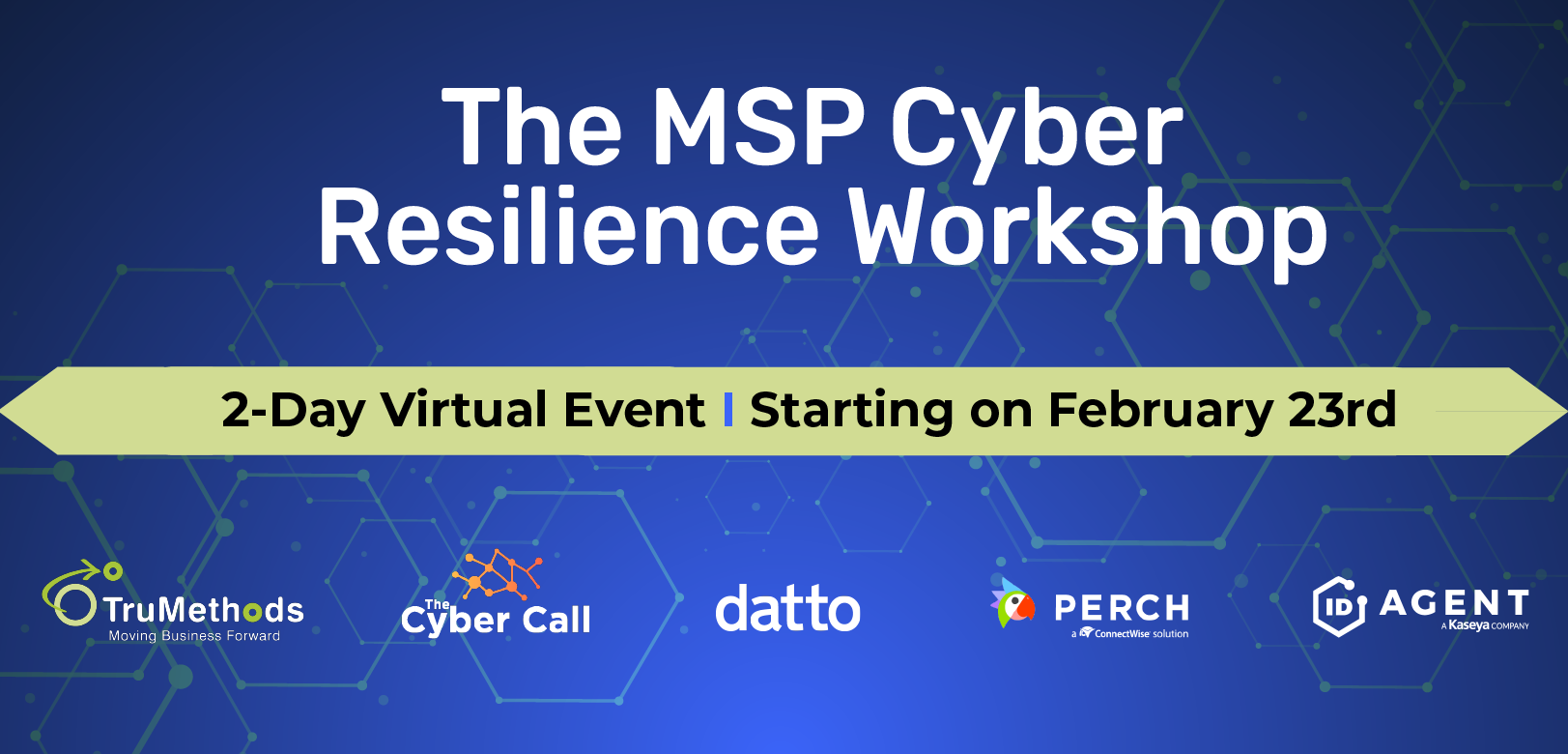
Two-Day Special Event: The MSP Cyber Resilience Workshop

Along with The Cyber Call, weekly 30-minute collaborative production, we’re hosting a two-day virtual event for MSPs looking to move their cybersecurity postures forward in a world with an ever-evolving threat landscape.

Experts from around the industry will come together on February 23rd and 24th to combine their security knowledge to give you an event you can’t afford to miss.

Over the course of these two days, our hosts, made up of cybersecurity and IT professionals, will be conducting a variety of webinars, interactive tabletops, and in-depth planning sessions to make sure that 2021 is the safest year yet for MSPs. 

The MSP Cyber Resilience Workshopis centered on cyber resilience. 

What is cyber resilience? Cyber resilience is your business’s ability to continually deliver exceptional IT services despite adverse cybersecurity events. The MSP Cyber Resilience Workshop will be every MSP’s go-to-guide to ensure they’re not only cyber resilient but ready to capitalize on these opportunities.

Some of the sessions include MSP Cyber Capability and The Cyber Resilience Gap, Building an Incident Response Plan for Success, Vulnerability Scanning and Exploitation, and Go-to-market and How to Sell an “Assume Breach” Offering. View the full agenda here.

The event will have education for the business leaders and the technical leaders in your organization, so be sure to extend the invite to your whole team! If you haven’t already registered, you can save your seat here

Make it a great day and I’ll see you at the event!

cybersecurity ebook

Leveraging myITprocess to Enhance Communication Between Service Delivery Roles

We all know that having a company be successful is a team effort.  Everyone needs to work together to make sure that everything runs smoothly, and things work the best when we all know where our edges are on our roles and we are empowered to become experts in our fields.  While TruMethods has a lot of content that talks about service delivery roles and we facilitate discussions about how the roles work together, how can myITprocess help with that communication?

Communication between the roles in our myITprocess software is actually critical to getting maximum efficiency in the system.  Without it, oftentimes TAM (Technology Alignment Manager) reviews are left uncompleted, or vCIO (Virtual Chief Information Officer) presentations do not have the backup of the review process to provide context for recommendations.  Making sure things are completed in the right order requires process and organizational discipline that many often don’t even realize exists.

A lot of this process starts with understanding what the TAM and vCIO really need to do, and what the heart of their roles really are.  In a perfect world, everything starts with the TAM; they gather enough information that the vCIO will have a clear technical picture of what is going on with a particular question, but not so much that it reads like a technical manual.  The TAM is the first filter towards getting the information in a business context to the customer.  Additionally, the vCIO usually is not super technical, so the TAM needs to translate their findings a bit so that the vCIO can understand it fully and present it well to decision makers.  It also helps if this information is conveyed across clients in generally the same way, and the Technical Analysis answers the things that are most important for your company way, so everyone needs to agree on what that means.  The TAM is also super important because they see all aspects of the client’s technical environment, not just the project team’s view or the helpdesk view or the centralized services view, and they can use that unique perspective to their advantage.  That’s much more than just answering yes/no questions!

So then what is the next step? The vCIO needs to build their presentation for a client on the information provided by the TAM.  Do they have enough technical knowledge and perspective to do that?  Can they verbalize what it means for a client to not have one of their best practices and provide a solution to it?  The vCIO needs to have all of the specifics of the review in their head, but should broaden things out for the recommendations on the roadmap in order to show value in the client; getting in the weeds with clients in the end really helps no one.  With that being said, the approach as a vCIO is going to be a bit different if they are talking to a CTO as opposed to a CEO.

From an organizational perspective, it’s also important to have standardized answers to the things that mostly only TAMs and vCIOs see in myITprocess.  The ‘Why are we asking’ and ‘How to’ fields should be filled out well, and clearly.  The former especially isn’t just for your customers, the TAM should know how what they are doing goes into the process as a whole, and they should be able to communicate that to your client.  The How-to area also has the capacity to define repeatable processes in the case of something being out of alignment.

myITprocess is helping with other types of communication as well.  As many know, myITprocess integrates with Autotask and Connectwise, so TAMs and vCIOs can create tickets directly in their systems from the review process.  And while it isn’t exactly an integration, it is also possible to copy the link of any given recommendation to the clipboard and paste it into a ticket, email, or anywhere else so a user can get directly to the recommendation referenced quickly.  Additionally, in the last 6 months we have launched our integration with IT Glue; members can now create recommendations directly from configurations on client roadmaps, and they can also attach configurations to specific questions in client templates.  We are continuing to expand this integration, but it has already shown to be invaluable to the members that use it.  Even our 2fa now works with your Gmail address to make the login process easier.  Finally, our team is continuing to work on the reporting API for the system so information can be pulled into things like Gainsight.

Communication in any business is critical, but sometimes in more technical businesses like ours it is easy to push those ‘softer’ skills aside.  By keeping discipline on this part of the process we ensure that people are clear on their roles and have the tools from myITProcess that they need to succeed.  As with any skill set, this requires practice and scrutiny; hopefully these skills can also be a great reflection of Your Company Way.

Request My Demo

Webinars to Help Your MSP Fight Back Against COVID-19

The pandemic has caused so much uncertainty for MSPs, but has also given them a great opportunity to fight back against the pandemic and make 2021 their best year yet. You may be thinking, “That sounds great…but where do I start?” Here are some free TruMethods webinars on topics like security, business planning, and compliance to put your business on the right track to becoming world class.

TruMethods Webinars:

The MSP Cyber Resilience Workshop

This workshop took place on February 23rd-24th and included experts from around the industry providing you with frameworks and strategies to become cyber resilient. Cyber resilience is your business’s ability to continually deliver exceptional IT services despite adverse cybersecurity events. These two days were filled with webinars, interactive tabletops, and in-depth planning sessions to ensure that 2021 is your MSP’s safest year yet.

Security Tabletop: Developing Your Incident Response Plan

Do you have a plan for handling a possible security breach? Have you run through that plan? During this interactive session, our group of security experts explained the crucial steps to be taken during your next security breach. You can watch the session recording now and walk away with strategies you can implement immediately to secure your MSP.

Key Steps to Creating Your Incident Response Plan

In this webinar, our experts dove a little deeper into your Incident Response Plan. What should be included? How do you work with external entities (legal, insurance, PR, etc.)? How do you get your team empowered to handle the next security breach? A tabletop simulation is also included to reveal how your current plan would hold up if a breach was to occur.

The MSP Success Summit

The MSP Success Summit was a five-day virtual event that ended with a great live panel discussion. Each day, we gave away a free resource to help you climb up the mountain of MSP success. You can still grab all of these resources today and watch the live panel discussion, where our industry experts further explained these resources and gave their perspectives on how COVID-19 has impacted their business.

Request My Demo

How is Your MSP Starting 2021?

We are already over a month into 2021!  A new year seems to always bring fresh perspectives, and it feels like the easiest time to start new processes and opportunities. Have you taken the time to understand what exactly this looks like for you and your team?

For many TruMethods members, this time of year is a bit slower for them, so they take the opportunity to really dig through their documentation, standards, and internal alignments in our myITprocess software that sometimes get pushed by the wayside throughout the year.

For many other members, this is actually the busiest time of year for them. Their clients have just accepted a bunch of project work to close out the end of the previous year, and now it’s time to put the pedal to the metal.

Regardless of the time of year, there should always be a focus on Technology Success.  Now especially is a great time to plan out your Technology Alignment (TAM) and vCIO visits for the year, as scheduling discipline plays a large part in keeping the process consistent.

But what else is a best practice for YOU to focus on now?

  • Is it a big Standards Library revamp in myITprocess?
  • Is it industry research for strategic recommendations?
  • Is it looking back at your finished 2021 business plan to ensure that your processes and strategies are corresponding with the plan?
  • Do you want to put more focus on cyber security tactics to ensure the safety of your business and customers this year?
  • Are you going to join an industry peer group to learn how your peers are navigating the current situation?

The pandemic derailed a lot of business plans and strategies in 2020, so the new year provides an awesome opportunity to bring forth new ideas and take advantage of the crazy situation we are currently in!

Request My Demo

Never Be Afraid to Fail

I always tell my children and my employees to never be afraid to fail. Failures and mistakes are the feedback we need on our way to success. 

Trying never to make a mistake is a sure route to mediocrity. 

I’ve had some success in my life because I’ve also had a lot of failure. We’re only judged by our successes. That’s assuming you succeed. While perspective is very valuableinclude a footnoteYou can’t keep making the same mistakes. 

You have to make new mistakes. If you know that you won’t make the same mistake twice, it makes failing much easier,and you wont to avoid failure. This allows you to be more confident in your decisions and aggressive in your goals. 

There are two mistakes I see MSPs making over and over again

You’re charging too little

The first is pricing. Too many of you are still charging too little and there’s no reason for it. 

Whatever you think the reason is, trust me when I say this:It’s just you. 

It’s not the customers, the prospects, the marketplace, or the competition

I get to see pricing for nearly 150 MSPs. I’ve alsooperated several MSPs of my own. If you don’t correct this mistake, you greatly limit your success, no matter how smart you are and how hard you work. It doesn’t matter how great your team or technology is. You have tomake new mistakes. 

You’re not running a sales-focused organization

The second mistake is lack of sales focus. I see many annual plans with sales goals, but no quarterly actions focused on changing sales results. 

If adding new MRR doesn’t become a top priority, you can’t expect to change results. What’s my definition of priority? It’s simple: A priority means that you spend more time and attention on it than other things that might also be important. 

This year holds a lot of promise for MSPs, even more for TruMethods members. If you can begin to correct these two mistakes, amazing things will happen, and you’ll be able to make new mistakes.

MSP Sales Mistakes

What If I Gave You A Clean Sheet of Paper?

If you could start your business from scratch today, what would you do differently? 

You wouldn’t have to bring old ideas, perspectives, customers, packaging and pricing revenue, team members and processes with you.

If I gave you a clean sheet of paper, would your service offering look the same? If not, what would it look like? What tools would be in your stack? What skillsets would you hire for? Would you be thinking about the needs of your customers? 

Would you have a PSA? Would you start with RMM? Would you think about security differently? 

Here’s a great question:Would your definition of a good customer change? 

Think about the needs of small and mediumsized businesses (what they are today and where they’re headed) Their dependency on technology is increasing. For example, their line of business apps are moving to the cloud. Their teams are more virtual. 

A lot of what we have built our businesses to deliver is going away or changing. Also, 2020 taught us that business needs are changing quickly. It’s time to look forward. 

What are the pillars of your value proposition that are diminishing? Are there new areas or skillsets that could add value? What did we learn about how to run our businesses during the pandemic? Are you thinking differently about leveragandgeography? Where customers and employees areWhat about sales and marketing? Do the changes we have mentioned impact how you need to reach prospects and what message you need to deliver?

Consider this: How will collaboration, security, mobility, BI and AI create new opportunities? Who on your team would you hire back enthusiastically? How would you design your role in the business differently?

Now, I know that I’ve asked a lot of questionsWhile you don’t have to answer them alla few should have crossed your mind.

I think this is a great thought experiment for you and your team to go through, and it’s a great time to do it.

So, as 2021 continues onthink about this: What would you do if I handed you a clean sheet of paper?

New call-to-action

Tax Season Already? What MSPs Need to Know About Taxes in 2021

On top of everything else MSPs need to worry about in2021, tax season is right around the corner.There’s been a lot of confusion over taxes this year, especially if you received a PPP loan last year. 

spoke briefly with Peter Briden,TruMethods Peer Group Leader, about what MSPs should prepare when meeting with an accountant, the tax implications of a PPP loan and loan forgiveness for PPP loans. 

A lightly edited transcript of our conversation follows.

Before sitting down with an accountant, what should an MSP gather? 

Start with gathering your thoughts.Think about what it is that you want to accomplish during the sit down.Common meeting agenda items would be tax planning, audit/accuracy/general review, preparing for an event (financing or acquisition), cash flow planning, etc. In most circumstances, you want to share your current situation and history.An accountant will want to see the P&L statement, balance sheet, and cashflow statements for all relevant periods. Together, these documents will tell a story.It is important for business owners to fully understand these documents and what they represent.Their accuracy should be absolute. 

What are the tax implications of a PPP loan?

In the U.S., the Payroll Protection Program was a part of the CARES Act of 2020.This program was intended to give small business access to tax free, forgivable loans to help offset revenue declines and maintain payroll and fixed expenses.These loans are now called “first draw PPP loans.” The majority ofthe IT managed services industry was eligible for this program.The original program has changed significantly since its introduction. While the original intent of the PPP loans was to be tax free, there is an IRS rule that prohibits the expenses paid for with forgiven loans to be deductible, thus decreasing the company’s expenses and increasing profits (or reducing net losses).As part of the COVID Stimulus Package signed in late December 2020, the IRS was overruled, and expenses paid for with PPP loan funds will be able to be deducted as qualified business expenses in 2020.

What if an MSP didn’t experience a significant drop in revenue? 

Most MSPs qualified for and have had (or are in the process of having) their loans forgiven.In many (most) cases, the MSP ended up not experiencing the revenue loss feared and have a surplus of cash on their balance sheets.This creates a conundrum of what to do with this surplus.Some uses are the following: invest back into the business, keep as additional working capital, distribute to ownership, employee bonus programs, etc. What shouldn’t be done is squander this cash on frivolous non-core business/personal expenses or investments. We are still in the pandemic and great thought should be given to cash reserve strategies.

What should MSPs know about loan forgiveness?

Most MSPs who received PPP loans and have properly accounted for how the loans were used will qualify for forgiveness.Generally, loans under $2M have a straightforward forgiveness process that is done through the lending institution.Like the PPP application process, the forgiveness process has been slow to roll out. Anyone who has a PPP loan which has not yet be forgiven should be in regular communications with the lending institution to find out when the process will be available.To date, we have not seen any PPP loan forgiveness requests be rejected. 

Does a forgiven PPP loan become taxable income?

As discussed above, originally the loan was tax free, meaning it did not count as revenue.However, an IRS rule which prohibits the expenses paid with the forgiven loan to be deducted as qualified business expense.The result of this would be an increase in taxable income equal to the loan amount.This situation was addressed in the in the December 2020 stimulus package.  The forgiven loan in not taxable and the expense deductions are allowed. 

What about PPP 2.0?

A part of the December 2020 stimulus package is another round of PPP loans.These are intended to go to businesses significantly impacted by the pandemic. One of the criteria is a 25 percent decline in revenue which few MSPs experienced.

This article is intended to help MSPs gain perspective and is not intended as accounting advice. Be sure to consult with a CPA for expert advice on the accounting needs of your business.

Become A Top Performing MSP: Learn How To Provide Profitable IT Solutions And Become World Class